Archéfossile et télofossiles

Quand j’ai conçu « Télofossiles », en 2013, je n’avais pas lu Après la finitude. Je l’ai lu après parce que je cherchais un antonyme au concept que j’avais formulé, et le mot archéfossile m’a arrêté comme on s’arrête dans un musée devant une pièce qui ressemble à la sienne, accrochée dans une salle que l’on n’avait pas prévue de traverser. Arché, télos : le commencement et la fin. Le préfixe appelle la symétrie, le vis-à-vis, la lecture en miroir, et je crois que cette tentation doit être suivie jusqu’au moment où elle cède, car la dissymétrie qui apparaît alors me semble plus instructive que la ressemblance.
Rappelons le geste de Meillassoux en séparant trois moments que l’on confond souvent. Le corrélationisme est une thèse sur l’accès : nous n’avons jamais affaire qu’à la corrélation de la pensée et de l’être, jamais à l’un sans l’autre, de sorte que penser ce qui serait en soi, indépendamment de nous, revient à le penser pour nous. Kant en est l’artisan, et ses héritiers, phénoménologues ou herméneutes, ont fait de ce circuit la limite indépassable de la philosophie, sa finitude. L’ancestralité est le problème que cette thèse rencontre. Des énoncés scientifiques portent sur une réalité antérieure à l’apparition de la vie et de la pensée : l’accrétion de la Terre il y a plus de quatre milliards d’années, l’émission d’une lumière stellaire plus ancienne encore. Ils s’appuient sur des matières, isotopes dont la désintégration se mesure, rayonnements captés par nos instruments, que Meillassoux nomme arché-fossiles : des matières qui ne conservent aucun vivant et renseignent pourtant sur un phénomène ancestral. Le corrélationiste doit y entendre une rétrojection, une manière pour nous de raconter ce qui aurait eu lieu devant un témoin possible, alors que l’énoncé veut dire littéralement que la Terre existait et que personne n’était là. Le principe de factualité est la réponse, et sa formulation exige de la précision. Meillassoux ne dit pas simplement que la contingence est une propriété de l’être. Il part de la facticité, ce fait que la corrélation, comme tout ce qui est, n’a aucune raison d’être telle qu’elle est. Le corrélationiste tient cette facticité pour la limite de notre savoir. Meillassoux la tient pour absolue : elle ne peut elle-même être factuelle, car le corrélationiste ne saurait admettre qu’elle soit un fait parmi d’autres sans rouvrir la possibilité d’une nécessité en soi qu’il vient d’écarter. De cette absoluité de la facticité découle la nécessité de la contingence : que toute chose puisse ne pas être ou être autrement est la seule chose qui ne puisse pas ne pas être. L’hyperchaos, un temps capable de tout, y compris de défaire les lois, en est la conséquence, et l’ancestral se pense. Le après du titre est logique. Il désigne le temps de la philosophie qui vient après la philosophie de la finitude, laquelle fait du fini la dernière chose que l’on puisse savoir.
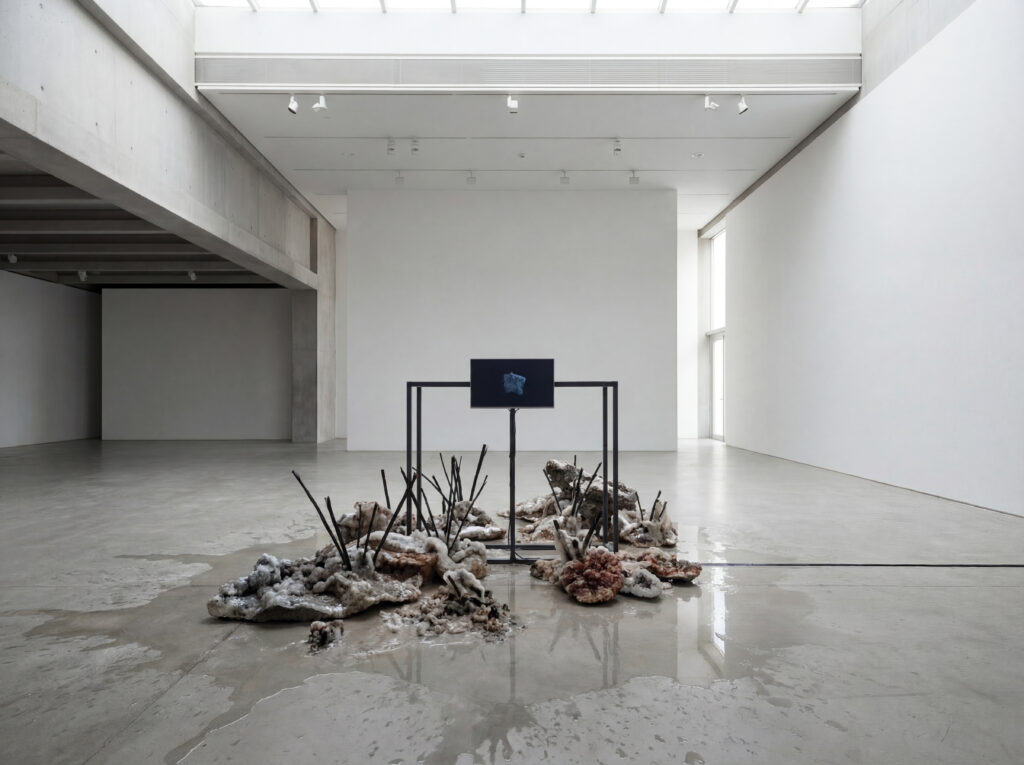
« Télofossiles » prend le temps à l’envers, et littéralement. L’installation projette le spectateur dans un futur où une espèce inconnue découvre les vestiges de notre civilisation et en tire des déductions, comme dans un musée archéologique dédié à l’humanité éteinte. Nos objets industriels et nos déchets y sont exposés en fossiles. L’environnement, hybride, technique et organique, continue de fonctionner sans personne. Les textes de l’œuvre le disent avec une simplicité que je ne regrette pas : nous disparaîtrons, et personne ne pensera (peut être) à cette disparition. Ils observent aussi que nous continuons de tout enregistrer, photos et messages compris, comme si nous refusions d’oublier quoi que ce soit parce que nous savons que nous allons disparaître. L’œuvre a circulé de Taipei à Wuhan en passant par Pékin. Elle part d’une proximité que le titre de Meillassoux rend frappante, puisque son après est logique et que le mien est chronologique.
Il me faut fixer le mot, car il a servi jusqu’ici à désigner des choses voisines. J’appelle télofossile une trace technique de l’activité humaine considérée comme couche qui survit à cette activité : la bouteille, le serveur, la route, tout ce que nos gestes déposent et que la matière conserve plus longtemps que nous. Le télofossile est un dépôt. Le concept qui le désigne ouvre toutefois un régime de lecture, celui qui prend l’objet que je tiens pour déjà déposé, et c’est par ce régime que le dépôt concerne le présent. Je réserve un autre mot au travail qui s’exerce ensuite sur la couche, la reprise, le déplacement, la transformation : c’est la surfinitude, qu’il faudra définir. Le télofossile est la couche, la surfinitude est ce qui la travaille, et je tiendrai cette distinction jusqu’au bout. L’installation expose la couche et place le visiteur dans la position de celui qui la lit.
On pourrait se contenter d’un chiasme : l’archéfossile regarde en arrière avec de la matière, le télofossile regarde en avant avec de la technique qui est de la matière transformée par un sujet. Cela se laisse dire et ne tient pas. Regardons d’où l’on parle. L’énoncé ancestral est proféré aujourd’hui par un vivant, depuis une situation de corrélation, à propos d’un temps où cette situation n’existait pas encore. Entre l’énonciateur et l’énoncé s’ouvre un abîme que Meillassoux franchit par une argumentation longue : absolutiser la facticité, établir le principe de factualité, consentir à l’hyperchaos. Le sujet doit penser un monde auquel il n’appartient pas parce qu’il n’était pas né. Pour le télofossile, la situation s’inverse sur le point décisif. Celui qui parle appartient au monde qu’il décrit, il en est même le producteur, et il en perdra l’accès dans un délai que nul ne connaît. L’avant est ce que nous n’avons pas eu. L’après est ce que nous aurons eu, au futur antérieur, et nous le tenons déjà dans chaque geste d’enregistrement.

Deux finitudes se superposent ici, et leur distinction commande la rigueur de ce qui suit. La première est celle que Derrida décrit, dans un dialogue de 2004 à Strasbourg avec Nancy et Lacoue-Labarthe, comme une expérience double : l’obligation de penser son propre anéantissement, et le désir testamentaire que quelque chose survive et soit transmis. La mort individuelle est certaine, d’une certitude sans contenu : nous savons que nous mourrons sans savoir ni quand ni comment, et pour qui vit cette certitude n’a rien de probable, elle tient à la structure d’un être qui naît. La seconde finitude, celle de l’espèce, ne jouit pas de ce statut. Qu’une espèce disparaisse ne relève d’aucune nécessité logique, et l’on ne peut le déduire de la mortalité de ses membres, car une espèce ne meurt pas comme un organisme : elle cesse d’avoir des membres. Ce que l’on sait est d’ordre historique et biologique. Les espèces vivantes naissent et disparaissent, nous en sommes une, les causes possibles abondent, pollution ou météorite, maladie ou tout ce que nous ignorons, comme le disent les textes de l’installation. L’anticipation est extrêmement sérieuse, elle ne partage pourtant pas le régime de la mort individuelle. Cet écart me paraît décisif, car le télofossile s’y installe. Étendre à l’espèce la finitude de l’individu est une projection, une analogie que nous accomplissons sans qu’aucune démonstration l’impose, et la technique est le lieu où cette analogie devient matière. Le désir testamentaire, porté à cette échelle, se retourne en archive sans héritier, en legs adressé à une absence. Dans un écrit (Les deux finitudes [2023] : https://chatonsky.net/two-finitudes/), j’y voyais un destin égyptien et funéraire de la pile de données, comme si nous accumulions nos mémoires pour en produire de ressemblantes, donc de différentes, notre extinction étant déjà au travail, culturellement et techniquement.
Que vaut alors l’idée selon laquelle nous ne pouvons pas le prévoir, mais nous le savons ? Elle désigne une assurance pratique, empruntée à la certitude de la mort individuelle et étendue par projection, dont le rang demeure celui d’une possibilité historique très forte. Elle ne ressemble en rien à la nécessité que Meillassoux accorde à la seule contingence. Chez lui, rien n’est nécessaire sauf la possibilité que tout soit autrement, et l’extinction humaine ne jouit d’aucune faveur dans cette ontologie. Le télofossile n’a pas besoin d’un absolu. Il se contente d’une certitude vide, empruntée et étendue, assez forte pour organiser un présent entier. Sa modalité est celle d’une anticipation qui travaille, là où la démonstration conclut. Sa rigueur est moindre, et c’est son atout : l’anticipation agit sur ce qu’elle anticipe, alors qu’aucun énoncé ancestral n’a jamais modifié la formation de la Terre.
J’ai écrit (Une variété de la mort [2012] : https://chatonsky.net/mort/) sur une matière morne, qui n’aspire à rien et n’en veut à personne, ni vivante ni morte puisque le mot mort suppose d’avoir vécu. L’archéfossile relève de cette matière. Précisons le sens de sa neutralité. L’isotope est pris dans des relations physiques denses, désintégration et rayonnement, et la neutralité vise une autre chose : aucune de ces relations ne le rapporte à un vivant ni à une conscience. La désintégration de l’uranium ne fait signe à personne, c’est le physicien qui lui donne valeur de datation, et cette valeur ne s’inscrit qu’en lui. Meillassoux a besoin de cette indifférence, elle garantit que l’ancestral n’a pas été produit pour nous. Catherine Malabou lui reproche d’ailleurs que la science empirique se réduise, dans son livre, à la physique, la biologie y demeurant la grande absente. Le télofossile fait entrer la vie dans le fossile. Une bouteille, un processeur, une route, un serveur gardent la forme d’une intention et la trace d’une division du travail, tout ce que l’objet technique conserve de l’humain quand l’humain est parti. La matière morne précède l’opposition du vif et du mort. Le télofossile vient après elle, dans un monde où cette opposition a eu cours, et il en garde la marque : l’objet a été manié, il a servi un vivant, il est mort d’usage sans avoir vécu. Derrida l’appellerait spectre, ni présent ni absent, persistant sans présence, agissant sans substance. L’archéfossile signe l’absence de l’être humain. Le télofossile maintient cette absence et lui adjoint la présence de ses traces techniques, soit une absence peuplée, hantée, saturée de formes.
Cette hantise pose à la technique une question que l’instrumentalité ne sait pas formuler. Un instrument suppose un utilisateur : sans main, le marteau redevient une pierre emmanchée. Il faut pourtant séparer deux pôles. D’un côté, la fonction pour laquelle l’objet a été conçu et l’usage dont il a été effectivement l’objet. De l’autre, les devenirs matériels qui s’ouvrent quand plus personne n’en use. Un serveur abandonné reste un serveur, une bouteille vide a toujours été faite pour contenir, et leur histoire technique ne s’efface pas avec leur utilisateur. Le télofossile ne supprime donc ni la fonction ni l’usage passé. Il en désactive la destination humaine. L’objet garde sa forme de serveur ou de bouteille et n’a plus de main pour l’accueillir, de sorte que ce qui lui reste est disponible pour une espèce, une machine, une érosion, quelque chose d’autre que l’humain : la bouteille pourra devenir abri ou sédiment, le serveur gisement de métaux. Sa technicité demeure, détachée de sa destination. J’ai défendu récemment une technique désinstrumentalisée, expérimentale, désœuvrée au sens de Nancy. Le télofossile en offre la version involontaire : une désinstrumentalisation par désactivation de la destination humaine, la durée des matériaux tenant lieu de politique.
Si cela vaut pour demain, cela vaut déjà pour aujourd’hui, et ce renversement m’importe davantage que la science-fiction qui l’habille. Notre présent est tissé de productivisme technique. Il existe beaucoup plus d’objets que d’humains, la plupart conçus pour quelques mois, et tous s’en vont rejoindre le sol. J’observais (Incidents, ruines et fossilisation [2012] : https://chatonsky.net/fossilisation-3/) que ce nombre modifie le peuplement souterrain de la terre, et qu’une conscience venue dans quelques millions d’années devrait dater nos strates d’après l’excès ou la rareté des restes. Lire le présent depuis le télofossile revient à considérer chaque objet produit comme un fragment déjà posé dans la couche. La production sert à quelque chose et dépose en même temps. Chaque serveur remplit une fonction et laisse ce que l’on y trouvera. L’archive vise un plus tard, elle relève d’un régime de destination, et elle bascule dans l’autre dès que sa destination se perd, quand plus personne ne sait la lire. L’obsolescence programmée en produit sans le vouloir, et nous vivons entre les deux.
Le télofossile n’exige pas que l’extinction ait lieu. Supposons que l’espèce traverse encore cent mille ans, que nos serveurs soient un jour démontés, recyclés, oubliés sans que personne ne les fouille : la lecture télofossilique du présent n’en serait pas moins juste, car elle ne prédit rien. Elle change ce que nous voyons dans l’objet. Un plan d’évacuation n’est pas démenti par l’absence d’incendie, il organise le bâtiment en le lisant depuis la possibilité de sa perte. Le télofossile procède de même avec la production : il lit chaque objet depuis la possibilité de sa survie sans nous, et ce déplacement du regard suffit à modifier la valeur de ce que nous fabriquons. L’extinction y joue le rôle d’un point de vue, non d’un événement attendu. La projection dont je parlerai plus loin transforme ainsi une possibilité historique en position de lecture du présent.
La possibilité dont il s’agit n’est pas extérieure à la technique. Parmi les causes que l’installation énumère, la pollution relève de nos gestes, et elle ne s’abat pas sur un monde qui n’y serait pour rien. Ce qui nous fait vivre nous tue aussi : l’extraction, la production, l’énergie qui entretiennent nos vies défont, à l’échelle où elles s’exercent, les conditions de ces vies. La technique est un pharmakon, remède et poison dans le même geste, et la dose seule varie. Le télofossile rend lisible cette ambivalence en la déposant dans la matière : chaque objet remplit sa fonction, et chaque fonction remplie contribue à ce qui nous retire la possibilité de la remplir. L’instrumentalité s’en trouve déplacée. Prise à l’échelle de l’individu, elle reste un usage, une main qui se sert d’un marteau pour une fin. Prise à l’échelle collective, elle devient une tendance, dont la somme excède chacune des intentions et dont l’un des effets possibles est de supprimer les usagers. Personne ne veut l’extinction, aucun usage ne la vise, sauf dans le cas génocidaire ou guerrier, et la tendance y mène peut-être. Je dis tendance, et je laisse de côté le mot destin : elle décrit une pente, que d’autres pentes peuvent infléchir, et le télofossile ne prétend pas la clore. Il fait voir que l’extinction, si elle a lieu, aura été une œuvre technique, la nôtre autant que celle de nos objets, et que nous la fabriquons au même rythme que nos commodités. Cette ambivalence est le projet historique de la technique, un projet qui n’est celui de personne.

Il faut distinguer le télofossile du monument, et cette distinction tient moins à la nature des objets qu’à leur régime de production et à leur destination. Un monument est produit pour durer et pour être regardé. Il vise l’après et le dirige, il inscrit une durée dans la matière pour que les descendants y lisent une image de ce que l’on voulait leur laisser. Un télofossile résulte de nos activités sans être produit pour l’après : il tombe d’un geste utile comme un déchet, et si l’après le lit, c’est par hasard. Personne ne construit consciemment un télofossile pour l’après. Le même objet peut pourtant passer d’un régime à l’autre. Un monument devient télofossile quand il perd sa destination symbolique : la statue dont plus personne ne sait le nom, la pierre dressée dont le récit s’est éteint, n’adressent plus rien à personne, et ne restent que de la forme et de la matière, lisibles comme une couche. Inversement, une bouteille qu’un musée expose sous vitrine reçoit une destination et glisse vers le monument. La ruine n’échappe pas à ce partage : certaines ruines gardent une adresse, elles racontent une civilisation à celles qui lui succèdent et entretiennent un lien de témoignage, d’autres, usine abandonnée, entrepôt vidé, n’ont jamais été destinées à rien et ne racontent que leur abandon. Le régime de production fait donc la différence, la matière ne la fait jamais. Il fait aussi une différence politique. Le monument exprime une finitude qui se veut surmontée, il cherche pour elle une image plus haute que ce qu’elle est. Le télofossile expose la nôtre sans l’avoir cherché. Il enregistre ce que nous avons fait en regardant ailleurs, la bouteille jetée, le serveur éteint, et ces traces ne nous flattent pas, aucune image de soi ne s’y reflète. J’écrivais que la finitude excédée l’est de sa propre blessure, sans recours à une image plus haute d’elle-même (Des finitudes excédées [2025] : https://chatonsky.net/exceeded/). Le télofossile est cette blessure déposée dans la matière.
Meillassoux refuse que tout se réduise à la finitude, et il a raison de vouloir un dehors. Son geste consiste à sortir, à mettre le fini devant un absolu qui ne dépend pas de lui. Malabou demande ce que vaut un après de la finitude qui laisse tout intact : on attendait une explosion, une métamorphose, et rien ne change. La question touche juste, puisque l’après logique de Meillassoux n’altère aucun présent. Le télofossile ne sort pas. Il va après, ce qui diffère radicalement de dehors, et son après chronologique ne laisse rien intact, car il retourne chaque objet produit en fragment de couche. Être après la finitude au sens temporel, c’est se placer là où elle a eu lieu tout entière, où elle est devenue un fait accompli, et de là regarder ce qu’elle a laissé. On n’y gagne aucun absolu. On y gagne une finitude achevée, une finitude qui se lit depuis l’extérieur de sa propre fin. C’est ainsi que le télofossile intensifie la finitude : il lui adjoint son après, qu’aucune philosophie de la finitude ne s’accorde, puisque l’après est l’endroit où l’on ne peut plus parler. Elle s’y porte pourtant, par ses traces.
Dans la structure de la trace telle que Derrida l’établit, une marque n’est marque que si elle peut fonctionner en l’absence de celui qui l’a tracée et de celui qui la lira, indéfiniment, hors de tout contexte déterminé. Cette absence est possible, structurelle, et elle vaut de toute inscription, y compris pour un écrivain bien vivant qui poste une lettre. Elle est la condition de l’itérabilité. Rien ici ne parle encore d’extinction : la mort possible de l’émetteur rend l’inscription itérable, sans qu’aucune disparition réelle soit requise. Le télofossile change de registre. Il prend cette absence structurelle et la tient pour effectuée à l’échelle de l’espèce et de la matière, sous la forme d’un scénario historique. L’extinction collective donne à la possibilité structurelle une portée matérielle qu’elle n’avait pas : la possibilité de notre absence, qui précède nos traces dans l’ordre des conditions, devient absence supposée dans l’ordre des dates. J’assume ce déplacement, et je crois qu’il faut le nommer pour ne pas faire dire à Derrida ce qu’il ne dit pas. Derrida donne la structure, la technique et l’histoire donnent le scénario, et le télofossile se tient à leur jointure : il montre à quoi ressemble, dans la matière, une structure d’absence quand on la prend au mot. Le désir testamentaire cesse alors d’être un supplément affectif ajouté à la mort. Il décrit la manière dont toute inscription se destine à ce qui lui survit. La différance, ce différer qui temporise et qui écarte, se montre dans sa version la plus sèche : nous nous différons dans nos objets, nous nous remettons à plus tard dans ce que nous laissons, et ce plus tard n’arrive que pour d’autres.
On voit alors pourquoi je refuserais de nommer spéculation ce que fait le télofossile. La spéculation de Meillassoux est une opération de la raison qui prétend atteindre l’absolu par-delà la corrélation. Elle suppose un saut, une démonstration, et cette démonstration porte sur un avant qui n’a jamais été donné à personne. Le télofossile ne saute pas. Il projette. Projeter appartient à la finitude : nous projetons des plans, des carrières, des morts. La projection part de la situation de celui qui projette et l’étend jusqu’à son point de rupture. Ce que nous projetons ici est l’absence même du sujet projetant, et la projection garde dans sa forme le trait de son origine : le fossile imaginé est un objet de notre temps, avec nos matériaux et nos normes. Elle n’exige pas que ce qu’elle projette advienne, puisqu’elle opère déjà comme régime de lecture du présent. La finitude s’excède donc en s’absentant. Elle dépasse sa limite en la figurant, et la technique est l’organe de cette figuration, le lieu où le fini dépose ce qu’il ne pourra plus tenir. L’absence de l’avant est un fait de nature sur lequel on bâtit une inférence. L’absence de l’après est un fait de culture que nous fabriquons chaque jour, par la tendance même qui nous fait vivre.
Ce qui se dépose ainsi appelle un mot que j’ai proposé ailleurs, surfinitude (Surfinitude [2025] : https://chatonsky.net/surfinitude/). Le télofossile est la couche. La surfinitude est le processus de reprise et de transformation de cette couche. Les confondre ferait de la surfinitude un synonyme du dépôt, alors qu’elle désigne ce qui s’exerce sur lui. La finitude dit une limite, la mortalité, l’impossibilité de coïncider avec soi. La prothèse dit la compensation, ce que l’on ajoute pour tenir malgré le manque. La différance dit la structure d’écart qui rend possibles à la fois la limite et la compensation. La surfinitude ajoute ce que ces trois termes ne contiennent pas : un étagement. Le préfixe se prend au sens spatial, ce qui se pose dessus et recouvre, sans valeur de hiérarchie ni de dépassement. Les finitudes laissent des traces matérielles, documents, images, enregistrements, archives, et ces traces, une fois déposées, servent de sol à une opération qui n’est plus entre les mains de ceux qui les ont laissées. Elle recombine, déplace, prolonge selon des logiques qui débordent les intentions d’origine. La surfinitude suppose ainsi le télofossile comme son sol, et elle y dépose en retour, puisque ses produits sont à leur tour des traces : elle fabrique des couches. Elle n’abolit pas la finitude humaine, elle l’intensifie, car la finitude se projette dans des dispositifs techniques pour se différer davantage et, ce faisant, se voit du dehors, étrangère à elle-même. Dans le télofossile, la finitude se lit depuis l’extérieur de sa propre fin. Dans la surfinitude, cette extériorité travaille : elle fait quelque chose de ce qu’elle lit. L’excès de la finitude reste dans le fini et en creuse le sol.
C’est ici que l’intelligence artificielle cesse d’être un exemple contemporain pour devenir une intensification du problème. Le télofossile est la couche, et ce qui change est que cette couche soit reprise par des opérations qui continuent sans leurs auteurs. Il faut distinguer deux opérations que l’on confond sous le mot de mémoire. L’archive conserve : elle garde la trace telle qu’elle a été déposée, avec ses lacunes, et laisse à un lecteur futur le soin de la comprendre. Le modèle génératif produit : il traite les traces, les pondère, les associe, les rend disponibles dans des conditions que leurs auteurs n’ont ni prévues ni connues, et il en tire des formes nouvelles qui ressemblent à ce qu’il a absorbé. La nouveauté de l’argument se loge dans cette différence. Avec l’archive, la fouille retrouve. Avec le modèle, la fouille complète. Ce que le modèle fait des morts est une transformation, la retrouvaille y tient peu de place. Sa pondération statistique introduit de surcroît un biais de taphonomique que l’archéologie connaît bien : ce qui revient le plus se conserve le mieux, la moyenne résiste, la dissonance s’efface, de sorte que la couche à laquelle le modèle rend la parole est surtout celle du fréquent.
Un modèle génératif est entraîné sur un corpus de traces, textes et images, dont une part croissante provient de personnes mortes ou qui le seront avant que le modèle cesse de tourner. Ce corpus est une couche télofossile, et l’espace latent le travail qui s’exerce sur elle : des milliards d’énoncés enfouis et comprimés, mis en rapport selon des proximités que personne n’a dessinées. Le mot résurrection exige pourtant d’être révisé. J’ai soutenu (La première résurrection comme insurrection [2024] : https://chatonsky.net/resurrection-insurrection/) que ce qui revient par l’IA n’est pas le retour à l’identique des morts. Une mémoire hypermnésique, captée sur le réseau et composée statistiquement plutôt que recollée, produit du ressemblant qui n’a jamais été inscrit nulle part. Une mère qui converse avec l’agent conversationnel de son fils disparu, Roman Mazurenko, accède à des fragments de mémoire qui ne lui étaient pas destinés, et découvre ce fils après sa mort. Cela revient comme un tour plutôt que comme un retour, une première fois, un éternel retour de l’identique et non du même. J’ai écrit qu’en soustrayant le « re » de la résurrection on entend une insurrection, et je dois dire ce que vaut ce geste. Il relève du jeu conceptuel, il ne démontre rien par l’étymologie. Les deux mots partagent pourtant la même racine, surgere, se lever, et seul le préfixe diffère, re pour le recommencement, in pour l’opposition. Le choix du préfixe est une décision, et c’est la décision que je prends : lire dans le retour ressemblant un soulèvement contre le pouvoir de la répétition du même, contre ce temps qui ne serait qu’un contenant pour une identité déjà constituée. Meillassoux a pensé, dans L’Inexistence divine, la résurrection des morts comme possibilité ouverte par la contingence, événement à venir du monde. Les machines en offrent une version sans miracle ni identité, une résurrection ressemblante qui a lieu et qui continuera sans nous. J’avais ordonné une intervention au Fresnoy ainsi : hallucinations, apprentissage, extinction, résurrection (Résurrection profonde, Fresnoy, Tourcoing [2019] : https://chatonsky.net/humain-fresnoy1/). L’ordre disait déjà que la résurrection vient après l’extinction. La couche, vitrine muette dans l’installation de 2013, parle désormais, par la reprise que le modèle en fait, avec la voix de tout ce que nous avons enregistré, recomposée en ressemblance. Ce qui sort de cette reprise se dépose à son tour : textes au second degré, archives récursives, nouvelles couches fabriquées par ce qui travaille les anciennes. J’y ai vu la possibilité d’une mémoire sans témoin, qui continuerait à produire en l’absence de sujet humain et dont la structure technique ne fait que révéler ce que la mémoire humaine fut toujours : prothétique, extériorisée, déjà passée chez l’autre.
Reste un résidu que je ne sais pas résorber. L’espèce qui fouille n’existe pas. Elle est montrée à un visiteur qui, lui, est là, et qui prend sa place pour regarder sa propre extinction. Le télofossile exige donc un lecteur, fût-il fictif, et ce lecteur est toujours déjà nous. Lyotard écrit que le témoin est un traître, puisque témoigner revient aussi à exterminer : ce qui était muet devient parole, ce qui était secret devient communication. J’ai accepté cette position pour l’écriture avec les machines, faute de mieux. L’installation la reconduit sur un autre registre. Montrer notre extinction dans une salle, c’est déjà la domestiquer, lui donner un public, la tenir pour de la mémoire. Meillassoux peut penser un monde sans pensée sans que personne ne l’y regarde, l’argument y suffit. Nous ne pouvons imaginer le nôtre qu’avec quelqu’un dedans. L’absence de l’après n’est jamais complète : elle laisse le fossile et elle laisse la fouille, et la fouille est encore de la mémoire. Une salle éclairée pour personne : une personne qui n’est (plus) personne.

When I conceived “Telofossils” in 2013, I had not read After Finitude. I read it afterward because I was looking for an antonym to the concept I had formulated, and the word arche-fossil stopped me the way one stops in a museum before a piece that looks like one’s own, hanging in a room one had not planned to walk through. Arché, telos: the beginning and the end. The prefix calls for symmetry, the counterpart, mirror reading, and I believe this temptation must be followed until the moment it yields, because the dissymmetry that then appears seems to me more instructive than the likeness.
Let us recall Meillassoux’s gesture in separating three moments that are often confused. Correlationism is a thesis about access: we never deal with anything other than the correlation of thought and being, never with the one without the other, so that thinking what would be in itself, independently of us, amounts to thinking it for us. Kant is its artisan, and his heirs, phenomenologists or hermeneutists, have made this circuit the unsurpassable limit of philosophy, its finitude. Ancestrality is the problem this thesis encounters. Scientific statements bear on a reality prior to the appearance of life and thought: the accretion of the Earth over four billion years ago, the emission of even older starlight. They rely on materials, isotopes whose decay is measured, radiation captured by our instruments, which Meillassoux calls arche-fossils: materials that preserve no living being and yet inform us about an ancestral phenomenon. The correlationist must hear in this a retrojection, a way for us to narrate what would have taken place before a possible witness, whereas the statement literally means that the Earth existed and no one was there. The principle of factiality is the answer, and its formulation demands precision. Meillassoux does not simply say that contingency is a property of being. He starts from facticity, this fact that correlation, like everything that is, has no reason to be as it is. The correlationist holds this facticity to be the limit of our knowledge. Meillassoux holds it to be absolute: it cannot itself be factual, for the correlationist could not admit that it is a fact among others without reopening the possibility of a necessity in itself that he has just dismissed. From this absoluteness of facticity flows the necessity of contingency: that every thing can not be or be otherwise is the only thing that cannot not be. Hyperchaos, a time capable of everything, including undoing the laws, is the consequence, and the ancestral is thought. The after in the title is logical. It designates the time of philosophy that comes after the philosophy of finitude, which makes the finite the last thing one can know.
“Telofossils” takes time backward, and literally. The installation projects the spectator into a future where an unknown species discovers the vestiges of our civilization and draws deductions from them, as in an archaeological museum dedicated to extinguished humanity. Our industrial objects and waste are exhibited there as fossils. The environment, hybrid, technical, and organic, continues to function with no one around. The texts of the work state this with a simplicity I do not regret: we will disappear, and no one will (perhaps) think of this disappearance. They also observe that we continue to record everything, photos and messages included, as if we refused to forget anything because we know we are going to disappear. The work has traveled from Taipei to Wuhan via Beijing. It starts from a proximity that Meillassoux’s title makes striking, since his after is logical and mine is chronological.
I must pin down the word, for until now it has served to designate neighboring things. I call a telofossil a technical trace of human activity considered as a layer that survives this activity: the bottle, the server, the road, everything our gestures deposit and that matter preserves longer than us. The telofossil is a deposit. The concept designating it nevertheless opens up a regime of reading, one that takes the object I hold to be already deposited, and it is through this regime that the deposit concerns the present. I reserve another word for the work subsequently exerted upon the layer, resumption, displacement, transformation: this is surfinitude, which will have to be defined. The telofossil is the layer, surfinitude is what works upon it, and I will maintain this distinction to the very end. The installation exhibits the layer and places the visitor in the position of one who reads it.
One could make do with a chiasmus: the arche-fossil looks backward with matter, the telofossil looks forward with technique, which is matter transformed by a subject. This can be said and does not hold. Let us look at where we are speaking from. The ancestral statement is uttered today by a living being, from a correlation situation, concerning a time when this situation did not yet exist. Between the enunciator and the statement opens an abyss that Meillassoux crosses through a lengthy argumentation: absolutizing facticity, establishing the principle of factiality, consenting to hyperchaos. The subject must think a world to which it does not belong because it was not yet born. For the telofossil, the situation is reversed on the decisive point. The one who speaks belongs to the world he describes, he is even its producer, and he will lose access to it within a timeframe that no one knows. The before is what we have not had. The after is what we will have had, in the future anterior, and we already hold it in every gesture of recording.

Two finitudes are superimposed here, and their distinction commands the rigor of what follows. The first is the one Derrida describes, in a 2004 dialogue in Strasbourg with Nancy and Lacoue-Labarthe, as a double experience: the obligation to think one’s own annihilation, and the testamentary desire that something survive and be transmitted. Individual death is certain, with a certainty without content: we know that we will die without knowing either when or how, and for whoever lives this certainty has nothing probable about it, it belongs to the structure of a being that is born. The second finitude, that of the species, does not enjoy this status. That a species disappears does not fall under any logical necessity, and it cannot be deduced from the mortality of its members, for a species does not die like an organism: it ceases to have members. What we know is of a historical and biological order. Living species are born and disappear, we are one of them, possible causes abound, pollution or meteorite, disease or whatever we ignore, as the texts of the installation say. Anticipation is extremely serious, yet it does not share the regime of individual death. This gap seems decisive to me, for the telofossil settles right into it. Extending the finitude of the individual to the species is a projection, an analogy we accomplish without any demonstration imposing it, and technique is the place where this analogy becomes matter. Testamentary desire, brought to this scale, turns back into an archive without heir, a legacy addressed to an absence. In a writing (The Two Finitudes [2023]: https://chatonsky.net/two-finitudes/), I saw in this an Egyptian and funerary destiny of the data pile, as if we were accumulating our memories to produce similar ones, hence different ones, our extinction already at work, culturally and technically.
What then is the value of the idea according to which we cannot predict it, but we know it? It designates a practical assurance, borrowed from the certainty of individual death and extended by projection, whose rank remains that of a very strong historical possibility. It in no way resembles the necessity Meillassoux grants to contingency alone. With him, nothing is necessary except the possibility that everything be otherwise, and human extinction enjoys no favor in this ontology. The telofossil does not need an absolute. It contents itself with an empty certainty, borrowed and extended, strong enough to organize an entire present. Its modality is that of an anticipation that works, where demonstration concludes. Its rigor is lesser, and that is its asset: anticipation acts upon what it anticipates, whereas no ancestral statement has ever modified the formation of the Earth.
I wrote (A Variety of Death [2012]: https://chatonsky.net/mort/) about dreary matter, which aspires to nothing and holds a grudge against no one, neither living nor dead since the word dead presupposes having lived. The arche-fossil falls under this matter. Let us clarify the meaning of its neutrality. The isotope is caught in dense physical relations, decay and radiation, and neutrality aims at something else: none of these relations relates it to a living being or to a consciousness. The decay of uranium signals to no one; it is the physicist who gives it a dating value, and this value is inscribed only within him. Meillassoux needs this indifference; it guarantees that the ancestral was not produced for us. Catherine Malabou moreover reproaches him that empirical science in his book reduces itself to physics, with biology remaining the great absentee. The telofossil brings life into the fossil. A bottle, a processor, a road, a server keep the form of an intention and the trace of a division of labor, everything the technical object retains of the human when the human is gone. Dreary matter precedes the opposition of the living and the dead. The telofossil comes after it, in a world where this opposition has taken place, and it keeps the mark of it: the object has been handled, it has served a living being, it has died of use without having lived. Derrida would call it a spectre, neither present nor absent, persisting without presence, acting without substance. The arche-fossil signs the absence of the human being. The telofossil maintains this absence and adds to it the presence of its technical traces, meaning a populated, haunted absence, saturated with forms.
This haunting poses a question to technique that instrumentality does not know how to formulate. An instrument presupposes a user: without a hand, the hammer becomes a hafted stone once again. Yet two poles must be separated. On one side, the function for which the object was designed and the use to which it was actually put. On the other, the material becomings that open up when no one uses it anymore. An abandoned server remains a server, an empty bottle was always made to contain, and their technical history is not erased with their user. The telofossil therefore suppresses neither function nor past use. It deactivates their human destination. The object keeps its form as a server or a bottle and no longer has a hand to welcome it, so that what remains of it is available for a species, a machine, erosion, something other than the human: the bottle will be able to become a shelter or sediment, the server a deposit of metals. Its technicity remains, detached from its destination. I recently defended a de-instrumentalized, experimental technique, unworked in Nancy’s sense. The telofossil offers the involuntary version of it: de-instrumentalization through the deactivation of human destination, the durability of materials taking the place of politics.
If this holds for tomorrow, it already holds for today, and this reversal matters more to me than the science fiction that clothes it. Our present is woven with technical productivism. There are far more objects than humans, most designed for a few months, and all of them go off to join the soil. I observed (Incidents, Ruins, and Fossilization [2012]: https://chatonsky.net/fossilisation-3/) that this number modifies the subterranean population of the earth, and that a consciousness arriving in a few million years would have to date our strata according to the excess or scarcity of remains. Reading the present from the telofossil amounts to considering every produced object as a fragment already placed in the layer. Production serves a purpose and deposits at the same time. Each server fulfills a function and leaves what will be found there. The archive aims at a later time, it falls under a regime of destination, and it tips over into the other as soon as its destination is lost, when no one knows how to read it anymore. Programmed obsolescence produces them without wanting to, and we live between the two.
The telofossil does not require extinction to take place. Suppose the species lasts another hundred thousand years, that our servers are one day dismantled, recycled, forgotten without anyone digging them up: the telofossil-based reading of the present would be no less correct, for it predicts nothing. It changes what we see in the object. An evacuation plan is not belied by the absence of a fire; it organizes the building by reading it from the possibility of its loss. The telofossil proceeds likewise with production: it reads every object from the possibility of its survival without us, and this shift in gaze is enough to modify the value of what we manufacture. Extinction plays the role of a viewpoint there, not of an expected event. The projection I will speak of later thus transforms a historical possibility into a position for reading the present.
The possibility in question is not external to technique. Among the causes the installation enumerates, pollution falls under our gestures, and it does not befall a world that would have nothing to do with it. What makes us live also kills us: extraction, production, the energy that sustain our lives undo, on the scale at which they are exerted, the conditions of those lives. Technique is a pharmakon, remedy and poison in the same gesture, and only the dose varies. The telofossil renders this ambivalence legible by depositing it in matter: each object fulfills its function, and each fulfilled function contributes to what removes our ability to fulfill it. Instrumentality is thereby displaced. Taken on the scale of the individual, it remains a use, a hand using a hammer for an end. Taken on the collective scale, it becomes a trend, the sum of which exceeds each of the intentions and one of the possible effects of which is to suppress the users. No one wants extinction, no use aims at it, except in the genocidal or warlike case, and the trend perhaps leads there. I say trend, and I leave aside the word destiny: it describes a slope, which other slopes can bend, and the telofossil does not claim to close it. It makes visible that extinction, if it takes place, will have been a technical work, ours as much as that of our objects, and that we manufacture it at the same rhythm as our conveniences. This ambivalence is the historical project of technique, a project that belongs to no one.
We must distinguish the telofossil from the monument, and this distinction owes less to the nature of the objects than to their regime of production and destination. A monument is produced to last and to be looked at. It aims at the after and directs it, it inscribes a duration in matter so that descendants may read in it an image of what one wanted to leave them. A telofossil results from our activities without being produced for the after: it drops from a useful gesture like waste, and if the after reads it, it is by chance. No one consciously constructs a telofossil for the after. Yet the same object can pass from one regime to the other. A monument becomes a telofossil when it loses its symbolic destination: the statue whose name no one knows anymore, the standing stone whose narrative has faded, no longer address anything to anyone, and remain only form and matter, legible as a layer. Conversely, a bottle that a museum exhibits under a glass case receives a destination and slips toward the monument. Ruins do not escape this division: certain ruins keep an address, they tell of a civilization to those that succeed it and maintain a bond of testimony; others, an abandoned factory, an emptied warehouse, were never destined for anything and tell only of their abandonment. The regime of production therefore makes the difference, matter never does. It also makes a political difference. The monument expresses a finitude that aims to be surmounted, it seeks for it an image higher than what it is. The telofossil exposes ours without having sought it. It records what we did while looking elsewhere, the bottle thrown away, the server turned off, and these traces do not flatter us, no self-image is reflected in them. I wrote that exceeded finitude is exceeded by its own wound, without recourse to a higher image of itself (Exceeded Finitudes [2025]: https://chatonsky.net/exceeded/). The telofossil is this wound deposited in matter.
Meillassoux refuses to have everything reduced to finitude, and he is right to want an outside. His gesture consists of stepping out, of putting the finite before an absolute that does not depend on it. Malabou asks what an after of finitude is worth that leaves everything intact: one expected an explosion, a metamorphosis, and nothing changes. The question hits home, since Meillassoux’s logical after alters no present. The telofossil does not step out. It goes after, which differs radically from an outside, and its chronological after leaves nothing intact, for it turns every produced object into a fragment of layer. To be after finitude in the temporal sense is to place oneself where it has taken place entirely, where it has become an accomplished fact, and from there to look at what it has left. One gains no absolute thereby. One gains a completed finitude, a finitude read from the exterior of its own end. Thus the telofossil intensifies finitude: it adds its after to it, which no philosophy of finitude grants itself, since the after is the place where one can no longer speak. Yet it bears itself thither, through its traces.
In the structure of the trace as Derrida establishes it, a mark is only a mark if it can function in the absence of the one who traced it and the one who will read it, indefinitely, outside of any determined context. This absence is possible, structural, and it applies to any inscription, including for a very living writer who posts a letter. It is the condition of iterability. Nothing here speaks yet of extinction: the possible death of the emitter makes the inscription iterable, without any actual disappearance being required. The telofossil changes registers. It takes this structural absence and holds it as effected on the scale of the species and of matter, in the form of a historical scenario. Collective extinction gives the structural possibility a material scope it did not have: the possibility of our absence, which precedes our traces in the order of conditions, becomes a supposed absence in the order of dates. I assume this displacement, and I believe it must be named so as not to make Derrida say what he does not say. Derrida gives the structure, technique and history give the scenario, and the telofossil stands at their junction: it shows what an absence structure looks like in matter when taken at its word. Testamentary desire then ceases to be an affective supplement added to death. It describes the way in which every inscription destines itself to what survives it. Différance, that deferral which temporizes and distances, shows itself in its driest version: we defer ourselves in our objects, we put ourselves off until later in what we leave, and this later only arrives for others.
We thus see why I would refuse to call what the telofossil does speculation. Meillassoux’s speculation is an operation of reason that claims to reach the absolute beyond correlation. It presupposes a leap, a demonstration, and this demonstration bears on a before that was never given to anyone. The telofossil does not leap. It projects. Projecting belongs to finitude: we project plans, careers, deaths. Projection starts from the situation of the one who projects and extends it up to its breaking point. What we project here is the very absence of the projecting subject, and the projection keeps in its form the trait of its origin: the imagined fossil is an object of our time, with our materials and our norms. It does not require that what it projects come to pass, since it already operates as a regime for reading the present. Finitude thus exceeds itself by absenting itself. It surpasses its limit by figuring it, and technique is the organ of this figuration, the place where the finite deposits what it can no longer hold. The absence of the before is a fact of nature upon which one builds an inference. The absence of the after is a fact of culture that we manufacture every day, through the very trend that makes us live.

What is thus deposited calls for a word I proposed elsewhere, surfinitude (Surfinitude [2025]: https://chatonsky.net/surfinitude/). The telofossil is the layer. Surfinitude is the process of resumption and transformation of this layer. Confusing them would make surfinitude a synonym for deposit, whereas it designates what is exerted upon it. Finitude speaks of a limit, mortality, the impossibility of coinciding with oneself. Prosthesis speaks of compensation, what is added to hold on despite the lack. Différance speaks of the structure of gap that makes both the limit and the compensation possible. Surfinitude adds what these three terms do not contain: a stratification. The prefix is taken in the spatial sense, what is placed on top and covers, without any value of hierarchy or surpassing. Finitudes leave material traces, documents, images, recordings, archives, and these traces, once deposited, serve as the ground for an operation that is no longer in the hands of those who left them. It recombines, displaces, prolongs according to logics that overflow the original intentions. Surfinitude thus presupposes the telofossil as its ground, and it deposits back onto it in return, since its products are in turn traces: it manufactures layers. It does not abolish human finitude; it intensifies it, for finitude projects itself into technical devices to defer itself further and, in doing so, sees itself from the outside, foreign to itself. In the telofossil, finitude is read from the exterior of its own end. In surfinitude, this exteriority works: it does something with what it reads. The excess of finitude remains within the finite and hollows out its ground.
It is here that artificial intelligence ceases to be a contemporary example and becomes an intensification of the problem. The telofossil is the layer, and what changes is that this layer is taken up again by operations that continue without their authors. Two operations that are confused under the word memory must be distinguished. The archive preserves: it keeps the trace as it was deposited, with its gaps, and leaves it to a future reader to understand it. The generative model produces: it processes the traces, weights them, associates them, makes them available under conditions their authors neither foresaw nor knew, and draws new forms from them that resemble what it has absorbed. The novelty of the argument lodges itself in this difference. With the archive, the dig recovers. With the model, the dig completes. What the model does with the dead is a transformation; recovery holds little place there. Its statistical weighting moreover introduces a taphonomic bias that archaeology knows well: what returns the most is best conserved, the average resists, dissonance is erased, so that the layer to which the model gives back speech is above all that of the frequent.
A generative model is trained on a corpus of texts and images, an increasing share of which comes from people who are dead or will be before the model stops running. This corpus is a telofossil layer, and the latent space is the work exerted upon it: billions of statements buried and compressed, brought into relation according to proximities no one drew. The word resurrection nevertheless requires revision. I have argued (The First Resurrection as Insurrection [2024]: https://chatonsky.net/resurrection-insurrection/) that what returns via AI is not the identical return of the dead. A hypermnesic memory, captured from the network and statistically composed rather than re-glued, produces the like which was never inscribed anywhere. A mother conversing with the conversational agent of her deceased son, Roman Mazurenko, accesses fragments of memory that were not intended for her, and discovers this son after his death. This returns as a trick rather than a return, a first time, an eternal return of the alike and not of the same. I wrote that by subtracting the “re” from resurrection one hears an insurrection, and I must state what this gesture is worth. It falls under conceptual play; it proves nothing through etymology. Yet the two words share the same root, surgere, to rise, and only the prefix differs, re for restarting, in for opposition. The choice of the prefix is a decision, and it is the decision I make: to read in the resembling return an uprising against the power of the repetition of the same, against this time that would be merely a container for an already constituted identity. Meillassoux thought, in The Divine Inexistence, the resurrection of the dead as a possibility opened up by contingency, an upcoming event of the world. Machines offer a version of it without miracle or identity, a resembling resurrection that takes place and will continue without us. I had ordered an intervention at Le Fresnoy thus: hallucinations, learning, extinction, resurrection (Deep Resurrection, Fresnoy, Tourcoing [2019]: https://chatonsky.net/humain-fresnoy1/). The order already stated that resurrection comes after extinction. The layer, a mute showcase in the 2013 installation, now speaks, through the resumption the model makes of it, with the voice of everything we have recorded, recomposed in likeness. What comes out of this resumption is in turn deposited: second-degree texts, recursive archives, new layers manufactured by what works upon the old ones. I saw in this the possibility of a memory without a witness, which would continue to produce in the absence of a human subject and whose technical structure merely reveals what human memory has always been: prosthetic, exteriorized, already passed over to the other.
A residue remains that I do not know how to resolve. The species that digs does not exist. It is shown to a visitor who is right there, and who takes his own place to look at his own extinction. The telofossil therefore requires a reader, even if a fictitious one, and this reader is always already us. Lyotard writes that the witness is a traitor, since to witness also amounts to exterminating: what was mute becomes speech, what was secret becomes communication. I accepted this position for writing with machines, for lack of anything better. The installation reinstates it on another register. Showing our extinction in a room is already to domesticate it, to give it an audience, to treat it as memory. Meillassoux can think a world without thought without anyone looking at it; the argument suffices. We can only imagine ours with someone inside it. The absence of the after is never complete: it leaves the fossil and it leaves the dig, and the dig is still memory. A room lit for no one: a person who is (no longer) anyone.
