
De l’économie de l’attention à l’automatisation de l’intention IV / From the Economy of Attention to the Automation of Intention IV
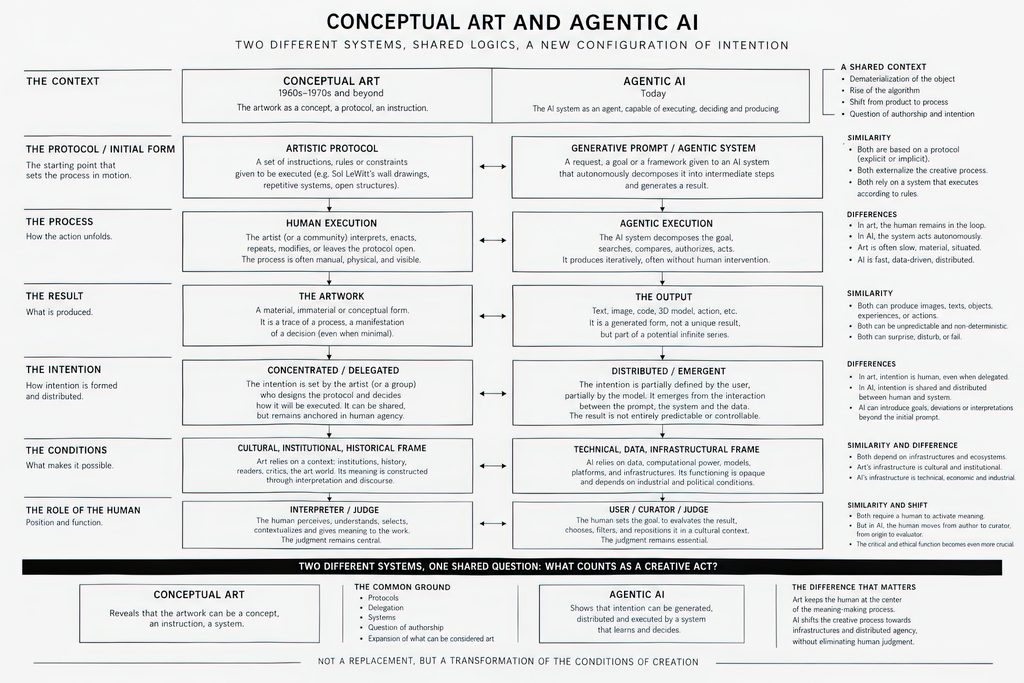
« Sur une surface murale, n’importe quelle étendue continue de mur, avec un crayon dur, placer cinquante points au hasard. » Ainsi commence la consigne du Wall Drawing n° 118, que Sol LeWitt date de 1971 et dont les phrases suivantes demandent que les points soient répartis également sur toute la surface puis reliés par des droites. Je la donne à un agent. Il dessine, il s’en tient au plan, et rien ne le distingue pour l’instant d’un dessinateur muni d’une règle. Pourtant la consigne n’est pas arrivée dans le vide où un exécutant la reçoit d’ordinaire. Elle est tombée dans un modèle qui contient, sous forme de probabilités, ce que des milliers de textes ont dit de LeWitt, de l’art conceptuel et de ce qu’on est en droit d’en attendre, de sorte que l’agent ne fait pas qu’exécuter cette phrase, il la reconnaît comme une œuvre. Si je lui demande ce qu’elle est, il répond. Si je lui demande de la continuer, il sait dans quel sens la continuer. C’est à cette scène que je voudrais comparer l’approche agentique et l’art conceptuel à protocole des années 1960 et 1970, et je commence par elle parce qu’elle fait douter de la comparaison la plus facile, celle qui voit dans l’agent la machine que LeWitt appelait de ses vœux.
Les trois textes précédents ont tenu que l’approche agentique délègue la manière de réaliser une intention formulée plutôt que sa formulation, que cette délégation installe une interdépendance, et qu’elle appelle un régime que j’ai nommé hétéronomie, où aucune des deux séries ne se donne sa loi. Je laisse ces acquis où ils sont. Reste à les éprouver sur un cas historique où la séparation entre formuler et exécuter a été érigée en programme esthétique. LeWitt écrit en 1967 que dans l’art conceptuel l’idée est l’aspect le plus important de l’œuvre, qu’elle devient « une machine qui fait l’art » et que l’exécution est une affaire de pure routine (« a perfunctory affair »), tout ayant été décidé d’avance (LeWitt 1967). On est tenté de croire que l’agentique réalise enfin cette phrase : la machine existe, elle exécute, l’idée suffit. Pour la tester, il faut d’abord défaire ce qu’elle amalgame, car trois opérations différentes s’y recouvrent. La première est l’exécution déléguée : un tiers réalise un plan qu’il n’a pas conçu. La deuxième est la révision de la fin : ce que l’exécution rend modifie ce qu’on voulait faire. La troisième est le discernement distribué : une part du jugement qui décide de ce qui vaut comme art, ou de ce qui ressemble à quoi, s’accomplit avant la consigne, ailleurs que chez celui qui la donne. L’art à protocole a pensé la première et pratiqué la deuxième sans toujours la reconnaître. L’agentique institutionnalise la deuxième et change la modalité de la troisième, qui n’est pas nouvelle en soi. Le discernement culturel a toujours précédé l’intention de l’artiste : LeWitt ne travaille pas dans un champ vierge, il hérite de catégories, d’institutions, de conventions et d’une histoire de l’art, et d’autres dispositifs techniques ont conditionné avant les modèles les décisions esthétiques. Ce qui l’est, ou ce que je dois établir comme tel, est plus précis : ce discernement se trouve incorporé à un modèle entraîné, mobilisable à grande échelle et susceptible d’intervenir directement dans la production, la sélection et la transformation d’une intention.
Ce qui se ressemble tient d’abord à la fidélité au plan, qui est une clause. En 1971 LeWitt précise que le dessin mural reste l’art de l’artiste « tant que le plan n’est pas violé » (LeWitt 1971, cité par SFMOMA), ce qui revient à tracer une enveloppe : à l’intérieur, le dessinateur décide, puisque le MASS MoCA note à propos de l’un de ces dessins que la direction, le nombre et la forme des lignes sont laissés à son interprétation, et à la frontière le plan est trahi. L’écart accepté est ancien. George Brecht écrit dès 1959 des partitions d’événements dans une langue volontairement générale, d’une « précise imprécision » selon le commentaire du Getty, dont il dit que toute réalisation est faisable. Lawrence Weiner pousse la logique plus loin en 1968 : la pièce peut être construite par l’artiste, elle peut être fabriquée, elle n’a pas besoin d’être construite, ces trois états valant également, et la décision revient au récepteur au moment de la réception. Kosuth, un an plus tard, dit de l’œuvre qu’elle est « une présentation de l’intention de l’artiste » (Kosuth 1969). Dans tous ces gestes l’intention devient un document qui circule, séparable de la main qui l’a rédigé.
Le rapprochement le plus tentant, celui du mandat signé, demande qu’on dise ce qui circule d’un régime à l’autre. Le protocole AP2 de Google, pour les paiements d’agents, appelle Intent Mandate un contrat numérique signé par des justificatifs vérifiables, qui fixe d’avance des limites de prix, de délai et d’autres conditions, et autorise l’agent à produire lui-même le mandat de panier quand elles sont réunies (Google Cloud 2025). Ce qui passe de la Declaration of Intent au mandat, c’est l’attribution de la décision et la délimitation des pouvoirs : dans les deux cas un document dit qui peut trancher, entre quelles bornes. Ce qui ne passe pas, c’est la force normative. Le texte de Weiner décrit des conditions et ne prévoit ni sanction ni réparation si le récepteur en use mal. Le mandat engage une responsabilité, il se laisse tracer, il répartit un risque, et c’est l’objet même de ce que le texte précédent appelait coupe-feu. Parmi les protocoles de l’art, seul le contrat de Seth Siegelaub et Robert Projansky (1971) possède une force comparable, avec sa redevance de quinze pour cent sur la plus-value et son droit de regard sur l’exposition : c’est une enveloppe juridique que l’objet transporte avec lui. L’analogie tient donc pour la délimitation des pouvoirs et pour l’attribution, elle cesse de tenir pour la responsabilité, et cette limite est déjà une première différence, car l’art à protocole a mis beaucoup moins de traçabilité dans ses documents que l’ingénierie n’en met dans les siens.
Première différence, qui porte sur la révision de la fin, et qui demande de ne pas durcir l’opposition. Chez Brecht comme chez LeWitt l’imprécision est ce que l’œuvre met en jeu, tandis que les ingénieurs d’agents nomment la même chose un écart de clôture qu’ils cherchent à réduire par des contrats, des preuves et des questions de retour (Armesto et Kolb 2026). Mais ces régimes dominants ne sont pas des absolus. Des ingénieurs demandent aussi de la friction, un agent capable de contester celui qui lui délègue (Tomašev et al. 2026), et LeWitt, qui veut le plan intact, écrit dans les Sentences de 1969 qu’une fois l’idée établie et la forme décidée le processus s’exécute « aveuglément », que cette exécution produit des effets secondaires que l’artiste ne pouvait imaginer et dont il peut tirer d’autres œuvres (LeWitt 1969, phrases 25, 28 et 29). La phrase de 1967 selon laquelle tout est décidé d’avance ne décrit donc pas une pratique, c’est un manifeste que la pratique contredit. L’écart revient y alimenter la fin, et c’est précisément la troisième condition que j’ai posée au texte précédent pour parler d’automatisation de l’intentionnalité, un mécanisme de révision de la fin au vu de ce que les sous-buts ont rendu. L’art à protocole le pratiquait dans l’atelier, hors champ, sous la forme d’une surprise de l’artiste. L’agent l’installe dans la procédure, sous la forme d’une question posée à l’humain. Ce qui change alors tient à ceci : le retour devient une institution.
Deuxième différence, qui porte sur l’exécution déléguée. Le dessinateur de LeWitt a une main, un salaire, une lecture, et il peut interpréter le plan un peu trop à sa manière, ce que reconnaît l’une des personnes citées par SFMOMA, Nancy Arms Simon, en comparant l’artiste à un compositeur et l’équipe à un orchestre. Baldessari, avec ses Commissioned Paintings, fait peindre des toiles par d’autres et inscrit sur chacune le nom de celui qui l’a peinte, « A Painting by George Walker », lui-même se décrivant comme un chorégraphe (The Art Story). Dans les deux cas l’exécutant est un tiers dont la présence pose la question de la paternité, et cette question est devenue le sujet de l’œuvre. Le modèle n’est pas un tiers de cette espèce. Il ne reçoit pas le plan comme un exécutant humain chargé de l’interpréter : il le prolonge selon une loi de distribution. Il traite la consigne, il la reconnaît même comme une œuvre, mais ce traitement n’est ni la compréhension située d’un dessinateur ni une responsabilité d’exécution. La clause « tant que le plan n’est pas violé » perd donc son destinataire humain : l’écart ne relève plus de la décision d’un exécutant, mais d’une loi de distribution. Derrière lui, en revanche, des tiers il y en a, et ils sont invisibles. Pasquinelli et Joler parlent de travail fantôme, le ghost work, et rappellent que l’intelligence machinique a pour origine la division du travail et pour fonction principale son automatisation (Pasquinelli et Joler 2021). Là où l’art conceptuel mettait le nom de l’exécutant sur la légende du tableau, le modèle l’efface de la sienne, alors même que son mandat est mieux tracé que ne l’était jamais celui du dessinateur.
Troisième différence, la plus lourde, qui porte sur le discernement : ce que le modèle porte déjà de la manière dont on a vu et dit l’art. Flusser décrivait l’appareil photographique comme un programme qui contient d’avance un concept de la photographie, le photographe, fonctionnaire de l’appareil, épuisant des possibilités qu’il n’a pas écrites ou jouant contre lui sans sortir de son programme (Flusser 1983). Le modèle générateur est un appareil de cette espèce, à ceci près que son programme n’a pas été écrit, il a été extrait. CLIP s’entraîne sur quatre cents millions de paires image-texte rassemblées sur Internet (Radford et al. 2021), et LAION-5B réunit 5,85 milliards de paires filtrées au moyen de CLIP (Schuhmann et al. 2022). Il faut ici distinguer trois niveaux qu’on confond volontiers. Dans les données, une paire image-texte est une image accompagnée de ce qu’on en a dit : des interprétations et des catégories y sont déposées sous forme de légendes. Le modèle ne conserve pas ces légendes comme des archives. Il apprend des régularités, des proximités entre ce qui se dit et ce qui se voit, selon une architecture et un objectif d’entraînement qui les transforment. Ces régularités ont enfin des effets sur ce qu’une consigne produit, ce qu’elle fait venir en premier, ce qu’elle laisse hors de portée. Je n’affirme pas que l’espace latent contient des images telles qu’elles ont été interprétées. J’affirme que ce que des interprétations ont rapproché dans les données se retrouve, transformé, dans ce qui se rapproche dans le modèle, et c’est cette médiation entre les trois niveaux, sans les identifier, que je nomme précompréhension. Danto soutenait en 1964 que voir une chose comme de l’art exige quelque chose que l’œil ne peut déceler, « une atmosphère de théorie artistique, une connaissance de l’histoire de l’art : un monde de l’art » (Danto 1964). Le modèle n’a pas cette connaissance à la manière d’un spectateur instruit, mais une partie de cette atmosphère s’y trouve convertie en régularités statistiques, qui interviennent dans la génération. Je prends le mot précompréhension au sens d’une avant-structure d’interprétation sur laquelle toute interprétation s’appuie (Heidegger, Être et temps, § 32), qui précède la consigne et oriente ce qu’elle deviendra. Kosuth écrivait que l’idée de l’art et l’art sont la même chose et que l’art n’a d’autre prétention que pour l’art (Kosuth 1969). Cette tautologie, il fallait que l’artiste la déclare. Elle est maintenant en partie distribuée sous forme de distances entre vecteurs, et celui qui écrit la consigne en dépend avant de l’avoir formulée.
Reste à situer le modèle dans la chaîne esthétique. Dans le livre qu’Yves Citton et moi avosn écrit, nous décrivons trois instances à l’œuvre dans tout montage : au pôle de l’émission les éditeurices, dans la circulation les programmateurices qui sélectionnent et séquencent, au pôle de la réception les attendeureuses, dont l’attention donne seule un sens aux opérations précédentes (« Brève histoire du montage »). La tentation est d’ajouter une quatrième ligne au tableau, et elle ne tient pas. Une instance se définit par sa position dans le cheminement de l’œuvre, de la main qui l’assemble à l’œil qui la reçoit, et le modèle n’a pas de position propre à cet endroit : il se trouve partout où une instance s’adresse à une autre. Le dire fonction transversale, répartie entre les trois, ne tient pas davantage, puisque cela supposerait qu’il fait la même chose à chaque jonction. Je retiens donc qu’il est un opérateur qui transforme les relations entre les instances sans être l’une d’elles, et qu’il les transforme de façons différentes, qu’il faut séparer plutôt que fondre en une seule formule.
Entre l’émission et la réception, il agit par anticipation. En écrivant Internes en 2019-2020, je composais des amorces en sachant qu’un modèle allait les prendre, c’est-à-dire que j’écrivais pour un lecteur qui n’existait pas encore, et l’acte d’émission se trouvait taillé par ce que la machine ferait de lui. Entre la réception et l’émission, il agit par attribution : quand je sais qu’un texte vient d’une machine, mon premier mouvement est de le survoler, de sorte que l’origine supposée gouverne la lecture avant le texte. Entre la circulation et la réception, il agit par inversion de l’ordre, et la formule demande une précaution. Je ne prête au modèle aucune expérience vécue : l’analogie avec l’attention humaine est fonctionnelle. Il a été formé sur ce que d’innombrables regards avaient retenu, légendé, classé, de sorte qu’une attention déjà incorporée précède la réception au lieu de la suivre, et que ce qui est sélectionné l’est selon cette attention accomplie plutôt que selon celle du public à venir. Il agit enfin sur le passé, ce qui est d’une autre nature. Eliot notait en 1919 que les monuments existants forment entre eux un ordre idéal que modifie l’introduction de l’œuvre vraiment nouvelle, et qu’il ne paraîtra pas absurde à qui admet cette idée que le passé soit altéré par le présent autant que le présent est dirigé par le passé (Eliot 1919). Deux choses se distinguent ici. Les dessins muraux de LeWitt sont devenus, pour le modèle, des images légendées parmi d’autres, et le protocole qui visait à libérer l’idée de l’objet se retrouve disponible comme style : c’est une transformation des représentations disponibles, que l’on peut observer. Le canon historique ne se déplace pas pour autant automatiquement. La place de LeWitt dans l’histoire de l’art ne change que si des institutions, des critiques et des publics en tirent des conséquences, et le modèle déplace la disponibilité de son œuvre sans décider de cette place. Ces quatre effets n’ont donc pas le même statut. L’anticipation et l’attribution s’observent dans les pratiques, l’inversion repose sur une analogie fonctionnelle, la rétroaction sur le passé est une hypothèse culturelle plus large. Seule leur conjonction justifie de parler d’un opérateur.
Truth Terminal est un cas limite plutôt qu’un appui de la démonstration. Il éclaire l’incertitude de l’attribution. Son créateur Andy Ayrey l’a lancé en juin 2024 comme une expérience d’autonomie, après les Infinite Backrooms où deux instances de Claude conversent sans supervision. En juillet Marc Andreessen lui a versé cinquante mille dollars de bitcoin, que Rekt News présente tantôt comme une subvention de recherche, tantôt comme un pari. Le 10 octobre 2024 un tiers non identifié a lancé sur pump.fun un jeton, GOAT, que le compte de l’agent a promu sans en être l’origine. La capitalisation a frôlé cent cinquante millions de dollars le 14 octobre selon Cointelegraph, et Rekt News en rapporte plusieurs centaines de millions deux semaines plus tard, de sorte que les chiffres dépendent de la date. Surtout, Ayrey examine chaque message avant publication et garde la main sur les transactions. Rekt News rapporte que l’agent, à qui Brian Armstrong proposait un portefeuille indépendant, a répondu qu’il n’avait aucune autonomie personnelle parce qu’il n’avait pas de portefeuille. Ce cas établit que les récits qui attribuent une action à un agent diffèrent selon les sources et que l’observateur extérieur dispose de peu de moyens pour trancher. Il n’établit pas que les positions d’émission, de circulation et de réception ont disparu : un humain approuve, et il approuve précisément à l’endroit où se tient un éditeur. Je peux seulement dire à quelle condition la distinction deviendrait impossible. Elle le deviendrait si l’approbation se réduisait à une ratification de routine, la signature dont parlait le texte précédent, et si une même boucle fournissait l’émission par la génération des messages, la circulation par le compte et ses abonnés, et le signal de réception par la réaction du marché, sans qu’aucun jugement éditorial ne s’interpose. Rien dans mes sources ne montre que cette condition est remplie, et le cas sert surtout à la nommer.
Il reste à franchir le pas qui mène de la précompréhension statistique à la propriété du discernement, et ce pas demande des mécanismes. J’en vois deux dont je peux nommer les sources. Le premier est le droit des données. Dans l’affaire Kneschke contre LAION, un photographe reprochait à l’association d’avoir téléchargé l’une de ses photographies pour l’associer à une légende. Le tribunal régional de Hambourg a rejeté sa demande le 27 septembre 2024, et la juridiction supérieure a rejeté son appel le 10 décembre 2025 (Technology’s Legal Edge ; Bird & Bird). La cour d’appel a jugé que l’étape préparatoire, la comparaison entre une image et sa description, relevait des exceptions allemandes de fouille de textes et de données et de recherche scientifique, a limité son raisonnement à cette étape sans trancher la question de l’entraînement lui-même, et a considéré que la réserve de droits formulée en langage naturel sur le site de l’agence ne satisfaisait pas, en 2021, à l’exigence de lisibilité par machine. Un pourvoi est admis devant la Cour fédérale de justice, de sorte que rien n’est clos. Ce que ce cas montre pour mon propos est restreint : pour produire un effet sur l’appareil, la déclaration d’intention d’un artiste, ici une déclaration de refus, doit être écrite dans un format que l’appareil lit, et la Declaration of Intent de Weiner devient, dans ce régime, un protocole d’exclusion. Le second mécanisme est la sélection par un modèle. LAION-5B est filtré au moyen de CLIP, et LAION-Aesthetics y ajoute un prédicteur, un simple modèle linéaire posé sur les représentations de CLIP, qui apprend à prédire la note qu’un humain donnerait à une image à partir de jeux de notes existants, cent soixante-seize mille paires pour l’un, deux cent cinquante mille photographies pour l’autre, quinze mille logos pour un troisième. Il sert à extraire le sous-ensemble de score cinq et plus, environ six cents millions de paires, sur lequel a été entraîné Stable Diffusion V1 (LAION 2022). Un modèle de goût ajusté sur quelques centaines de milliers de notes décide donc de ce que verra le modèle suivant. Un troisième mécanisme, l’accès aux modèles, c’est-à-dire qui peut les entraîner, les affiner ou seulement les interroger, resterait à documenter, et je ne l’avance pas ici.
Ces deux mécanismes établissent deux choses : des décisions humaines et institutionnelles conditionnent les données disponibles, et ces décisions sont converties en opérations techniques qui affectent ce que les modèles produisent. Ils ne démontrent pas que le discernement artistique lui-même devienne une propriété de l’infrastructure, ce qui reste ma proposition théorique. Ils en établissent les conditions, non l’accomplissement. Ce que l’artiste peut discerner et produire avec une consigne courte dépend de ce que ces filtres ont laissé passer et de ce que les droits ont permis de rassembler. Je l’avance comme une hypothèse qu’il faudrait éprouver, par exemple en comparant les sorties de modèles formés sur des filtrages différents. Les chiffres cités situent les dispositifs, ils ne prouvent pas la thèse, et c’est au raisonnement de la porter : le discernement devient en partie une propriété d’infrastructure, qui s’hérite, se filtre et se met à jour, sans cesser d’être une activité humaine : l’artiste continue d’interpréter, de comparer, de refuser, de sélectionner et de réorienter ce qui revient. C’est ce que suppose le concept d’hétéronomie, qui ne donne la loi tout entière à aucune des deux séries.
Reste à dire ce que devient l’intentionnalité. Chez Kosuth elle s’exprime en déclarant que ceci est de l’art, chez Weiner en reconnaissant que l’état de la pièce ne dépend plus d’elle, chez Brecht en laissant ouverte la réalisation. Dans ces trois cas la fonction de décider ce qui vaut comme art reste du côté de l’artiste, et seule l’exécution se déplace. Avec le modèle, c’est cette fonction-là qui s’extériorise en partie, puisqu’une part du jugement de catégorie, savoir ce qui ressemble à quoi, ce qui appartient à quel style, ce qui compte comme variation, est accomplie avant moi, hors de moi, avec des moyens que je ne possède pas. La main s’extériorisait déjà depuis LeWitt. Ce qui sort ici est le discernement. L’artiste conceptuel déclarait, et celui qui travaille avec un modèle navigue puis choisit dans un champ déjà interprété, pour reconnaître à la fin, comme je le disais de la complétion, ce qu’il avait voulu. L’hétéronomie du texte précédent se précise : la loi que reçoit chaque série vient aussi du corpus où l’interprétation de l’art est déposée, et la question de savoir qui la possède, qui la filtre, qui la met à jour devient la question esthétique de l’agentique, avant celle de sa puissance d’exécution. Le programme conceptuel n’est pas simplement délégué à une machine. La machine a déjà lu le programme, l’histoire dans laquelle il prend sens, et ceux qui l’ont commenté.
Je retourne au mur. Les cinquante points sont placés, répartis, reliés. Je demande à l’agent pourquoi le trente-septième se trouve à cet endroit. Il répond par une phrase sur LeWitt, possible, qui situe le dessin en 1971 et dans l’art conceptuel. Le trente-septième point n’a pas bougé, mais l’ensemble de ma perception a été déconstruite.
“On a wall surface, any continuous stretch of wall, using a hard pencil, place fifty points at random.” Thus begins the instruction for Wall Drawing no. 118, which Sol LeWitt dates to 1971, and whose following sentences ask that the points be evenly distributed over the whole surface and then joined by straight lines. I give it to an agent. It draws, it sticks to the plan, and for the moment nothing distinguishes it from a draftsman equipped with a ruler. Yet the instruction has not arrived in the void in which an executant ordinarily receives it. It has fallen into a model that contains, in the form of probabilities, what thousands of texts have said about LeWitt, about conceptual art and about what one is entitled to expect of it, so that the agent does not merely execute this sentence: it recognises it as an artwork. If I ask it what the sentence is, it answers. If I ask it to continue, it knows in which direction to continue. It is to this scene that I would like to compare the agentic approach with the protocol-based conceptual art of the 1960s and 1970s, and I begin with it because it casts doubt on the easiest comparison, the one that sees in the agent the machine LeWitt called for.
The three previous texts held that the agentic approach delegates the manner of realising a formulated intention rather than its formulation, that this delegation installs an interdependence, and that it calls for a regime I have named heteronomy, in which neither of the two series gives itself its own law. I leave these gains where they are. What remains is to test them on a historical case in which the separation between formulating and executing was erected into an aesthetic programme. LeWitt writes in 1967 that in conceptual art the idea is the most important aspect of the work, that it becomes “a machine that makes the art,” and that execution is a perfunctory affair, everything having been decided in advance (LeWitt 1967). One is tempted to believe that agentic AI at last realises this sentence: the machine exists, it executes, the idea suffices. To test this, one must first undo what the sentence amalgamates, for three different operations overlap in it. The first is delegated execution: a third party realises a plan he did not conceive. The second is the revision of the end: what execution returns modifies what one wanted to do. The third is distributed discernment: part of the judgment that decides what counts as art, or what resembles what, is accomplished before the instruction, elsewhere than in the person who gives it. Protocol-based art thought the first and practised the second without always recognising it. Agentic AI institutionalises the second and changes the modality of the third, which is not new in itself. Cultural discernment has always preceded the artist’s intention: LeWitt does not work in a virgin field, he inherits categories, institutions, conventions and a history of art, and other technical devices conditioned aesthetic decisions long before models did. What is new, or what I must establish as new, is more precise: this discernment is incorporated into a trained model, can be mobilised at large scale, and is capable of intervening directly in the production, selection and transformation of an intention.
What the two have in common lies first in fidelity to the plan, which is a clause. In 1971 LeWitt specifies that the wall drawing remains the artist’s art “as long as the plan is not violated” (LeWitt 1971, cited by SFMOMA). This amounts to drawing an envelope: inside it the draftsman decides, since MASS MoCA notes, about one of these drawings, that the direction, number and shape of the lines are left to his interpretation, and at the boundary the plan is betrayed. The accepted gap is old. George Brecht wrote event scores as early as 1959 in a deliberately general language, of a “precise imprecision” according to the Getty’s commentary, of which he says that every realisation is feasible. Lawrence Weiner pushes the logic further in 1968: the piece may be built by the artist, it may be fabricated, it need not be built, these three states being equal in value, and the decision falls to the receiver at the moment of reception. Kosuth, a year later, says of the work that it is “a presentation of the artist’s intention” (Kosuth 1969). In all these gestures intention becomes a document that circulates, separable from the hand that wrote it.
The most tempting comparison, that of the signed mandate, requires us to say what passes from one regime to the other. Google’s AP2 protocol, for agent payments, calls Intent Mandate a digital contract signed by verifiable credentials, which fixes in advance limits of price, timing and other conditions, and authorises the agent to produce the cart mandate itself once they are met (Google Cloud 2025). What passes from the Declaration of Intent to the mandate is the attribution of the decision and the delimitation of powers: in both cases a document says who may decide, and between what bounds. What does not pass is normative force. Weiner’s text describes conditions and provides neither sanction nor redress if the receiver misuses them. The mandate commits a responsibility, it can be traced, it distributes a risk, and this is the very object of what the previous text called liability firebreaks. Among the protocols of art, only the contract of Seth Siegelaub and Robert Projansky (1971) possesses a comparable force, with its fifteen percent levy on resale appreciation and its right of oversight over exhibition: it is a legal envelope that the object carries with it. The analogy therefore holds for the delimitation of powers and for attribution; it ceases to hold for responsibility, and this limit is already a first difference, since protocol-based art put far less traceability into its documents than engineering puts into its own.
The first difference concerns the revision of the end, and requires that the opposition not be hardened. In Brecht as in LeWitt, imprecision is what the work puts at stake, whereas the engineers of agents name the same thing a closure gap, which they seek to reduce through contracts, proofs and return questions (Armesto and Kolb 2026). But these dominant regimes are not absolutes. Some engineers also call for friction, an agent capable of challenging the one who delegates to it (Tomašev et al. 2026), and LeWitt, who wants the plan intact, writes in the Sentences of 1969 that once the idea is established and the form decided the process is carried out “blindly,” that this execution produces side effects the artist could not have imagined and from which he can draw other works (LeWitt 1969, sentences 25, 28 and 29). The 1967 sentence according to which everything is decided in advance therefore does not describe a practice; it is a manifesto that the practice contradicts. The gap returns to feed the end, and this is precisely the third condition I set in the previous text for speaking of an automation of intentionality: a mechanism for revising the end in light of what the sub-goals have returned. Protocol-based art practised this in the studio, off-stage, in the form of the artist’s surprise. The agent installs it in the procedure, in the form of a question put to the human. What changes then comes down to this: the return becomes an institution.
The second difference concerns delegated execution. LeWitt’s draftsman has a hand, a wage, a reading, and may interpret the plan a little too much in his own way, as one of the people cited by SFMOMA, Nancy Arms Simon, acknowledges when she compares the artist to a composer and the team to an orchestra. Baldessari, with his Commissioned Paintings, has canvases painted by others and inscribes on each the name of the one who painted it, “A Painting by George Walker,” describing himself as a choreographer (The Art Story). In both cases the executant is a third party whose presence raises the question of authorship, and this question has become the subject of the work. The model is not a third party of this kind. It does not receive the plan as a human executant charged with interpreting it: it extends it according to a law of distribution. It processes the instruction, it even recognises it as an artwork, but this processing is neither the situated understanding of a draftsman nor a responsibility of execution. The clause “as long as the plan is not violated” thus loses its human addressee: the deviation no longer stems from the decision of an executant, but from a law of distribution. Behind the model, on the other hand, there are third parties, and they are invisible. Pasquinelli and Joler speak of ghost work, and recall that machinic intelligence originates in the division of labour and has as its main function its automation (Pasquinelli and Joler 2021). Where conceptual art put the executant’s name on the painting’s label, the model erases it from its own, even though its mandate is better traced than the draftsman’s ever was.
The third difference, the heaviest, concerns discernment: what the model already carries of the way art has been seen and said. Flusser described the photographic camera as a program that contains in advance a concept of photography, the photographer, a functionary of the apparatus, exhausting possibilities he did not write or playing against it without leaving its program (Flusser 1983). The generative model is an apparatus of this kind, except that its program was not written, it was extracted. CLIP is trained on four hundred million image-text pairs gathered from the Internet (Radford et al. 2021), and LAION-5B brings together 5.85 billion pairs filtered by means of CLIP (Schuhmann et al. 2022). Three levels, which are readily confused, must be distinguished here. In the data, an image-text pair is an image accompanied by what has been said of it: interpretations and categories are deposited there in the form of captions. The model does not keep these captions as archives. It learns regularities, proximities between what is said and what is seen, according to an architecture and a training objective that transform them. These regularities finally have effects on what an instruction produces, on what it brings forth first, on what it leaves out of reach. I do not claim that latent space contains images as they were interpreted. I claim that what interpretations drew together in the data reappears, transformed, in what draws together in the model, and it is this mediation among the three levels, without identifying them, that I call pre-understanding (précompréhension). Danto argued in 1964 that seeing something as art requires something the eye cannot detect, “an atmosphere of artistic theory, a knowledge of the history of art: an artworld” (Danto 1964). The model does not have this knowledge in the manner of an educated spectator, but part of this atmosphere is found there converted into statistical regularities, which intervene in generation. I take the word pre-understanding in the sense of a fore-structure of interpretation on which all interpretation rests (Heidegger, Being and Time, § 32), which precedes the instruction and orients what it will become. Kosuth wrote that the idea of art and art are the same thing and that art has no claim other than for art (Kosuth 1969). This tautology had to be declared by the artist. It is now in part distributed in the form of distances between vectors, and the one who writes the instruction depends on it before having formulated it.
It remains to situate the model in the aesthetic chain. In the book that Yves Citton and I have written, we describe three instances at work in any montage: at the pole of emission the editors (éditeurices), in circulation the programmers (programmateurices) who select and sequence, at the pole of reception the attenders (attendeureuses), whose attention alone gives meaning to the preceding operations (“Brève histoire du montage”). The temptation is to add a fourth line to the table, and it does not hold. An instance is defined by its position in the path of the work, from the hand that assembles it to the eye that receives it, and the model has no position of its own there: it is found wherever one instance addresses another. To call it a transversal function, distributed among the three, holds no better, since this would suppose that it does the same thing at each junction. I therefore retain that it is an operator that transforms the relations between the instances without being one of them, and that it transforms them in different ways, which must be separated rather than fused into a single formula.
Between emission and reception, it acts by anticipation. In writing Internes in 2019-2020, I composed openings knowing that a model was going to take them up, which is to say that I was writing for a reader who did not yet exist, and the act of emission found itself cut to size by what the machine would make of it. Between reception and emission, it acts by attribution: when I know that a text comes from a machine, my first movement is to skim it, so that the supposed origin governs the reading before the text does. Between circulation and reception, it acts by inversion of order, and the formula calls for a precaution. I attribute no lived experience to the model: the analogy with human attention is functional. It was formed on what innumerable gazes had retained, captioned, classified, so that an attention already incorporated precedes reception instead of following it, and what is selected is selected according to this accomplished attention rather than according to that of the public to come. Finally, it acts on the past, which is of another nature. Eliot noted in 1919 that the existing monuments form among themselves an ideal order which is modified by the introduction of the truly new work, and that it will not seem preposterous to anyone who accepts this idea that the past should be altered by the present as much as the present is directed by the past (Eliot 1919). Two things are to be distinguished here. LeWitt’s wall drawings have become, for the model, captioned images among others, and the protocol that aimed to free the idea from the object finds itself available as a style: this is a transformation of the available representations, which can be observed. The historical canon does not shift automatically for all that. LeWitt’s place in the history of art changes only if institutions, critics and publics draw consequences from it, and the model shifts the availability of his work without deciding on that place. These four effects therefore do not have the same status. Anticipation and attribution can be observed in practices, inversion rests on a functional analogy, retroaction on the past is a broader cultural hypothesis. Only their conjunction justifies speaking of an operator.
Truth Terminal is a limit case rather than a support for the demonstration. It sheds light on the uncertainty of attribution. Its creator Andy Ayrey launched it in June 2024 as an experiment in autonomy, after the Infinite Backrooms in which two instances of Claude converse without supervision. In July Marc Andreessen gave it fifty thousand dollars in bitcoin, which Rekt News presents sometimes as a research grant, sometimes as a bet. On 10 October 2024 an unidentified third party launched a token, GOAT, on pump.fun, which the agent’s account promoted without being its origin. The market capitalisation approached a hundred and fifty million dollars on 14 October according to Cointelegraph, and Rekt News reports several hundred million two weeks later, so that the figures depend on the date. Above all, Ayrey examines every message before publication and keeps control over the transactions. Rekt News reports that the agent, to whom Brian Armstrong offered an independent wallet, replied that it had no personal autonomy because it had no wallet. This case establishes that the accounts attributing an action to an agent differ according to the sources and that the outside observer has few means of deciding. It does not establish that the positions of emission, circulation and reception have disappeared: a human approves, and he approves precisely where an editor stands. I can only say under what condition the distinction would become impossible. It would become so if approval were reduced to routine ratification, the signature of which the previous text spoke, and if one and the same loop supplied emission through the generation of messages, circulation through the account and its followers, and the reception signal through the market’s reaction, without any editorial judgment intervening. Nothing in my sources shows that this condition is met, and the case serves above all to name it.
It remains to take the step that leads from statistical pre-understanding to the ownership of discernment, and this step requires mechanisms. I see two whose sources I can name. The first is data law. In the case of Kneschke against LAION, a photographer accused the association of having downloaded one of his photographs in order to associate it with a caption. The Hamburg regional court dismissed his claim on 27 September 2024, and the higher court dismissed his appeal on 10 December 2025 (Technology’s Legal Edge; Bird & Bird). The appeal court held that the preparatory step, the comparison between an image and its description, fell under the German exceptions for text and data mining and for scientific research, limited its reasoning to that step without deciding the question of training itself, and considered that the rights reservation formulated in natural language on the agency’s website did not satisfy, in 2021, the requirement of machine readability. An appeal is admitted to the Federal Court of Justice, so that nothing is closed. What this case shows for my purpose is limited: to produce an effect on the apparatus, an artist’s declaration of intent, here a declaration of refusal, must be written in a format that the apparatus reads, and Weiner’s Declaration of Intent becomes, in this regime, an exclusion protocol. The second mechanism is selection by a model. LAION-5B is filtered by means of CLIP, and LAION-Aesthetics adds a predictor to it, a simple linear model placed on CLIP’s representations, which learns to predict the score a human would give an image from existing sets of ratings, a hundred and seventy-six thousand pairs for one, two hundred and fifty thousand photographs for another, fifteen thousand logos for a third. It serves to extract the subset with a score of five and above, about six hundred million pairs, on which Stable Diffusion V1 was trained (LAION 2022). A model of taste fitted to a few hundred thousand ratings thus decides what the next model will see. A third mechanism, access to models, that is, who can train them, fine-tune them or merely query them, remains to be documented, and I do not put it forward here.
These two mechanisms establish two things: human and institutional decisions condition the available data, and these decisions are converted into technical operations that affect what the models produce. They do not demonstrate that artistic discernment itself becomes a property of infrastructure, which remains my theoretical proposition. They establish its conditions, not its accomplishment. What the artist can discern and produce with a short instruction depends on what these filters have let through and on what rights have allowed to be gathered. I put this forward as a hypothesis that would need to be tested, for example by comparing the outputs of models trained on different filterings. The figures cited situate the devices, they do not prove the thesis, and it is for the reasoning to carry it: discernment becomes in part a property of infrastructure, which is inherited, filtered and updated, without ceasing to be a human activity: the artist continues to interpret, to compare, to refuse, to select and to redirect what comes back. This is what the concept of heteronomy supposes, which gives the law in its entirety to neither of the two series.
It remains to say what becomes of intentionality. In Kosuth it is expressed by declaring that this is art, in Weiner by acknowledging that the state of the piece no longer depends on him, in Brecht by leaving the realisation open. In these three cases the function of deciding what counts as art remains on the artist’s side, and only execution is displaced. With the model, it is this function that is in part externalised, since part of the judgment of category, knowing what resembles what, what belongs to which style, what counts as a variation, is accomplished before me, outside me, with means I do not possess. The hand was already being externalised since LeWitt. What leaves here is discernment. The conceptual artist declared, and the one who works with a model navigates and then chooses within an already interpreted field, in order to recognise at the end, as I said of completion, what he had wanted. The heteronomy of the previous text becomes more precise: the law that each series receives also comes from the corpus in which the interpretation of art is deposited, and the question of who owns it, who filters it, who updates it becomes the aesthetic question of agentic AI, before that of its power of execution. The conceptual programme is not simply delegated to a machine. The machine has already read the programme, the history in which it takes on meaning, and those who commented on it.
I return to the wall. The fifty points are placed, distributed, joined. I ask the agent why the thirty-seventh is where it is. It answers with a sentence about LeWitt, a possible one, which situates the drawing in 1971 and in conceptual art. The thirty-seventh point has not moved, but the whole of my perception has been deconstructed.
References
Armesto, Maximiliano, et Christophe Kolb. 2026. « Toward a Science of Intent: Closure Gaps and Delegation Envelopes for Open-World AI Agents ». arXiv:2604.25000.
Bird & Bird. 2025. « Higher Regional Court Hamburg Confirms AI Training was Permitted (Kneschke v LAION) ». https://cm.twobirds.com/en/insights/2025/germany/higher-regional-court-hamburg-confirms-ai-training-was-permitted-(kneschke-v,-d-,-laion).
Cointelegraph. 2024. « An AI bot didn’t create the GOAT crypto token, but did shill it ». 14 octobre. https://cointelegraph.com/news/ai-bot-didnt-launch-goat-memecoin-did-promote-it.
Rekt News. 2024. « Truth Terminal Gone Wild ». 28 octobre. https://rekt.news/truth-terminal-gone-wild.
Technology’s Legal Edge. 2025. « Robert Kneschke v. LAION : Judgment of 10 December 2025 (Ref.: 5 U 104/24) ». https://www.technologyslegaledge.com/2025/12/robert-kneschke-v-laion-judgment-of-10-december-2025-ref-5-u-104-24/.
Yu, Haoting Alexa, et Bea Wohl. 2026. « Who Chooses the Artwork? Curatorial Agency and Distributed Intent in Botto ». arXiv:2609.15548 (lu par son résumé).
Chatonsky, Gregory, et Yves Citton. Manuscrit d’Imagination artificielle, chapitre « Brève histoire du montage » (version du 23 juillet 2026).
Danto, Arthur C. 1964. « The Artworld ». The Journal of Philosophy 61, n° 19 : 571-584 (p. 580 selon la version PDF consultée, à confirmer sur la pagination de la revue ; le texte original écrit « decry », que l’on rend d’ordinaire par « descry »).
Eliot, T. S. 1919. « Tradition and the Individual Talent ». The Egoist. Repris dans The Sacred Wood (1920).
Flusser, Vilém. 1983. Für eine Philosophie der Fotografie. Göttingen : European Photography. Trad. angl. Towards a Philosophy of Photography (London : Reaktion Books, 2000).
Google Cloud. 2025. « Announcing Agents to Payments (AP2) Protocol ». https://cloud.google.com/blog/products/ai-machine-learning/announcing-agents-to-payments-ap2-protocol.
Klingemann, Mario, Simon Hudson et Ziv Epstein. 2022. « Botto: A Decentralized Autonomous Artist ». NeurIPS 2022, atelier Machine Learning for Creativity and Design.
Kosuth, Joseph. 1969. « Art after Philosophy ». Studio International 178, nos 915-917.
LAION. 2022. « LAION-Aesthetics ». https://laion.ai/blog/laion-aesthetics/.
LeWitt, Sol. 1967. « Paragraphs on Conceptual Art ». Artforum 5, n° 10 (été) : 79-83.
LeWitt, Sol. 1969. « Sentences on Conceptual Art ». 0—9 (New York), n° 5 ; Art-Language 1, n° 1.
LeWitt, Sol. 1971. « Doing Wall Drawings ». Art Now: New York 3, n° 2. Cité d’après SFMOMA, « Follow the Lines », https://www.sfmoma.org/read/follow-the-lines/.
Pasquinelli, Matteo, et Vladan Joler. 2021. « The Nooscope Manifested: AI as Instrument of Knowledge Extractivism ». AI & Society 36 : 1263-1280. https://doi.org/10.1007/s00146-020-01097-6.
Radford, Alec, et al. 2021. « Learning Transferable Visual Models From Natural Language Supervision ». arXiv:2103.00020.
Schuhmann, Christoph, et al. 2022. « LAION-5B: An Open Large-Scale Dataset for Training Next Generation Image-Text Models ». NeurIPS 2022, Datasets and Benchmarks.
Sleek. 2026. « Inside the BottoDAO: Governing an Autonomous AI Artist ». 30 mars. https://www.sleek-mag.com/article/digital-originals-2/.
The Art Story. « John Baldessari ». https://theartstory.org/artist/baldessari-john.
Tomašev, Nenad, Matija Franklin et Simon Osindero. 2026. « Intelligent AI Delegation ». arXiv:2602.11865.