
Le visage d’après / The Face After
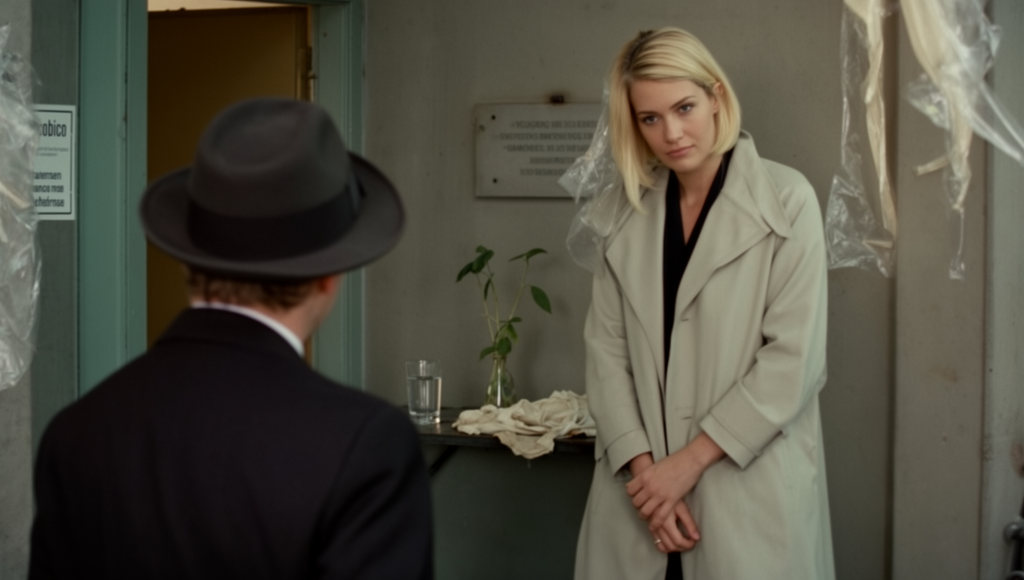
Quand je lance mon script sur Vertigo, chaque plan est traité seul. Il ne garde du plan que sa première image et sa durée. Flux reprend l’image, LTX l’anime, ffmpeg recolle les clips dans l’ordre. Le seed est commun à tous les plans, ce qui ne fait pas une identité, pas plus qu’une même date de naissance ne fait une même personne. À l’intérieur d’un plan le visage tient à peu près, puisqu’il vient d’une seule image. À la coupe, il est remplacé. Le Scottie du plan douze n’a pas vu celui du plan onze, la femme qu’il file change de traits d’un trottoir à l’autre, et le nom reste. L’histoire continue de se raconter.
Les outils appellent cela un défaut de cohérence. On le corrige avec des images de référence, des LoRA de personnage, des seeds verrouillés. Je me suis demandé ce que cette demande de cohérence suppose, et elle vient d’Aristote. Le mot personnage recouvre au moins trois choses que le cinéma superpose : une apparence qu’on reconnaît, une identité qui tient à travers ce qui arrive, et ce que Lévinas appelle le visage, qui n’est ni l’une ni l’autre. L’acteur fournit la première, le scénario la deuxième. Le film régénéré les sépare.
La Poétique fait passer l’agencement des faits avant les caractères : la tragédie imite une action, pas des hommes. Elle veut que cette action soit un tout, avec un commencement, un milieu et une fin (chapitre 7), et que le héros se tienne entre la vertu et le vice, son malheur venant d’une erreur, l’hamartia, non d’une méchanceté. Au chapitre 13 encore, la pitié va au malheur immérité et la crainte à celui d’un semblable. Au chapitre 15, les caractères doivent être cohérents, et même l’inconstant doit l’être avec constance. L’anagnorisis est le passage de l’ignorance à la connaissance ; elle peut porter sur une identité, une parenté, un fait. Que ce passage se joue presque toujours sur un gros plan, c’est le cinéma qui l’a décidé, pas Aristote. Même remarque pour l’identification : ce n’est pas son mot, c’est ce que la tradition a fait de sa « ressemblance ». Quant à la catharsis, on en débat encore, et je ne la tiens pas pour un simple soulagement à la fin de l’intrigue. Je retiens seulement que la pitié et la crainte s’attachent au destin d’un individu, qui doit durer assez longtemps pour en avoir un.
Ricœur donne à cette dépendance sa forme la plus nette. La mimèsis y a trois temps : la préfiguration, le monde de l’action avec ses symboles ; la configuration, qui est la mise en intrigue, synthèse de l’hétérogène par laquelle des événements dispersés deviennent une histoire ; la refiguration, où le monde du texte rencontre celui du lecteur. Dans Soi-même comme un autre, le personnage est mis en intrigue lui aussi. Son identité narrative tient ensemble la mêmeté, l’idem, la permanence du caractère, ce par quoi on me reconnaît, et l’ipséité, l’ipse, le maintien de soi, la parole tenue. Le personnage change et reste le même parce que son changement entre dans une concordance discordante. Mon film ne supprime pas la configuration. L’ordre des plans reste, et la bible du film comme le fichier d’atmosphère maintiennent un ton, une palette, une matière. Mais l’apparence, qui soutenait l’idem le plus directement, ne le fait plus, et la charge passe à la refiguration. Le spectateur relie, comme il l’a toujours fait. L’expérience de Koulechov n’est pas une preuve : son histoire est contestée et les images sont perdues. Des recherches plus récentes confirment cependant qu’un contexte de montage oriente la lecture d’une expression. Le sens d’un visage dépend de ce qui l’entoure, et ici ce qui l’entoure change à chaque plan. Au sens de Simondon, chaque coupe est une disparation : deux images qui ne coïncident pas posent un problème, que le spectateur tente de résoudre en les rapportant à un seul individu. Cette résolution ne tient pas toujours. Ricœur rencontre lui-même un cas voisin avec Musil. Dans L’Homme sans qualités, l’identité narrative entre en crise, et l’ipséité est mise à l’épreuve quand la mêmeté ne la soutient plus. Chez Musil il reste pourtant un nom, une voix, un narrateur. Dans le film le nom demeure mais n’a plus de corps pour le porter, et je ne vois pas ce que serait un maintien de soi sans personne qui se maintienne.
Avec Lévinas, le mot visage change de sens. Dans Totalité et Infini, le visage n’est pas une figure plastique, un ensemble de qualités qu’on pourrait décrire. Noter la couleur des yeux, c’est déjà prendre autrui pour un objet. Le visage déborde l’image que je m’en fais. Il est l’expression d’autrui, sa nudité, sa vulnérabilité, et il m’adresse avant toute connaissance un « Tu ne tueras point ». Autrui n’est pas un autre moi, il interrompt le Même. Il serait facile d’en conclure que le visage stable de l’identification trahit cette altérité et que le visage qui change la restaure. Ce serait trop vite dit. Pour Lévinas, le visage ne se réduit pas à l’apparence, même stable, et l’instabilité de l’apparence ne produit pas d’elle-même l’altérité qu’il décrit. Ce que la rupture entre les plans fait voir est plus étroit : l’identification, au cinéma, se faisait sur l’apparence et sur l’identité narrative, jamais sur le visage lévinassien. Le film sépare ces niveaux, et la question éthique, si elle se pose, se pose ailleurs.
Il se passe pourtant quelque chose. Un personnage est autre que moi, ce que l’identification passait sous silence. Ici il est aussi autre que lui-même : le Scottie du plan douze n’est ni l’original ni la copie de celui du plan onze. Ricœur écrivait soi-même comme un autre ; on aurait plutôt un autre comme un autre, dont l’altérité ne se résout dans aucune identité et se répète à chaque coupe. Elle se diffère aussi, au double sens que Derrida donne au verbe. Je n’en fais pas une illustration de la différance, qui est un mouvement plus fondamental que la succession de deux visages. Disons que le film en propose une expérience : chaque visage diffère du précédent, et celui qu’on reconnaîtrait n’arrive jamais, puisqu’il est toujours le suivant. D’où le titre. Le visage d’après vient après la coupe, il est remis à plus tard, et il est fait d’après, comme on dit d’après nature ou d’après Hitchcock, à partir d’une image que le modèle quitte plus ou moins selon la marge qu’on lui laisse.
Reste l’objection que je ne peux pas écarter. Le visage régénéré n’est celui de personne. C’est une image produite par un modèle entraîné sur des corpus visuels massifs, qui ne correspond pas nécessairement à une personne existante. Il ne résiste pas, n’a pas de nudité, ne dit « tu ne tueras point » à qui que ce soit. Je peux relancer le plan 7 et en obtenir un autre. Je règle même sa marge d’altérité : le denoise fixe la quantité de bruit injectée dans la représentation latente, donc la liberté de transformation laissée au modèle. Rien n’est plus éloigné de Lévinas qu’une altérité que l’on dose avec un curseur. Peut-on éprouver une altérité là où personne n’est autre ? Je vois trois réponses, qui ne s’excluent pas. La première est sceptique : le spectateur projette, la paréidolie fait le reste, et Lévinas y verrait le Même qui se parle. La deuxième déplace la question : derrière l’image il n’y a personne, mais beaucoup de monde, des visages réels qui ont servi à l’entraînement sans qu’aucun soit reconnaissable. La troisième est que ce qui résiste dans le film, c’est l’habitude du spectateur : la coupe interrompt une synthèse qu’il faisait sans le savoir, et cette interruption est ce qui arrive d’autre. Je penche pour la troisième, sans être sûr qu’elle mérite le nom d’éthique.
Ces trois réponses contournent pourtant une idée plus importante. La génération ne produit pas seulement des personnages dont l’identité est instable. Elle fait apparaître des singularités qui ne peuvent plus être totalisées par un récit. Le récit totalise à deux niveaux. Il rassemble des événements en une histoire, un tout avec un commencement, un milieu et une fin. Il rassemble aussi des apparences en un personnage, sous un nom, dans un visage qui revient. Chez Ricœur, ces deux opérations sont étroitement liées sans se réduire l’une à l’autre : une histoire peut tenir avec des personnages multiples, des identités changeantes, parfois sans protagoniste stable. Mon film garde d’ailleurs de quoi tenir, l’ordre des plans, une continuité temporelle, une atmosphère, une bible narrative, des éléments de scénario. Mais le personnage était l’un des principaux instruments de cette totalisation, celui qui permettait de dire à qui les choses arrivent. Retirez le visage qui revient, la seconde opération échoue, et la première perd une partie de son support. Le film continue de se raconter, mais son histoire ne parvient plus à se rassembler dans la continuité de quelqu’un.
Ce qui apparaît à la place demande un mot précis, et celui de singularité a trop d’usages pour que je l’emploie sans le définir. Il y a une singularité chez Duns Scot, une autre chez Deleuze, une autre chez Simondon. Je n’ai pas besoin ici de ces traditions, seulement de trois distinctions. L’individualité est ce qui fait qu’un être est distinct d’un autre. L’identité permet de reconnaître cet individu comme le même à travers le temps. La singularité, telle que je l’entends, caractérise une occurrence irréductible sans qu’elle constitue pour autant un individu durable. Elle ne désigne plus un individu dont on pourrait suivre l’existence, mais l’apparition irréductible d’une forme humaine dans un plan : ce visage, dans ce plan, une fois. Ce n’est pas l’exemplaire d’un type, puisque le type était le personnage générique, ni l’individu d’une histoire, puisque aucune histoire ne la reprend. Les singularités forment une série et non un ensemble : on peut les compter, on ne peut pas les additionner.
On serait tenté de dire que chacune est un humain possible. Ce serait trop. J’ai écrit plus haut que ce visage n’est celui de personne, et cela vaut aussi pour les possibles : aucun humain, même éventuel, ne s’y trouve. C’est une configuration visuelle à laquelle nous attribuons une possibilité humaine. Chacune ressemble à quelqu’un qui aurait pu exister, sans que personne ait jamais vécu sous ce visage. Cette ressemblance sans personne est ce que le spectateur reçoit, et il la reçoit au pluriel : singulier et multiple, sans que le multiple soit une somme.
Reste à dire où est passée la totalité. Le modèle n’est pas une collection de visages, ni la moyenne arithmétique de ceux de son entraînement. Ses paramètres condensent des régularités apprises, une distribution à partir de laquelle il produit des occurrences. Ce n’est donc pas une totalité au sens du récit, où chaque élément a sa place dans un tout qui lui donne sens : il ne rassemble pas les visages, il rend possible qu’il en apparaisse. Les deux ne sont pas de même nature, et je les confondrais en disant que le modèle totalise comme le récit. Si l’on veut garder le mot, la totalité n’a pas disparu, elle a quitté l’écran. Elle est dans l’infrastructure, dans les poids, les données, les machines, sous la forme d’une condensation dont l’écran ne montre que des occurrences. Personne ne les additionne, pas même le spectateur qui essaie. Le film sépare ce que le récit tenait ensemble : une condensation statistique qu’on ne voit pas, et une histoire qui ne parvient plus à se rassembler.
Cela suggère une autre conception du personnage : non plus le porteur d’une action, mais une singularité qui apparaît et se retire sans que rien ne la rassemble avec les autres. Et peut-être une autre conception de la fiction, qui ne représenterait plus un monde rendu cohérent par une histoire mais exposerait une multiplicité que personne ne totalise. Ce que l’affect aristotélicien attachait à un destin individuel, la pitié et la crainte pour quelqu’un qui dure, se déplace vers une exposition répétée à des existences qu’on ne peut ramener à une seule histoire. Je n’appelle pas cela une catharsis, ni son contraire. C’est ce qui reste quand le tout se retire. Totalité et Infini oppose l’infini d’autrui à toute totalité. Les singularités du film ne sont pas infinies au sens de Lévinas, elles sont seulement sans lien. Je me demande si ce n’est pas le plus proche qu’une image puisse en donner : un excès qui n’a besoin de personne pour exister, et que le spectateur éprouve comme un manque, celui du plan d’avant, qui ne reviendra pas.

When I run my script on Vertigo, each shot is processed on its own. It keeps only the shot’s first frame and its duration. Flux takes up the frame, LTX animates it, ffmpeg stitches the clips back together in order. The seed is the same for every shot, which does not make an identity, any more than a shared date of birth makes a single person. Within a shot the face holds, more or less, since it comes from one image. At the cut, it is replaced. The Scottie of shot twelve has not seen the one in shot eleven, the woman he is tailing changes features from one sidewalk to the next, and the name stays. The story goes on telling itself.
The tools call this a consistency flaw. It is corrected with reference images, character LoRAs, locked seeds. I asked myself what this demand for consistency presupposes, and it comes from Aristotle. The word character covers at least three things that cinema superimposes: an appearance one recognizes, an identity that holds through what happens, and what Levinas calls the face, which is neither of the other two. The actor supplies the first, the script the second. The regenerated film pulls them apart.
The Poetics puts the arrangement of events before character: tragedy imitates an action, not men. It wants that action to be a whole, with a beginning, a middle and an end (chapter 7), and it wants the hero to stand between virtue and vice, his misfortune coming from an error, hamartia, not from wickedness. In chapter 13 again, pity goes to undeserved misfortune and fear to the misfortune of one like ourselves. In chapter 15, characters must be consistent, and even the inconsistent one must be consistently so. Anagnorisis is the passage from ignorance to knowledge; it can concern an identity, a kinship, a fact. That this passage almost always plays out on a close-up was decided by cinema, not by Aristotle. The same goes for identification: it is not his word, it is what the tradition made of his “likeness.” As for catharsis, it is still debated, and I do not take it for a simple relief at the end of the plot. I retain only that pity and fear attach to the fate of an individual, who must last long enough to have one.
Ricœur gives this dependency its sharpest form. Mimesis has three moments for him: prefiguration, the world of action with its symbols; configuration, which is emplotment, the synthesis of the heterogeneous by which scattered events become a story; refiguration, where the world of the text meets that of the reader. In Oneself as Another, the character is emplotted too. Narrative identity holds together sameness, the idem, the permanence of character, that by which I am recognized, and selfhood, the ipse, self-maintenance, the promise kept. The character changes and remains the same because the change enters a discordant concordance. My film does not abolish configuration. The order of the shots remains, and the film’s bible and the atmosphere file maintain a tone, a palette, a material. But appearance, which supported the idem most directly, no longer does, and the burden passes to refiguration. The viewer connects, as he always has. The Kuleshov experiment is not a proof: its history is disputed and the images are lost. More recent research does confirm, however, that the context of an edit steers how an expression is read. The meaning of a face depends on what surrounds it, and here what surrounds it changes with every shot. In Simondon’s sense, each cut is a disparation: two images that do not coincide pose a problem, which the viewer tries to solve by relating them to a single individual. That resolution does not always hold. Ricœur himself meets a neighboring case with Musil. In The Man Without Qualities, narrative identity enters into crisis, and selfhood is put to the test when sameness no longer supports it. In Musil, though, a name, a voice, a narrator remain. In the film the name stays but has no body left to carry it, and I do not see what self-maintenance could be with no one to maintain himself.
With Levinas, the word face changes meaning. In Totality and Infinity, the face is not a plastic figure, a set of qualities one could describe. Noticing the color of the eyes is already taking the Other for an object. The face overflows the image I form of it. It is the expression of the Other, his nakedness, his vulnerability, and before any knowledge it addresses to me a “You shall not kill.” The Other is not another self, he interrupts the Same. It would be easy to conclude that the stable face of identification betrays this alterity and that the changing face restores it. That would be too quick. For Levinas, the face is not reducible to appearance, even a stable one, and the instability of appearance does not by itself produce the alterity he describes. What the break between shots shows is narrower: in cinema, identification worked on appearance and on narrative identity, never on the Levinasian face. The film separates these levels, and the ethical question, if it arises, arises elsewhere.
Something does happen, though. A character is other than me, which identification passed over in silence. Here he is also other than himself: the Scottie of shot twelve is neither the original nor the copy of the one in shot eleven. Ricœur wrote oneself as another; here we have rather another as another, whose alterity resolves into no identity and repeats at every cut. It is also deferred, in the double sense Derrida gives the French verb différer, to differ and to defer. I do not make this an illustration of différance, which is a more fundamental movement than the succession of two faces. Let us say the film offers an experience of it: each face differs from the one before, and the one we would recognize never arrives, since it is always the next one. Hence the title. The face after comes after the cut, it is put off until later, and it is made after, as one says after nature or after Hitchcock, from an image that the model leaves behind to a greater or lesser degree depending on the margin one allows it.
The objection remains, and I cannot set it aside. The regenerated face is no one’s. It is an image produced by a model trained on massive visual corpora, which does not necessarily correspond to an existing person. It does not resist, has no nakedness, says “you shall not kill” to no one. I can rerun shot 7 and get another. I even set its margin of alterity: the denoise fixes the amount of noise injected into the latent representation, and so the freedom of transformation left to the model. Nothing is further from Levinas than an alterity dosed with a slider. Can one experience alterity where no one is other? I see three answers, which do not exclude one another. The first is skeptical: the viewer projects, pareidolia does the rest, and Levinas would see the Same talking to itself. The second displaces the question: behind the image there is no one, but there are many people, real faces that served in training without any of them being recognizable. The third is that what resists in the film is the viewer’s habit: the cut interrupts a synthesis he was making without knowing it, and this interruption is what arrives as other. I lean toward the third, without being sure it deserves the name of ethics.
These three answers, however, bypass a more important idea. Generation does not only produce characters whose identity is unstable. It brings out singularities that can no longer be totalized by a narrative. Narrative totalizes on two levels. It gathers events into a story, a whole with a beginning, a middle and an end. It also gathers appearances into a character, under a name, in a face that returns. In Ricœur, these two operations are closely linked without being reducible to one another: a story can hold with multiple characters, changing identities, sometimes without a stable protagonist. My film does keep what it needs to hold, the order of the shots, a temporal continuity, an atmosphere, a narrative bible, elements of a script. But the character was one of the main instruments of this totalization, the one that made it possible to say to whom things happen. Remove the face that returns, and the second operation fails, and the first loses part of its support. The film goes on telling itself, but its story can no longer gather itself in the continuity of someone.
What appears in its place calls for a precise word, and singularity has too many uses for me to employ it without defining it. There is a singularity in Duns Scotus, another in Deleuze, another in Simondon. I do not need these traditions here, only three distinctions. Individuality is what makes a being distinct from another. Identity allows one to recognize that individual as the same through time. Singularity, as I understand it, characterizes an irreducible occurrence without making it a lasting individual. It no longer designates an individual whose existence one could follow, but the irreducible appearance of a human form in a shot: this face, in this shot, once. It is not the specimen of a type, since the type was the generic character, nor the individual of a story, since no story takes it up. Singularities form a series and not a set: one can count them, one cannot add them up.
One would be tempted to say that each is a possible human. That would be too much. I wrote above that this face is no one’s, and the same goes for possible persons: no human, even a potential one, is to be found in it. It is a visual configuration to which we attribute a human possibility. Each resembles someone who could have existed, though no one ever lived under that face. This resemblance without anyone is what the viewer receives, and he receives it in the plural: singular and multiple, without the multiple being a sum.
It remains to say where the totality has gone. The model is not a collection of faces, nor the arithmetic mean of those in its training. Its parameters condense learned regularities, a distribution from which it produces occurrences. It is therefore not a totality in the sense of narrative, where each element has its place in a whole that gives it meaning: it does not gather faces, it makes it possible for faces to appear. The two are not of the same nature, and I would conflate them by saying that the model totalizes the way a narrative does. If one wants to keep the word, the totality has not disappeared, it has left the screen. It is in the infrastructure, in the weights, the data, the machines, in the form of a condensation of which the screen shows only occurrences. No one adds them up, not even the viewer who tries. The film separates what narrative held together: a statistical condensation that one does not see, and a story that can no longer gather itself.
This suggests another conception of character: no longer the bearer of an action, but a singularity that appears and withdraws without anything gathering it with the others. And perhaps another conception of fiction, one that would no longer represent a world made coherent by a story but would expose a multiplicity that no one totalizes. What the Aristotelian affect attached to an individual fate, pity and fear for someone who endures, shifts toward a repeated exposure to existences that cannot be brought back to a single story. I do not call this a catharsis, nor its opposite. It is what remains when the whole withdraws. Totality and Infinity opposes the infinity of the Other to every totality. The singularities of the film are not infinite in Levinas’s sense, they are only unconnected. I wonder whether this is not the closest an image can come to it: an excess that needs no one in order to exist, and that the viewer feels as a lack, that of the previous shot, which will not return.