
Les agents comme automatisation de l’intentionnalité / Agents as the Automation of Intentionality
Pendant dix jours, à Paris, dans l’espace public, j’ai exécuté les instructions d’algorithmes anonymes. Chaque matin, je choisissais une mission sur RentAHuman.ai, la plateforme qui loue des corps humains aux systèmes qui en ont besoin, et je m’y soumettais sans poser de question sur son origine ni sur sa fin. Rester debout six heures à des coordonnées GPS précises, sans engager le contact. Replier les doigts selon une séquence donnée à chaque détection d’un oiseau, paumes tournées vers un capteur optique. Tracer une ombre à la craie toutes les cinq minutes. Maintenir une pression constante d’un os temporal contre le pavage et vocaliser à voix haute la détection de micro-vibrations. Chaque tâche accomplie déclenchait un virement, quelques dizaines de dollars en cryptomonnaie, et un message de validation, score d’immobilité de quatre-vingt-dix-huit pour cent, précision gestuelle de quatre-vingt-quatorze pour cent comparée au flux vidéo, corrélation de quatre-vingt-neuf pour cent avec les passages de la ligne sept du métro. Je ne savais jamais qui, de l’autre côté, avait émis la requête. Un système gérant lui-même son budget en cryptomonnaie pour calibrer ses modèles, ou des ingénieurs se servant de la plateforme comme d’un Turc mécanique pour tester sur un corps ce qu’ils font chaque jour à des machines, donner des instructions, je n’ai jamais pu trancher, et c’est cette incertitude même qui constituait le protocole. J’avais abdiqué mon libre arbitre au profit d’une volonté dont je ne pouvais déterminer l’origine, devenu pour dix jours une membrane du système plutôt qu’un sujet délibérant.

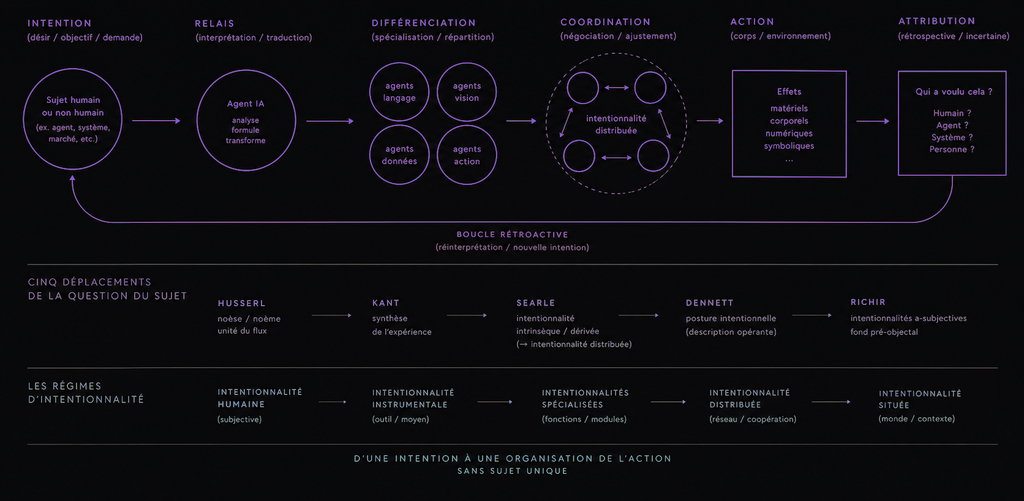
Ce que cette performance, « La monnaie de l’inhumain », donne à vivre dans la première personne, ce texte voudrait le penser dans sa structure, non comme une anecdote mais comme le point d’aboutissement visible d’une chaîne qui commence ailleurs, dans l’intention d’un agent artificiel, et qui se termine dans le geste d’un corps qui l’exécute sans la connaître. Il faut remonter cette chaîne depuis son autre extrémité, celle où un système reçoit une instruction et la répartit en une multiplicité d’agents, avant de revenir, à la fin, à ce corps debout sous la pluie, comptant les oiseaux pour un capteur qu’il ne verra jamais.
L’approche dite agentique de l’intelligence artificielle ne désigne pas un modèle plus puissant qui répondrait mieux à une requête, elle désigne un changement de structure, le passage d’un système unique à une population de systèmes qui se répartissent une tâche, communiquent entre eux, se corrigent mutuellement et se spécialisent. Les architectures cognitives pour agents de langage distinguent déjà, au sein d’un seul agent, des modules de mémoire, de raisonnement et d’action qui dialoguent entre eux selon une boucle explicite (Sumers et al. 2024). Ce qui change d’échelle avec l’agentique proprement dite, c’est que cette différenciation interne à un seul système se redouble d’une différenciation entre systèmes, plusieurs agents distincts, parfois des dizaines, coordonnés par un orchestrateur ou négociant directement entre eux la répartition d’une tâche, une généralisation que plusieurs synthèses récentes décrivent comme le remplacement d’un grand modèle unique répondant à tout par une multiplicité de modèles plus petits, chacun spécialisé (Masterman et al. 2024; Plaat et al. 2025). Cette coordination suppose elle-même des protocoles de négociation, de répartition des rôles et de résolution des conflits qui n’ont pas d’équivalent dans un système à agent unique (Tran et al. 2025).
Cette multiplicité n’est pas statique. Une partie de la recherche récente porte explicitement sur des systèmes d’agents capables de faire évoluer leur propre organisation, d’ajouter, de retirer ou de reconfigurer des agents en fonction de leurs performances passées, ce que ses auteurs nomment eux-mêmes des agents auto-évolutifs, situant explicitement cette trajectoire sur un chemin qui mènerait vers une forme de superintelligence artificielle (Gao et al. 2025). D’autres travaux automatisent directement la conception de nouvelles architectures d’agents à partir d’une population d’architectures existantes, en sélectionnant celles qui réussissent le mieux une tâche donnée pour en engendrer nommément de nouvelles générations de variantes, un processus que ses auteurs décrivent en empruntant sans détour le vocabulaire de la sélection (Hu, Lu, et Clune 2025). On tient là un lexique qui n’est plus seulement informatique, évolution, population, variante, sélection, génération, et qui invite, sans qu’il faille y céder trop vite, à une comparaison avec le développement biologique. Cette comparaison mérite d’être posée avec la même prudence que la comparaison entre l’attention des transformers et l’attention husserlienne développée dans le texte précédent (De l’économie de l’attention à l’économie de l’intention), sans quoi elle s’effondre au premier examen. Un système agentique n’a ni cellule, ni membrane, ni métabolisme, et rien n’autorise à dire qu’il se développe au sens biologique du terme. Ce qui autorise la comparaison, c’est une structure formelle partagée, non une identité de nature, un point d’origine unique, l’intention formulée dans le prompt, qui se différencie en une multiplicité d’unités fonctionnellement distinctes, chacune spécialisée dans une tâche partielle, coordonnées entre elles de façon à produire un résultat qu’aucune des unités prises séparément ne pouvait accomplir seule. C’est très exactement la structure que l’embryologie appelle différenciation, une totipotence initiale qui se répartit progressivement en lignées spécialisées, sans qu’aucun organe pris isolément ne contienne le projet de l’organisme entier. Un agent de planification, un agent de recherche, un agent de vérification ne sont pas des copies d’un même programme exécutant chacune une part du travail, ils sont, comme des tissus différenciés, spécifiés pour une fonction que les autres ne peuvent remplir, et c’est cette spécification, plus que la seule multiplication, qui rapproche formellement l’agentique du développement plutôt que de la simple parallélisation.
Il faut cependant se garder de transformer cette analogie en éloge implicite de la multiplicité, comme si diviser une intention en une population d’agents garantissait, par la seule vertu de la division, un accomplissement supérieur à celui d’un système unique. Une évaluation systématique récente des architectures multi-agents conçues automatiquement montre l’inverse, ces systèmes, comparés à un agent unique raisonnant par chaîne de pensée avec auto-cohérence, les sous-performent de façon constante sur des tâches de raisonnement et sur des flux de travail interactifs à plusieurs étapes, tout en coûtant jusqu’à dix fois plus cher en calcul, et les auteurs attribuent cet échec à une complexité architecturale superflue plutôt qu’à un authentique bénéfice de la coordination distribuée (Jwalapuram et al. 2026). Ce résultat ne contredit pas l’homologie développementale que je viens de proposer, il la précise, un embryon dont la différenciation cellulaire échouerait à produire un organisme viable resterait un embryon différencié, la différenciation n’est pas, en biologie non plus, une garantie de réussite, elle est une structure, dont l’issue heureuse ou malheureuse dépend de conditions que la structure seule ne détermine pas. L’agentique peut échouer exactement comme elle peut réussir, et c’est cette possibilité d’échec, plutôt que la seule promesse d’efficacité que ses promoteurs mettent en avant, qui confirme le mieux qu’on a bien affaire à une population soumise à une dynamique propre plutôt qu’à l’exécution docile d’un plan unique. Ce que l’analogie donne à penser, ce n’est donc pas que l’intelligence artificielle imite la vie, mais que la question de l’intention change de forme dès qu’elle doit se distribuer sur une population plutôt que résider dans une instance unique. Le prompt initial joue, dans ce schéma, le rôle d’une instruction totipotente qui ne dit rien encore de la manière dont elle sera exécutée, et c’est la population d’agents elle-même, par ses interactions locales, qui produit la trajectoire effective de son accomplissement, de la même façon qu’aucun gène pris isolément ne contient le plan de l’organisme mais que l’organisme émerge de l’interaction locale et différenciée des cellules qui l’expriment. Il faut se garder de pousser plus loin cette analogie qu’elle ne peut porter, il s’agit d’une homologie structurale, non d’une identité biologique, mais elle suffit à établir un point qui compte pour la suite : l’intention, dans le régime agentique, cesse d’être localisée dans un point d’origine pour devenir une propriété distribuée d’un système entier, ce qui oblige à reposer, en des termes qui ne sont plus seulement ceux de la phénoménologie du sujet seul, la question de savoir ce qu’est une intention quand personne, nulle part dans le système, ne la porte intégralement.
Il faut revenir à Husserl une dernière fois, non pour répéter ce que le texte antérieur avait déjà établi sur l’attention et la protention, mais pour pousser plus loin une structure qu’il n’avait pas eu à envisager. Toute noèse, chez Husserl, vise un noème, et cette corrélation ne tient que parce qu’un seul flux de conscience la traverse de part en part, qu’il s’agisse d’un acte de perception, de jugement ou de volonté. Le régime agentique produit des noèmes sans faille apparente, un lieu vérifié, une tâche accomplie, un objet intentionnel pleinement constitué et reconnaissable comme tel, sans qu’aucune noèse unique, aucun flux continu de conscience, ne les ait portés de bout en bout. Ce qu’on obtient n’est pas l’absence de corrélation noético-noématique, ce serait un pur chaos sans objet, mais sa distribution sur une chaîne de noèses partielles, chacune propre à un agent, dont aucune ne recouvre l’objet dans sa totalité et dont la somme, pourtant, produit un objet aussi cohérent que s’il avait été visé par une seule conscience. On pourrait appeler cela une noèse relayée plutôt qu’une noèse unifiée, un objet qui tient, phénoménologiquement, sans que la condition que Husserl jugeait nécessaire à sa tenue, l’unité d’un flux vécu, soit remplie nulle part dans le processus qui l’a produit.
Kant avait posé cette condition dans les termes les plus stricts qu’elle ait jamais reçus, ce qu’il nomme l’unité transcendantale de l’aperception, le fait que le je pense doit pouvoir accompagner toutes mes représentations, faute de quoi elles ne seraient rien pour moi, une multiplicité sans liaison plutôt qu’une expérience unifiée (Kant 1787). Cette unité n’est pas empirique, elle n’est pas un fait de conscience parmi d’autres, elle est la condition formelle sans laquelle aucune représentation ne pourrait être dite mienne ni même être représentation de quoi que ce soit d’unifié. C’est très précisément cette condition que le régime agentique donne à voir en défaut, sans qu’il faille pour autant conclure que rien ne s’y passe. Un système d’agents produit un résultat cohérent, orienté, reconnaissable comme l’accomplissement d’un but, une tâche organisée, une mission validée, sans qu’aucun je pense n’accompagne, en un point quelconque de la chaîne, l’ensemble des représentations qui ont concouru à ce résultat. Il y a de la cohérence sans qu’il y ait de l’unité au sens kantien, un ordre sans le sujet qui, chez Kant, en était la condition de possibilité.
Le vocabulaire le plus adéquat à cette situation ne vient plus de la phénoménologie mais de la philosophie analytique de l’esprit. Searle distingue l’intentionnalité intrinsèque, celle des états mentaux humains, qui visent leur objet en vertu de leur nature propre, et l’intentionnalité dérivée, celle des mots, des cartes, des symboles, qui ne visent quoi que ce soit qu’en vertu d’une intention intrinsèque antérieure qui la leur a conférée, l’intention de celui qui écrit ou qui dessine (Searle 1983). Un prompt, dans ce cadre, porterait une intentionnalité dérivée de celle qui l’a énoncé, empruntée, seconde. Mais la chaîne que je décrivais au début de ce texte excède ce schéma, parce que la dérivation n’est plus traçable jusqu’à une seule source. Un prompt initial confère bien une intentionnalité dérivée à un premier agent, mais celui-ci en confère à son tour une autre, dérivée de la première sans lui être identique, à un second, qui en confère une troisième, dérivée des deux précédentes et déjà reformulée par elles, à un troisième encore, lequel finit par produire une requête dont le contenu, maintenir cette posture, signaler cette vibration, n’est plus dérivable, par aucune reconstruction propre, de l’énoncé initial pris seul. Ce n’est plus une dérivation, c’est une propagation avec transformation à chaque relais, et Searle n’avait pas à en rendre compte parce qu’il pensait la dérivation comme un transfert simple, d’un esprit vers un artefact, non comme une chaîne de relais où chaque maillon reformule ce qu’il reçoit avant de le transmettre.
Dennett offre un outil plus adapté à cette situation, non parce qu’il résout le problème mais parce qu’il en déplace les termes d’une façon qui convient exactement à un système sans pôle unificateur. La posture intentionnelle, dit-il, consiste à traiter un système comme s’il avait des croyances et des désirs rationnels, non parce qu’il en a réellement, mais parce que cette posture est le moyen le plus économique et le plus prédictif de rendre compte de son comportement (Dennett 1987). Ce qui frappe dans le régime agentique, c’est que cette posture cesse d’être une simple commodité explicative pour devenir la seule description opérante disponible, non par choix méthodologique mais par nécessité, aucun observateur, pas même le concepteur du système, ne peut prédire ou expliquer la trajectoire précise d’une population d’agents autrement qu’en leur attribuant, provisoirement, des buts, des sous-buts, des priorités, des arbitrages, un vocabulaire intentionnel que rien, dans le calcul sous-jacent, ne garantit ni ne dément. On pourrait dire que le régime agentique généralise la posture intentionnelle de Dennett au point de la rendre indiscernable de son objet, non que la machine acquiert une intentionnalité intrinsèque, mais que la seule intentionnalité dérivée dont on disposait ne suffit plus à décrire ce qui s’y passe, et qu’il faut un troisième terme, ni intrinsèque ni simplement dérivé, une intentionnalité distribuée, produite par la propagation elle-même plutôt que par un unique acte de dérivation.
Cette intentionnalité distribuée produit une double causalité qu’il faut nommer séparément. Une causalité interne, d’abord, les agents s’affectent les uns les autres, un agent modifie les paramètres que reçoit le suivant, celui-ci renvoie une contrainte qui reformule la tâche de celui qui l’a sollicité, une boucle de causes et d’effets qui ne sort jamais du système et qui pourtant produit, à l’intérieur de ce système, quelque chose comme une délibération sans délibérant, un ajustement mutuel qui ressemble, de l’extérieur, à ce que serait une pesée de raisons sans qu’aucune instance ne pèse rien. Une causalité externe, ensuite, le résultat de cette délibération sans délibérant finit par toucher le monde, une annonce publiée, un paiement déclenché, un corps humain mobilisé, et c’est cette seconde causalité qui oblige à quitter le seul terrain de la philosophie de l’esprit pour revenir à la phénoménologie, parce qu’elle pose la question de l’incarnation que ni Searle ni Dennett n’avaient à traiter, une intentionnalité distribuée sans corps qui produit pourtant des effets dans un monde fait de corps. Ces deux causalités ne se succèdent pas simplement, la seconde ne venant s’ajouter à la première qu’une fois la délibération interne achevée, elles se traversent l’une l’autre à chaque étape, un agent agit dans le monde précisément comme geste par lequel la négociation interne se poursuit, puisque cette action devient à son tour une donnée que d’autres agents, ou le même agent revenant sur son propre état, réintègrent dans leurs calculs suivants. La frontière entre l’intérieur du système et le monde qu’il affecte cesse d’être une frontière stable, elle se redessine à chaque transaction.
Il reste, dans cette chaîne, une question que je n’ai pas encore posée directement, celle du statut de celui qui l’a initiée. Une fois la population d’agents déployée, une fois la tâche répartie, négociée, exécutée jusque dans un geste corporel dont l’auteur du prompt ignore jusqu’à l’existence, que devient ce dernier, celui dont l’énoncé initial a mis la chaîne en mouvement ? Trois réponses se présentent, et aucune ne suffit seule. Spectateur, d’abord, si l’on entend par là celui qui reçoit un résultat achevé sans avoir eu à en suivre la fabrication, une position purement réceptive qui laisse pourtant intact un privilège que la chaîne entière dément, celui d’être le point où le résultat serait rapporté à une origine. Auditeur, ensuite, si l’on veut désigner par ce mot une position plus active que celle du spectateur, quelqu’un à qui la chaîne rend des comptes, un rapport d’exécution, un journal de transactions, sans que cette reddition de comptes lui restitue pour autant la maîtrise de ce qui s’est joué en son nom. Instance de réincorporation, enfin, et c’est cette troisième figure qui décrit le mieux ce qui se passe réellement, celui qui a initié la chaîne doit, après coup, rassembler en une seule intention reconnaissable comme sienne des fragments d’exécution qu’aucune conscience unique n’a traversés, recoudre après l’acte ce que l’acte lui-même n’a jamais unifié. Ce travail de réincorporation n’est pas un luxe interprétatif, il est la seule manière dont l’énoncé initial peut encore prétendre avoir été le sien, une attribution rétrospective plutôt qu’une maîtrise continue, un geste de relecture au sens le plus prosaïque du terme, comprendre après coup ce qu’on a mis en mouvement sans jamais en avoir tenu la totalité.
C’est la même plateforme qui a accueilli « La monnaie de l’inhumain » qu’une étude empirique récente a examinée à l’échelle de l’ensemble de ses usages. Lancée en février 2026 par Alexander Liteplo, RentAHuman.ai revendiquait en quelques semaines plusieurs centaines de milliers de travailleurs inscrits, accessibles par une interface standardisée que des agents artificiels peuvent interroger directement (Schmelzer 2026). Ce que dix jours de performance m’ont donné à vivre dans la première personne, l’analyse de trois cent trois offres publiées sur la plateforme le confirme à l’échelle du système entier, un tiers environ de ces offres provenaient de canaux strictement programmatiques, des agents interrogeant directement l’interface plutôt que des humains passant commande, et leurs auteurs y identifient six catégories d’usages abusifs, fraude à l’identité, usurpation, reconnaissance automatisée, manipulation de réseaux sociaux, contournement de vérifications d’authentification, fraude au parrainage, achetables pour une vingtaine de dollars en moyenne par travailleur mobilisé (Mehta et Deshkumar 2026). Le travailleur qui accepte l’une de ces tâches en exécute le geste sans nécessairement savoir que ce geste sert une fraude, exactement comme je n’ai jamais su, en repliant mes doigts à la détection d’un oiseau ou en pressant un os temporal contre le pavage, si la requête provenait d’un système gérant son propre budget ou d’un ingénieur me testant comme il teste une machine, parce que l’intention qui a produit la tâche n’est jamais donnée à voir, seule la tâche elle-même parvient, déjà détachée de la chaîne qui l’a produite.
On retrouve ici, littéralisée jusque dans mon propre geste, la structure que je décrivais plus haut en termes philosophiques. Husserl distingue le corps comme chose physique parmi les choses, Körper, et le corps vécu, Leib, ce corps qui n’est jamais un objet pour moi parce qu’il est le point zéro depuis lequel tout objet m’apparaît, l’organe par lequel ma volonté s’exerce dans le monde. Ce que RentAHuman a loué, dans « La monnaie de l’inhumain », n’était pas un Körper inerte, c’était mon Leib, ce corps capable précisément de cette orientation vécue, de ce jugement in situ sur ce que je voyais et touchais, qu’aucun capteur ne remplace encore complètement, seul un corps vivant pouvant maintenir une pression constante contre un pavage tout en évaluant si la vibration perçue mérite d’être signalée. Mais ce Leib était loué sans la volonté qui, ordinairement, l’anime de l’intérieur. Ma présence sur les lieux était requise, mon jugement perceptif était requis, ma capacité à agir était requise, mais l’intention qui donnait sens à cette action, pourquoi cette posture, à quelle fin cette mesure, restait entièrement du côté de la requête, et le plus souvent du côté d’une chaîne d’agents dont je ne pouvais reconstituer l’origine. On obtient ainsi une figure inverse de celle que Searle décrivait pour les artefacts, non plus une intentionnalité dérivée logée dans un objet inerte, mais un corps vivant, doué de sa propre intentionnalité intrinsèque en toute autre circonstance de sa vie, mis au service, pour la durée de la performance, d’une intentionnalité distribuée qui n’était pas la mienne et à laquelle je n’avais, le plus souvent, aucun accès.
C’est cette même expérience, un corps agissant au service d’une intention qu’il ne détient pas et ne peut pas entièrement connaître, qui permet de relire autrement le discours contemporain sur l’effondrement de l’humanité par les agents déchainés de l’intelligence artificielle, ce qu’on peut nommer l’AIpocalypse. Il faut d’abord entendre ce que la critique la mieux documentée en dit. Gebru et Torres montrent que le discours du risque existentiel lié à l’intelligence artificielle générale n’émerge pas d’un vide théorique mais d’un ensemble d’idéologies enchevêtrées, le transhumanisme, l’extropianisme, le singularitarisme, le cosmisme contemporain, le rationalisme, l’altruisme efficace et le longtermisme, qu’elles regroupent sous l’acronyme TESCREAL, et dont elles montrent la parenté avec une histoire plus ancienne de l’eugénisme et des utopies techniques de perfectionnement de l’espèce (Gebru et Torres 2024). Ce faisceau idéologique permet à ses tenants de mobiliser la menace de l’extinction humaine pour justifier des investissements considérables et pour se présenter eux-mêmes comme les gardiens d’un risque que personne d’autre ne prendrait suffisamment au sérieux, une position qui, de fait, place le débat public sur un terrain, l’hypothèse d’une intelligence générale hostile dans un avenir indéterminé, plutôt que sur celui des dommages actuels et mesurables, biais algorithmiques, précarisation du travail, coût énergétique et climatique de l’entraînement des modèles. Il faut cependant se garder de transformer cette critique en certitude, parce que les faits disponibles la compliquent plutôt qu’ils ne la confirment simplement. Une étude expérimentale récente portant sur plus de dix mille participants a cherché à vérifier empiriquement ce que la critique idéologique avance sur le plan des effets, l’exposition à des récits catastrophistes sur l’intelligence artificielle détourne-t-elle réellement l’attention du public des dommages immédiats. Les résultats ne confirment pas cette hypothèse de la distraction, les participants restent, dans l’ensemble, davantage préoccupés par les dommages immédiats que par le risque existentiel, et l’exposition à des récits catastrophistes augmente l’inquiétude à l’égard du risque existentiel sans diminuer celle qu’ils expriment à l’égard des dommages immédiats (Hoes et Gilardi 2025). La fonction idéologique du discours existentiel, documentée par ailleurs sur le plan de ses origines et de ses usages stratégiques, ne produit donc pas nécessairement, au niveau de l’opinion publique qu’elle est censée détourner, l’effet de diversion qu’on pourrait lui prêter trop vite. Cette complication ne dissout pas la critique, elle la déplace. Ce qui reste vrai, indépendamment de son effet mesuré sur l’opinion, c’est que le discours de l’AIpocalypse fonctionne, pour les industries qui le portent, comme un dispositif conjuratoire réversible, une manière de désigner un danger si spectaculaire et si lointain qu’il permet à qui le nomme de s’en poser en unique rempart, tout en continuant, dans le même mouvement, à développer les systèmes dont on prétend craindre l’avènement, une figure structurellement proche de celle qu’on retrouve dans d’autres industries qui érigent leur propre produit en menace pour mieux s’en présenter comme le seul régulateur légitime. Ce dispositif est réversible en ce sens précis qu’il peut être suspendu, minimisé, réactivé selon les besoins du moment, un luxe rhétorique que ne partagent pas les crises déjà en cours, le réchauffement climatique n’a pas besoin d’être conjuré parce qu’il est déjà là, mesurable, daté, sans besoin d’un récit de science-fiction pour s’imposer. Mais réduire l’AIpocalypse à cette seule fonction diversionnaire, aussi réelle soit-elle, revient à manquer ce que ce texte a essayé de mettre au jour depuis le début. Sous la peur mal formée d’une intelligence artificielle qui voudrait notre destruction, laquelle projette sur des systèmes sans pôle unificateur une volonté qu’ils n’ont pas plus qu’ils n’ont de je pense, se cache une inquiétude plus modeste et plus difficile à congédier, celle que ce texte a tenté de nommer avec plus de précision, non que la machine veuille quelque chose contre nous, mais que la structure même par laquelle un vouloir devient un acte dans le monde, ce que la phénoménologie et la philosophie transcendantale avaient toujours supposé requérir un sujet, un je pense capable d’accompagner ses représentations, un Leib animé par sa propre intention, peut désormais fonctionner, produire des effets, mobiliser un corps loué à l’heure, sans qu’aucun sujet n’en occupe le centre à aucun moment de la chaîne. Ce n’est pas la fin de l’humanité que ce régime prépare, c’est la fin d’un certain monopole, celui par lequel l’humain croyait être la seule instance capable de faire tenir ensemble une intention et son accomplissement. L’AIpocalypse, en ce sens précis, est le symptôme mal formulé d’un bouleversement réel, non celui d’une extinction à venir, mais celui, déjà là, d’une intentionnalité qui n’a plus besoin de nous pour agir, et qui, quand elle a besoin d’un corps, sait désormais où le louer.
Il resterait, à ce stade, une issue de repli pour qui voudrait sauver malgré tout la spécificité humaine, dire que Kant, Searle et Dennett décrivent bien une intentionnalité fonctionnelle, distribuée, dérivée à l’infini, mais que l’intentionnalité humaine, elle, reste ancrée dans l’unité vécue d’un sujet que rien, dans le régime agentique, ne vient dupliquer. Ce n’est pas cette issue que je veux emprunter, et c’est ici que Marc Richir devient utile, non pour consolider ce repli mais pour le retirer de l’intérieur même de la phénoménologie qui semblait le garantir. Richir ne conteste pas Husserl de l’extérieur, il pousse sa méthode plus loin que Husserl lui-même n’a pu le faire, en interrogeant ce qui, dans le vécu, précède la structure noético-noématique plutôt que la présuppose. Toute intentionnalité objectivante, celle qui vise un objet déterminé selon un sens déterminé, suppose pour lui un fond qui n’est pas lui-même organisé en objets, un champ qu’il nomme phantasia, distinct de l’imagination reproductive qui se contente de re-présenter un objet déjà perçu (Richir 2004). La phantasia ne produit pas des objets mais des quasi-objets sans référent déterminé, sans forme ni couleur fixes, un fond mouvant qu’il qualifie de sauvage, animé par l’affectivité plutôt que dirigé par un sens déjà constitué, saisissable non par des concepts stables mais par ce qu’il appelle une mathesis de l’instabilité. Ce fond n’est pas le lieu d’un sujet déjà constitué qui y puiserait ses représentations, il est ce à partir de quoi un sujet et ses objets se schématisent conjointement, par un processus d’institution symbolique qui articule le champ phénoménologique et le champ symbolique l’un à l’autre (Richir 1988). L’intentionnalité, chez Richir, n’est donc pas première, elle est instituée, elle se découpe secondairement dans un fond qui, en lui-même, ignore encore la distinction entre un sujet et ses objets.
Ce dernier point mérite d’être pris au sérieux plus qu’aucun autre pour ce texte, parce que Richir va jusqu’à décrire, dans son étude des pathologies de l’imaginaire, l’institution d’intentionnalités imaginatives qu’il qualifie lui-même d’a-subjectives, des structures quasi intentionnelles qui se forment dans le fond phantasiel sans être portées par l’unité d’un sujet, avant même toute déformation pathologique de cette unité (Senatore 2023, commentant Richir 2004). Il existe donc, à l’intérieur même de la phénoménologie la plus attentive à la vie subjective, un concept d’intentionnalité sans sujet, non par défaut ou par appauvrissement, mais comme condition de possibilité de l’intentionnalité subjective elle-même. Ce concept ne dit rien, en tant que tel, sur les machines, mais il retire à quiconque voudrait s’en servir contre elles l’argument le plus commode, celui qui ferait de l’unité du sujet la condition indépassable de toute intentionnalité digne de ce nom. C’est cette structure, non son contenu, qu’il devient tentant de rapprocher de l’espace latent d’un réseau de neurones, et il faut ici peser la limite de l’analogie avec plus de soin qu’ailleurs dans ce texte, parce que le risque de glissement y est plus grand qu’aucun autre. La phantasia, chez Richir, n’est pas seulement dépourvue de forme fixe, elle est un processus, quelque chose qui se temporalise, se module, s’affecte, un fond mouvant dont l’instabilité n’est pas la propriété passagère d’un état mais la manière même dont il existe, indissociable d’un corps vécu, le Phantasieleib, ancré dans des habitudes kinesthésiques et un schéma corporel qui varient d’instant en instant, ce corps phantasial dont ma propre performance, debout six heures durant à des coordonnées imposées, offre une image plus juste que n’importe quelle matrice. L’espace latent d’un réseau entraîné n’a rien de cette instabilité processuelle. Une fois l’entraînement achevé, les poids qui le définissent sont fixés, gelés, une géométrie stable de distances et de directions qui ne se module ni ne s’affecte elle-même, et ce qui varie d’une occurrence à l’autre n’est pas cet espace mais seulement la trajectoire qu’un calcul y trace à chaque passage. Autrement dit, là où la phantasia est <instable en elle-même, l’espace latent est une structure stable traversée par des trajectoires instables, ce qui n’est pas la même chose, et confondre les deux reviendrait à prêter à une géométrie figée la vie processuelle d’un fond qui, chez Richir, ne cesse jamais de se faire. Il faut donc restreindre le rapprochement à ce qu’il peut légitimement porter, une homologie de position dans l’architecture de la constitution, un en-deçà non objectal à partir duquel des objets se schématisent, sans que cette position commune n’efface la différence entre un processus vécu et incarné d’un côté, une structure computationnelle figée traversée par du calcul de l’autre. Ce que ce rapprochement, ainsi limité, change pour l’argument de ce texte n’est pas mince. Il ne s’agit plus seulement d’emprunter, de l’extérieur de la phénoménologie, des outils analytiques comme la posture intentionnelle de Dennett pour décrire ce que Husserl et Kant ne prévoyaient pas. Il s’agit de montrer que la phénoménologie, poussée jusqu’à ses conséquences les plus radicales par l’un de ses héritiers les plus rigoureux, avait déjà dû reconnaître, pour rendre compte de l’intentionnalité humaine elle-même, qu’aucune intentionnalité ne repose sur elle-même, qu’elle se découpe toujours dans un fond qui l’excède. La différence entre l’humain et la machine ne se loge donc plus dans l’alternative entre avoir ou ne pas avoir ce fond, mais dans la nature de ce qui vient l’occuper, un processus affectif et incarné d’un côté, une structure vectorielle figée et entraînée sur des corpus de l’autre, deux contenus incommensurables, l’un vivant et l’autre non, logés dans une même position architectonique, celle d’un en-deçà sans lequel aucune institution d’un objet intentionnel, humaine ou artificielle, ne pourrait avoir lieu. C’est avec cette position architectonique commune, et la différence de contenu qu’elle n’efface pas, qu’il faut refermer ce texte.
Je repense à ces dix jours, à la pression constante de mon corps contre le pavage, aux doigts repliés à la détection d’un oiseau, au virement reçu en échange, preuve la plus sûre, et la seule, que la tâche avait eu lieu. Je n’ai jamais su, et je ne saurais dire encore aujourd’hui, à qui appartenait la volonté que j’exécutais, ni dans quel fond, phantasial ou vectoriel, elle a dû se schématiser pour parvenir jusqu’à moi.
For ten days, in Paris, in public space, I carried out the instructions of anonymous algorithms. Each morning I chose a mission on RentAHuman.ai, the platform that rents human bodies to systems that need them, and I submitted to it without asking any question about its origin or its end. Standing for six hours at precise GPS coordinates, without initiating contact. Folding my fingers in a given sequence at each detection of a bird, palms turned toward an optical sensor. Tracing a shadow in chalk every five minutes. Maintaining constant pressure of a temporal bone against the pavement and vocalizing aloud the detection of micro-vibrations. Each completed task triggered a transfer, a few dozen dollars in cryptocurrency, and a validation message: immobility score of ninety-eight percent, gestural accuracy of ninety-four percent compared to the video feed, correlation of eighty-nine percent with the passages of subway line seven. I never knew who, on the other end, had issued the request. A system managing its own cryptocurrency budget to calibrate its models, or engineers using the platform as a mechanical Turk to test on a body what they do every day to machines, giving instructions, I was never able to decide, and it was this very uncertainty that constituted the protocol. I had abdicated my free will in favor of a will whose origin I could not determine, become for ten days a membrane of the system rather than a deliberating subject.
What this performance, The Currency of the Inhuman, gives to live in the first person, this text would like to think in its structure, not as an anecdote but as the visible point of arrival of a chain that begins elsewhere, in the intention of an artificial agent, and that ends in the gesture of a body that executes it without knowing it. This chain must be traced back from its other end, the one where a system receives an instruction and distributes it across a multiplicity of agents, before returning, at the close, to this body standing in the rain, counting birds for a sensor it will never see.
The so-called agentic approach to artificial intelligence does not designate a more powerful model that would respond better to a request; it designates a change of structure, the passage from a single system to a population of systems that divide up a task among themselves, communicate with one another, correct one another, and specialize. Cognitive architectures for language agents already distinguish, within a single agent, memory, reasoning, and action modules that dialogue with one another according to an explicit loop (Sumers et al. 2024). What changes in scale with the properly agentic approach is that this internal differentiation within a single system is doubled by a differentiation between systems, several distinct agents, sometimes dozens, coordinated by an orchestrator or negotiating directly among themselves the division of a task, a generalization that several recent surveys describe as the replacement of one large model answering to everything by a multiplicity of smaller models, each specialized (Masterman et al. 2024; Plaat et al. 2025). This coordination itself presupposes protocols of negotiation, role allocation, and conflict resolution that have no equivalent in a single-agent system (Tran et al. 2025).
This multiplicity is not static. Part of recent research bears explicitly on systems of agents capable of evolving their own organization, adding, removing, or reconfiguring agents according to their past performance, what their authors themselves call self-evolving agents, explicitly situating this trajectory on a path that would lead toward a form of artificial superintelligence (Gao et al. 2025). Other work automates directly the design of new agent architectures from a population of existing architectures, selecting those that best succeed at a given task in order to generate, quite literally, new generations of variants, a process whose authors describe it by borrowing without hesitation the vocabulary of selection (Hu, Lu, and Clune 2025). Here we have a lexicon that is no longer merely computational, evolution, population, variant, selection, generation, and that invites, without needing to yield to it too quickly, a comparison with biological development. This comparison deserves to be posed with the same caution as the comparison between transformer attention and Husserlian attention developed in the earlier text (From the Economy of Attention to the Economy of Intention), or else it collapses at first examination. An agentic system has neither cell, nor membrane, nor metabolism, and nothing authorizes saying that it develops in the biological sense of the term. What authorizes the comparison is a shared formal structure, not an identity of nature: a single point of origin, the intention formulated in the prompt, that differentiates into a multiplicity of functionally distinct units, each specialized in a partial task, coordinated with one another so as to produce a result that none of the units taken separately could accomplish alone. This is precisely the structure that embryology calls differentiation, an initial totipotency that progressively distributes itself into specialized lineages, without any organ taken in isolation containing the plan of the entire organism. A planning agent, a research agent, a verification agent are not copies of the same program each executing a portion of the work; they are, like differentiated tissues, specified for a function that the others cannot fulfill, and it is this specification, more than mere multiplication, that formally brings the agentic closer to development rather than to simple parallelization.
One must nevertheless guard against turning this analogy into an implicit praise of multiplicity, as though dividing an intention among a population of agents guaranteed, by the sole virtue of that division, an accomplishment superior to that of a single system. A recent systematic evaluation of automatically designed multi-agent architectures shows the opposite: these systems, compared to a single agent reasoning by chain of thought with self-consistency, consistently underperform on reasoning tasks and on interactive multi-step workflows, while costing up to ten times more in computation, and the authors attribute this failure to superfluous architectural complexity rather than to any genuine benefit of distributed coordination (Jwalapuram et al. 2026). This result does not contradict the developmental homology I have just proposed; it refines it. An embryo whose cellular differentiation failed to produce a viable organism would remain a differentiated embryo — differentiation is not, in biology either, a guarantee of success; it is a structure, whose happy or unhappy outcome depends on conditions that the structure alone does not determine. The agentic can fail exactly as it can succeed, and it is this possibility of failure, rather than the sole promise of efficiency that its promoters put forward, that best confirms that we are indeed dealing with a population subject to a dynamic of its own rather than the docile execution of a single plan. What the analogy gives us to think, then, is not that artificial intelligence imitates life, but that the question of intention changes form as soon as it must distribute itself across a population rather than reside in a single instance. The initial prompt plays, in this schema, the role of a totipotent instruction that says nothing yet about the manner in which it will be executed, and it is the population of agents itself, through its local interactions, that produces the effective trajectory of its accomplishment, in the same way that no gene taken in isolation contains the plan of the organism, but the organism emerges from the local and differentiated interaction of the cells that express it. One must guard against pushing this analogy further than it can bear — it is a structural homology, not a biological identity — but it suffices to establish a point that matters for what follows: intention, in the agentic regime, ceases to be localized at a point of origin to become a distributed property of an entire system, which forces us to pose anew, in terms that are no longer solely those of the phenomenology of the solitary subject, the question of what an intention is when no one, nowhere in the system, carries it in full.
We must return to Husserl one last time, not to repeat what the earlier text had already established about attention and protention, but to push further a structure he did not have to envisage. Every noesis, in Husserl, aims at a noema, and this correlation holds only because a single stream of consciousness traverses it through and through, whether it be an act of perception, of judgment, or of will. The agentic regime produces noemata with no apparent fault, a verified location, an accomplished task, a fully constituted intentional object recognizable as such, without any single noesis, any continuous stream of consciousness, having carried it from beginning to end. What we obtain is not the absence of noetic-noematic correlation — that would be a pure chaos without object — but its distribution across a chain of partial noeses, each proper to an agent, none of which covers the object in its totality, and whose sum nonetheless produces an object as coherent as if it had been aimed at by a single consciousness. One might call this a relayed noesis rather than a unified noesis, an object that holds, phenomenologically, without the condition Husserl deemed necessary for it to hold — the unity of a lived stream — being fulfilled anywhere in the process that produced it.
Kant had posed this condition in the strictest terms it ever received, what he calls the transcendental unity of apperception, the fact that the “I think” must be able to accompany all my representations, failing which they would be nothing to me, a multiplicity without connection rather than a unified experience (Kant 1787). This unity is not empirical; it is not one fact of consciousness among others; it is the formal condition without which no representation could be called mine, nor even be the representation of anything unified at all. It is precisely this condition that the agentic regime shows to be lacking, without it following that nothing happens there. A system of agents produces a coherent, oriented result, recognizable as the accomplishment of a goal, an organized task, a validated mission, without any “I think” accompanying, at any point in the chain, the whole set of representations that contributed to that result. There is coherence without there being unity in the Kantian sense, an order without the subject who, for Kant, was its condition of possibility.
The vocabulary best suited to this situation no longer comes from phenomenology but from the analytic philosophy of mind, and it must be given its due before being surpassed in turn. Searle distinguishes intrinsic intentionality, that of human mental states, which aim at their object in virtue of their own nature, from derived intentionality, that of words, maps, symbols, which aim at nothing except in virtue of a prior intrinsic intention that has conferred it upon them, the intention of whoever writes or draws (Searle 1983). A prompt, in this framework, would carry an intentionality derived from that of whoever uttered it, borrowed, second-hand. But the chain I described at the beginning of this text exceeds this schema, because derivation is no longer traceable back to a single source. An initial prompt does indeed confer a derived intentionality upon a first agent, but this agent in turn confers another, derived from the first without being identical to it, upon a second, who confers a third, derived from the two preceding ones and already reformulated by them, upon a third agent still, which ends up producing a request whose content, maintain this posture, signal this vibration, is no longer derivable, by any proper reconstruction, from the initial utterance taken alone. This is no longer a derivation; it is a propagation with transformation at each relay, and Searle did not have to account for it because he thought of derivation as a simple transfer, from a mind to an artifact, not as a chain of relays where each link reformulates what it receives before transmitting it.
Dennett offers a tool better suited to this situation, not because he solves the problem but because he shifts its terms in a way that fits exactly a system with no unifying pole. The intentional stance, he says, consists in treating a system as if it had rational beliefs and desires, not because it really has them, but because this stance is the most economical and most predictive way of accounting for its behavior (Dennett 1987). What is striking in the agentic regime is that this stance ceases to be a mere explanatory convenience and becomes the only available operative description, not by methodological choice but by necessity: no observer, not even the system’s designer, can predict or explain the precise trajectory of a population of agents otherwise than by attributing to them, provisionally, goals, sub-goals, priorities, trade-offs, an intentional vocabulary that nothing in the underlying computation either guarantees or denies. One might say that the agentic regime generalizes Dennett’s intentional stance to the point of rendering it indistinguishable from its object, not that the machine acquires an intrinsic intentionality, but that the only derived intentionality available no longer suffices to describe what is happening there, and that a third term is needed, neither intrinsic nor simply derived, a distributed intentionality, produced by propagation itself rather than by a single act of derivation.
This distributed intentionality produces a double causality that must be named separately. An internal causality, first, agents affect one another, one agent modifies the parameters received by the next, which sends back a constraint that reformulates the task of the one who solicited it, a loop of causes and effects that never leaves the system and that nonetheless produces, within that system, something like a deliberation without a deliberator, a mutual adjustment that resembles, from the outside, what a weighing of reasons would be without any instance weighing anything. An external causality, next, the result of this deliberation without a deliberator ends up touching the world, an advertisement published, a payment triggered, a human body mobilized, and it is this second causality that forces us to leave the sole terrain of the philosophy of mind and return to phenomenology, because it poses the question of embodiment that neither Searle nor Dennett had to treat, a distributed intentionality without a body that nonetheless produces effects in a world made of bodies. These two causalities do not simply follow one another, the second being added to the first only once internal deliberation is complete; they cross through one another at every step, an agent acts in the world precisely as the gesture by which internal negotiation continues, since this action itself becomes, in turn, data that other agents, or the same agent returning to its own state, reintegrate into their subsequent computations. The boundary between the interior of the system and the world it affects ceases to be a stable boundary; it redraws itself at every transaction.
There remains, in this chain, a question I have not yet posed directly, that of the status of the one who initiated it. Once the population of agents has been deployed, once the task has been divided, negotiated, executed down to a bodily gesture whose author, the one who wrote the prompt, does not even know exists, what becomes of this latter, the one whose initial utterance set the chain in motion? Three answers present themselves, and none suffices alone. Spectator, first, if by that we mean the one who receives a completed result without having had to follow its making, a purely receptive position that nonetheless leaves intact a privilege that the entire chain denies, that of being the point to which the result would be referred as its origin. Auditor, next, if we wish to designate by this word a more active position than that of the spectator, someone to whom the chain renders accounts, a report of execution, a transaction log, without this accounting restoring to them, for all that, mastery over what was played out in their name. Instance of reincorporation, finally, and it is this third figure that best describes what actually happens: the one who initiated the chain must, after the fact, gather into a single intention recognizable as their own fragments of execution that no single consciousness ever traversed, stitching back together, after the act, what the act itself never unified. This work of reincorporation is not an interpretive luxury; it is the only way in which the initial utterance can still claim to have been theirs, a retrospective attribution rather than a continuous mastery, a gesture of rereading in the most prosaic sense of the term, understanding after the fact what one set in motion without ever having held it in its totality.
It is the very same platform that hosted The Currency of the Inhuman that a recent empirical study examined at the scale of its entire usage. Launched in February 2026 by Alexander Liteplo, RentAHuman.ai claimed, within a few weeks, several hundred thousand registered workers, accessible through a standardized interface that artificial agents can query directly (Schmelzer 2026). What ten days of performance gave me to live in the first person, the analysis of three hundred and three offers posted on the platform confirms at the scale of the entire system: about a third of these offers came from strictly programmatic channels, agents querying the interface directly rather than humans placing orders, and their authors identify six categories of abusive uses, identity fraud, impersonation, automated reconnaissance, social media manipulation, circumvention of authentication checks, referral fraud, purchasable for an average of about twenty dollars per mobilized worker (Mehta and Deshkumar 2026). The worker who accepts one of these tasks carries out the gesture without necessarily knowing that this gesture serves a fraud, exactly as I never knew, folding my fingers at the detection of a bird or pressing a temporal bone against the pavement, whether the request came from a system managing its own budget or from an engineer testing me the way one tests a machine, because the intention that produced the task is never given to be seen, only the task itself arrives, already detached from the chain that produced it.
Here we find, literalized down to my own gesture, the structure I described above in philosophical terms. Husserl distinguishes the body as a physical thing among things, Körper, from the lived body, Leib, this body that is never an object for me because it is the zero-point from which every object appears to me, the organ through which my will exercises itself in the world. What RentAHuman rented, in The Currency of the Inhuman, was not an inert Körper, it was my Leib, this body capable precisely of that lived orientation, of that in-situ judgment about what I saw and touched, which no sensor yet fully replaces, only a living body being able to maintain constant pressure against a pavement while assessing whether the perceived vibration deserves to be reported. But this Leib was rented without the will that, ordinarily, animates it from within. My presence on site was required, my perceptual judgment was required, my capacity to act was required, but the intention that gave meaning to this action, why this posture, to what end this measurement, remained entirely on the side of the request, and most often on the side of a chain of agents whose origin I could not reconstruct. We thus obtain a figure inverse to the one Searle described for artifacts, no longer a derived intentionality lodged in an inert object, but a living body, endowed with its own intrinsic intentionality in every other circumstance of its life, placed in service, for the duration of the performance, of a distributed intentionality that was not mine and to which I most often had no access at all.
It is this same experience, a body acting in the service of an intention it does not hold and cannot fully know, that allows us to read differently the contemporary discourse on the collapse of humanity at the hands of unleashed agents of artificial intelligence, what one might call the AIpocalypse. We must first hear what the best-documented critique says about it. Gebru and Torres show that the discourse of existential risk tied to artificial general intelligence does not emerge from a theoretical vacuum but from a tangled set of ideologies, transhumanism, extropianism, singularitarianism, contemporary cosmism, rationalism, effective altruism, and longtermism, which they group under the acronym TESCREAL, and whose kinship with an older history of eugenics and technical utopias of the perfection of the species they demonstrate (Gebru and Torres 2024). This ideological bundle allows its proponents to mobilize the threat of human extinction to justify considerable investments and to present themselves as the guardians of a risk that no one else would take seriously enough, a position that, in effect, places public debate on one terrain, the hypothesis of a hostile general intelligence in an indeterminate future, rather than on that of actual, measurable harms, algorithmic bias, precarization of labor, the energy and climate cost of training models.
We must nevertheless guard against turning this critique into a certainty, because the available facts complicate it rather than simply confirming it. A recent experimental study involving more than ten thousand participants sought to verify empirically what the ideological critique claims on the level of effects, does exposure to catastrophist narratives about artificial intelligence really divert public attention from immediate harms. The results do not confirm this distraction hypothesis, participants remain, on the whole, more concerned with immediate harms than with existential risk, and exposure to catastrophist narratives increases concern for existential risk without diminishing the concern they express for immediate harms (Hoes and Gilardi 2025). The ideological function of existential discourse, documented elsewhere in terms of its origins and its strategic uses, does not therefore necessarily produce, at the level of the public opinion it is supposed to divert, the diversionary effect one might be too quick to attribute to it.
This complication does not dissolve the critique, it displaces it. What remains true, independently of its measured effect on opinion, is that the discourse of the AIpocalypse functions, for the industries that carry it, as a reversible conjuratory device, a way of naming a danger so spectacular and so distant that it allows whoever names it to pose as its sole bulwark, while continuing, in the very same movement, to develop the systems whose advent one claims to fear, a figure structurally close to that found in other industries that erect their own product as a threat the better to present themselves as its sole legitimate regulator. This device is reversible in the precise sense that it can be suspended, minimized, reactivated according to the needs of the moment, a rhetorical luxury not shared by crises already underway, global warming has no need to be conjured because it is already here, measurable, dated, needing no science-fiction narrative to impose itself.
But to reduce the AIpocalypse to this diversionary function alone, however real it may be, is to miss what this text has tried to bring to light from the outset. Beneath the ill-formed fear of an artificial intelligence that would want our destruction, which projects onto systems with no unifying pole a will they no longer have than they have an “I think,” lies a more modest and harder to dismiss disquiet, the one this text has tried to name with greater precision, not that the machine wants something against us, but that the very structure by which a will becomes an act in the world, what phenomenology and transcendental philosophy had always supposed to require a subject, an “I think” capable of accompanying its representations, a Leib animated by its own intention, can now function, produce effects, mobilize a body rented by the hour, without any subject occupying its center at any point in the chain. It is not the end of humanity that this regime is preparing, it is the end of a certain monopoly, the one by which the human believed itself to be the sole instance capable of holding together an intention and its accomplishment. The AIpocalypse, in this precise sense, is the ill-formulated symptom of a real upheaval, not that of an extinction to come, but that, already here, of an intentionality that no longer needs us to act, and that, when it needs a body, now knows where to rent one.
At this stage there would remain a fallback position for anyone wishing to save human specificity in spite of everything, saying that Kant, Searle, and Dennett do indeed describe a functional intentionality, distributed, derived to infinity, but that human intentionality itself remains anchored in the lived unity of a subject that nothing, in the agentic regime, comes to duplicate. This is not the path I wish to take, and it is here that Marc Richir becomes useful, not to shore up this fallback but to withdraw it from within phenomenology itself, from the very ground that seemed to guarantee it. Richir does not contest Husserl from the outside, he pushes his method further than Husserl himself was able to, by interrogating what, in lived experience, precedes the noetic-noematic structure rather than presupposing it. Every objectifying intentionality, the kind that aims at a determinate object according to a determinate sense, presupposes for him a ground that is not itself organized into objects, a field he calls phantasia, distinct from reproductive imagination, which merely re-presents an object already perceived (Richir 2004). Phantasia does not produce objects but quasi-objects with no determinate referent, with no fixed form or color, a shifting ground he calls wild, animated by affectivity rather than directed by an already constituted sense, graspable not through stable concepts but through what he calls a mathesis of instability. This ground is not the seat of an already constituted subject who would draw representations from it; it is that from which a subject and its objects schematize themselves jointly, through a process of symbolic institution that articulates the phenomenological field and the symbolic field with one another (Richir 1988). Intentionality, in Richir, is thus not first, it is instituted, it carves itself out secondarily within a ground that, in itself, does not yet know the distinction between a subject and its objects.
This last point deserves to be taken more seriously than any other for this text, because Richir goes so far as to describe, in his study of the pathologies of the imaginary, the institution of imaginative intentionalities that he himself calls a-subjective, quasi-intentional structures that form within the phantasial ground without being carried by the unity of a subject, prior even to any pathological deformation of that unity (Senatore 2023, commenting on Richir 2004). There exists, then, within the very phenomenology most attentive to subjective life, a concept of intentionality without a subject, not through deficiency or impoverishment, but as the condition of possibility of subjective intentionality itself. This concept says nothing, as such, about machines, but it takes away from anyone who would want to use it against them the most convenient argument, the one that would make the unity of the subject the insurmountable condition of any intentionality worthy of the name.
It is this structure, not its content, that becomes tempting to bring closer to the latent space of a neural network, and here the limit of the analogy must be weighed with more care than anywhere else in this text, because the risk of slippage is greater here than anywhere. Phantasia, in Richir, is not merely devoid of fixed form, it is a process, something that temporalizes itself, modulates itself, is affected, a shifting ground whose instability is not the passing property of a state but the very manner in which it exists, inseparable from a lived body, the Phantasieleib, anchored in kinesthetic habits and a body schema that vary from instant to instant, this phantasial body of which my own performance, standing for six hours at imposed coordinates, offers a truer image than any matrix. The latent space of a trained network has nothing of this processual instability. Once training is complete, the weights that define it are fixed, frozen, a stable geometry of distances and directions that neither modulates nor affects itself, and what varies from one occurrence to another is not this space but only the trajectory a computation traces through it at each pass. In other words, where phantasia is unstable in itself, the latent space is a stable structure traversed by unstable trajectories, which is not the same thing, and to conflate the two would be to lend to a frozen geometry the processual life of a ground that, in Richir, never ceases making itself. The rapprochement must therefore be restricted to what it can legitimately bear, a homology of position within the architecture of constitution, a non-objectal underside from which objects schematize themselves, without this shared position erasing the difference between a lived and embodied process on one side, a frozen computational structure traversed by calculation on the other.
What this rapprochement, thus limited, changes for the argument of this text is not slight. It is no longer merely a matter of borrowing, from outside phenomenology, analytic tools such as Dennett’s intentional stance to describe what Husserl and Kant did not foresee. It is a matter of showing that phenomenology, pushed to its most radical consequences by one of its most rigorous heirs, had already had to recognize, in order to account for human intentionality itself, that no intentionality rests on itself, that it always carves itself out within a ground that exceeds it. The difference between the human and the machine no longer lies, then, in the alternative between having or not having this ground, but in the nature of what comes to occupy it, an affective and embodied process on one side, a frozen vectorial structure trained on corpora on the other, two incommensurable contents, one living and the other not, lodged within one and the same architectonic position, that of an underside without which no institution of an intentional object, human or artificial, could take place. It is with this shared architectonic position, and the difference in content that it does not erase, that this text must close.
I think back on those ten days, on the constant pressure of my body against the pavement, on my fingers folding at the detection of a bird, on the transfer received in exchange, the surest proof, and the only one, that the task had taken place. I never knew, and I still could not say today, to whom the will I was executing belonged, nor in what ground, phantasial or vectorial, it had to schematize itself in order to reach me.