
The White Cube in Black Box Ideology
Installation générative, ordinateur, écrans, aluminium, LED
Version française et anglaise
Dimensions variables
Stable Diffusion XL, AnimDiff, Mistral 7B, XTTS, dataset : laion-5B
Collection : Frac Île-de-France
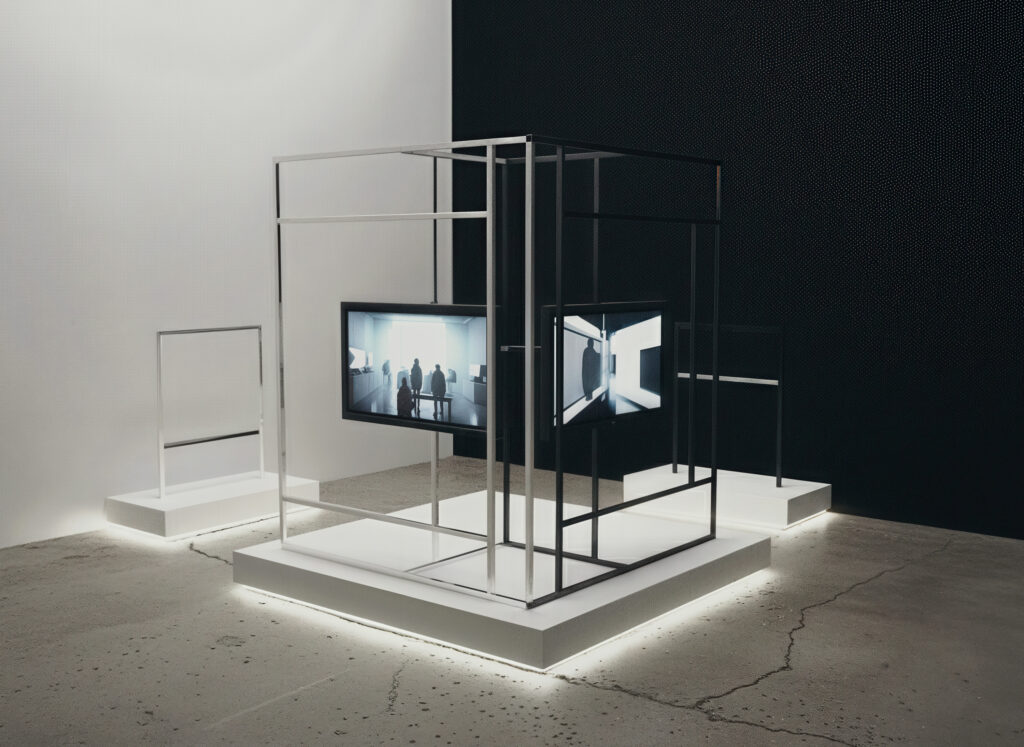
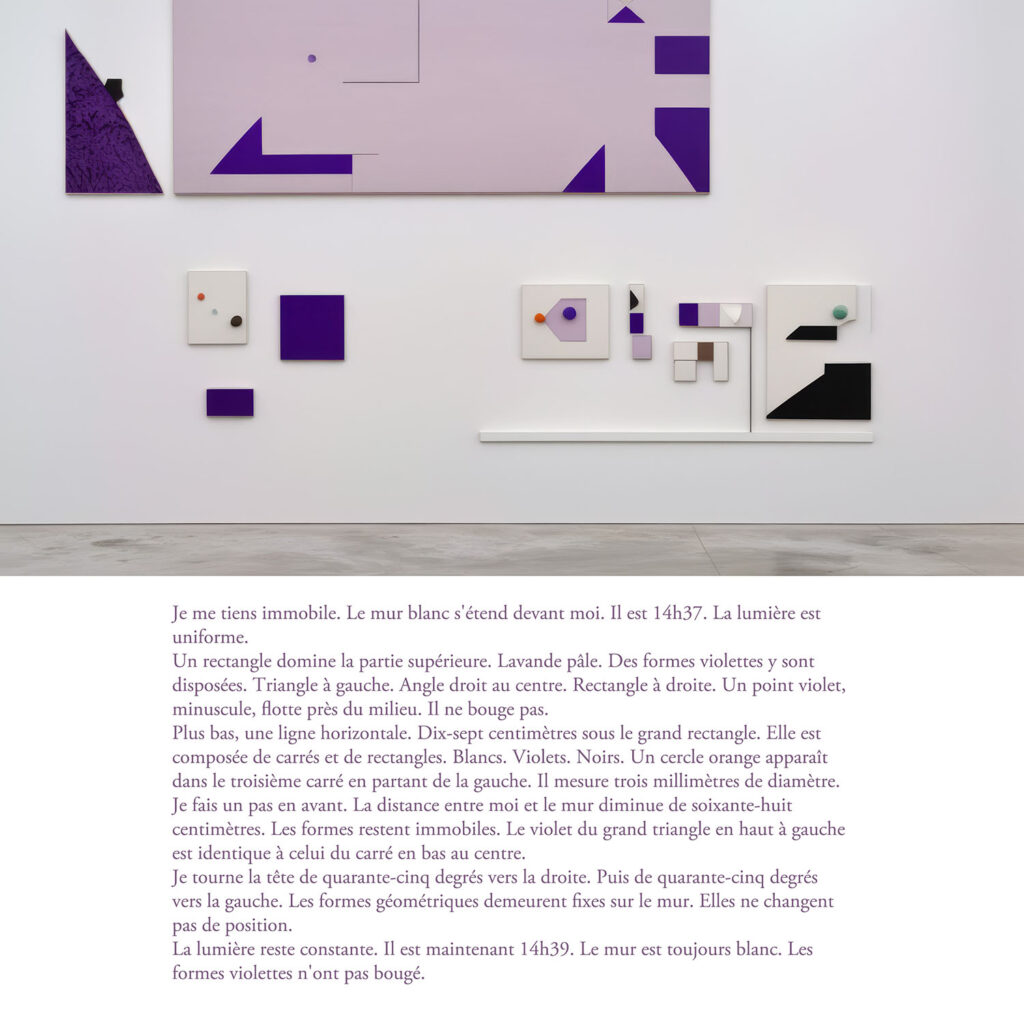
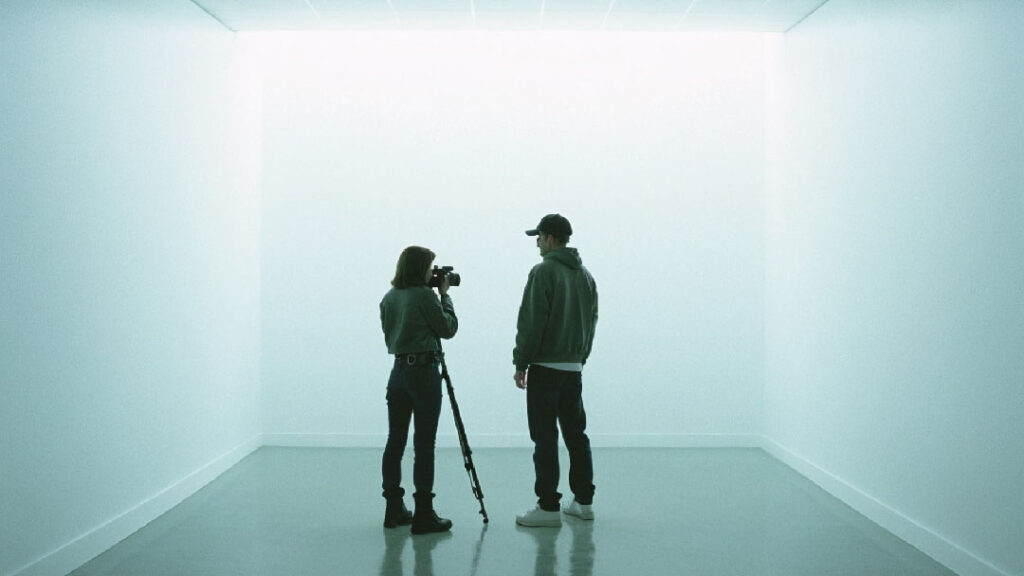
Cette installation met en dialogue deux paradigmes : le “cube blanc” du lieu d’exposition et la “boîte noire” de l’intelligence artificielle. Au cœur du dispositif, un système génératif produit en continu des images d’espaces d’exposition et d’oeuvres. Il les accompagne de descriptions imitant le discours d’un esthète. Nourrie par des milliards de documents issus du réseau, la machine génère une mémoire alternative de l’art moderne et contemporain. Elle simule à la fois un public en contemplation devant des œuvres invisibles et des œuvres contrefactuelles reprenant les lieux communs du champ artistique, dans des espaces blancs et immaculés caractéristiques des institutions muséales. Ce travail explore la capacité des systèmes d’IA à produire non pas une répétition fidèle du passé, mais une version alternative de notre mémoire collective. Entre simulation et génération, l’œuvre questionne notre relation aux institutions artistiques et aux discours qui les entourent, tout en suggérant que la machine, dans sa “boîte noire”, réinvente notre histoire culturelle comme s’il fallait la reprendre depuis son origine.
This installation brings two paradigms into dialogue: the “white cube” of the exhibition space and the “black box” of artificial intelligence. At the heart of the installation, a generative system continuously produces images of exhibition spaces and works of art. It accompanies them with descriptions that mimic the discourse of an aesthete. Fed by billions of documents from the internet, the machine generates an alternative memory of modern and contemporary art. It simulates both an audience contemplating invisible works and counterfactual works that echo the clichés of the art world, in the immaculate white spaces characteristic of museum institutions. This work explores the ability of AI systems to produce not a faithful repetition of the past, but an alternative version of our collective memory. Between simulation and generation, the work questions our relationship to artistic institutions and the discourse surrounding them, while suggesting that the machine, in its “black box,” reinvents our cultural history as if it had to be rewritten from its origins.