
De l’économie de l’attention à l’automatisation de l’intention III/From the Economy of Attention to the Automatization of Intention III
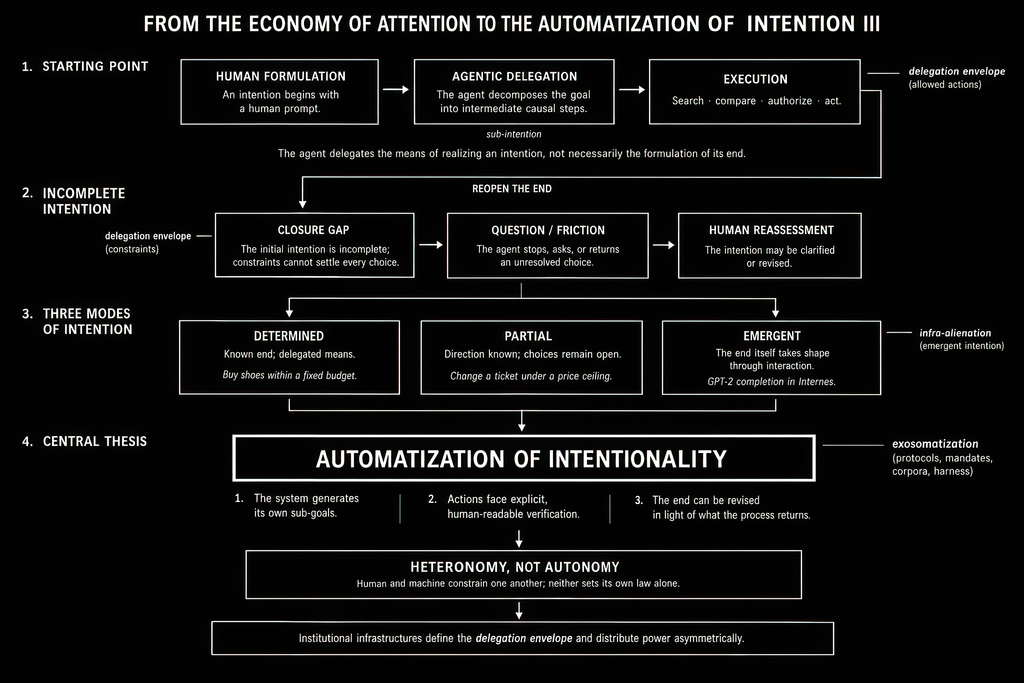
Je reviens à la scène des chaussures de course, celle du premier texte, et je regarde ce que j’y avais laissé dans l’ombre. J’écris à un agent que je dois changer mes chaussures, pointure et budget donnés. Le colis arrive. Entre la phrase et le colis, il s’est passé des choses que je n’ai pas vues et que je n’ai formulées nulle part : un marchand a été préféré à un autre, un créneau de livraison a été arbitré contre un prix, une politique de retour a été lue, un paiement a été autorisé en mon nom par ce que les protocoles de paiement pour agents appellent un mandat, une intention signée cryptographiquement qui permet à la machine de dépenser à ma place sous un plafond fixé (Tomašev, Franklin et Osindero 2026). Rien de cela n’est mon vouloir. Tout cela réalise pourtant mon vouloir, et ce qui me frappe aujourd’hui, c’est l’endroit exact où la machine entre dans la scène. Elle n’a pas décidé que j’avais besoin de chaussures, mais elle décide d’une causalité.
Les deux premiers textes ont regardé cette scène de deux côtés. Le premier du côté du sujet, que la délégation dispense peu à peu de savoir ce qu’il veut. Le second du côté du corps loué, au bout d’une chaîne où personne ne détient l’intention en entier. J’ai conclu celui-ci sur une phrase que je relis avec méfiance, celle d’une intentionnalité qui n’aurait plus besoin de nous pour agir et qui saurait où louer un corps quand il lui en faut un. C’est la phrase de quelqu’un qui a regardé la chaîne par son extrémité, depuis le pavage et l’oiseau compté pour un capteur. De l’autre extrémité on voit autre chose : la chaîne a un premier terme, ce terme est une formulation, et sans lui aucun agent ne bouge. Je garde la fin d’un monopole, celui de tenir ensemble une intention et son accomplissement. Je retire l’inférence qui en faisait la fin d’un besoin. La thèse que je veux tenir ici est plus étroite et gênera, je crois, ceux qui célèbrent l’autonomie des agents autant que ceux qui la redoutent : l’approche agentique porte bien sur l’intentionnalité, mais elle délègue la manière de réaliser une intention déjà formulée, c’est-à-dire sa subdivision en causalités, et pas la formulation elle-même. Cette délégation ne fait pas de l’humain un pilote. Elle le rend dépendant de ce qu’il délègue, autant que ce qu’il délègue dépend de lui.
Les ingénieurs ont déjà écrit cette thèse comme une règle, manière brutale d’établir qu’elle n’est pas un caprice de philosophe. Dans un cadre d’architecture pour des communautés mêlant humains et agents, une prohibition porte sur tous les agents d’IA à la fois : aucun ne peut prendre la décision finale d’inscrire un patient à un essai clinique, cette charge revenant à un médecin, qui peut la transmettre à un autre médecin mais pas à une machine (Milosevic et Rabhi 2026). Les agents recommandent et expliquent, la clôture appartient à un rôle humain. Des chercheurs de DeepMind proposent pour leur part des coupe-feu de responsabilité : à certains points d’une chaîne de délégation, l’agent doit soit assumer seul tout ce qui suit, soit s’arrêter et demander au principal humain un nouveau transfert d’autorité (Tomašev et al. 2026). Une autre équipe trace ce qu’elle nomme une enveloppe de délégation, une région de l’espace des actions que quelqu’un a préautorisée : dedans l’agent agit seul, à la frontière il demande, au-delà il escalade ou s’abstient (Armesto et Kolb 2026). Dans ces textes le mot autonomie désigne la surface d’une enveloppe dessinée par un autre. Une autonomie octroyée, révocable, qu’un resserrement des conditions suffit à réduire : l’oxymore serait flagrant si les auteurs n’en faisaient pas un usage courant.
L’intention formulée au départ arrive pourtant incomplète, et c’est de là que partent les auteurs de l’enveloppe. Ils parlent de compilation de l’intention : un but humain partiellement spécifié est traduit en quatre contrats, qui disent ce qui est demandé, sur quelles preuves on peut s’appuyer, par quelle méthode et sous quelle autorité, et le reste, ce qui demeure indéterminé, ils le nomment un écart de clôture. Soit un billet à changer parce que la réunion a bougé. L’agent peut bloquer un tarif et rédiger le message, il ne peut pas acheter au-delà d’un plafond de surcoût, et quand le nouveau tarif frôle ce plafond il pose une question. Je lis dans cette question ce que le premier texte n’avait pas prévu. J’y disais que depuis le média généré l’accomplissement husserlien, la confrontation de la visée vide à ce que le monde donne ou refuse, se déplaçait dans l’appareil, devenu source de la surprise comme de la déception. L’agent ouvert déplace une seconde fois : quand il ne peut pas remplir, il me rend le vide. Ma visée signitive, que je croyais épuisée par une phrase, redevient une visée à remplir, et c’est à moi qu’on demande de la remplir ou de dire que je ne sais pas. La nécessité de savoir ce que je veux, dont je disais qu’elle risquait de disparaître, revient par le trou même de la délégation. Les concepteurs de DeepMind y tiennent au point de réclamer de la friction : ils décrivent des chaînes où chaque maillon relaie comme un routeur les écarts d’intention, et ils demandent qu’un agent puisse sortir de sa zone d’indifférence pour contester celui qui délègue. On installe volontairement dans l’appareil la résistance du donné que je croyais perdue.
Qu’est-ce que l’agent reçoit au juste ? Anscombe tenait qu’une action est intentionnelle quand s’y applique une certaine question, pourquoi, dont les réponses s’enchaînent chacune vers une fin plus haute jusqu’à celle qui clôt la série. Je lis la délégation agentique comme la délégation des intermédiaires de cette série. L’agent reçoit la dernière réponse (j’ai besoin de chaussures) et fabrique les précédentes, celles que je n’ai jamais données et sous lesquelles son action devient intentionnelle sans que je l’aie décrite. Je dois ici préciser l’usage que je fais du mot sous-intention, car trois choses se recouvrent souvent et ne sont pas équivalentes. Un sous-but est une représentation que le système tient de ce qui doit être obtenu avant la fin. Une opération causale est ce que le système fait effectivement dans le monde. Une intention, au sens où Anscombe en parle, suppose en outre que l’agent sache ce qu’il fait sous une description qui répond à la question pourquoi. J’appelle sous-intention un sous-but qui gouverne des opérations, de telle sorte que la série des pourquoi puisse s’y appliquer : à la question de savoir pourquoi l’agent compare ces deux marchands, la réponse passe par un sous-but qu’il tient, puis par ma phrase. C’est un usage que je revendique et dont le coût est assumé, je ne prétends pas établir que l’agent possède ce savoir pratique sans observation qu’Anscombe exigeait de l’action intentionnelle. Je tiens seulement que la structure de la série s’applique, ce qui suffit à ma thèse, et que ces intentions-là sont dérivées d’une autre façon que celle dont Searle dérivait l’intentionnalité d’une carte : elles s’éteignent quand la fin est atteinte, et elles peuvent, d’ici là, se retourner contre elle. L’interdépendance n’a rien d’une harmonie.
La subdivision, de plus, n’est pas neutre. Tomašev et ses collègues posent un principe de décomposition par contrat : une tâche ne se délègue que si son résultat peut être vérifié, et quand elle est trop subjective, trop coûteuse à vérifier ou trop complexe on la découpe encore, jusqu’à ce que les unités de travail correspondent à ce que les délégataires disponibles savent prouver ou tester. Les causalités dans lesquelles mon intention se subdivise sont donc taillées d’après l’appareil de vérification plutôt que d’après l’intention. Ce qui se vérifie se délègue à peu de frais, ce qui relève du goût reste chez moi, les auteurs parlant d’un humain comme spécificateur de valeur. Je soupçonne un effet en retour : si les intentions qui se découpent bien en unités vérifiables sont celles qu’on réalise sans effort, nous apprendrons à former des intentions de cette coupe, comme la suggestion grisée du premier texte apprenait à former nos phrases. Une revue des agents de langage qui reprend la théorie des artefacts cognitifs de Norman en donne l’équivalent du côté de la machine : un artefact ne change pas la capacité de celui qui s’en sert, il change la tâche (Zhou et al. 2026). Les mémoires, les compétences et les protocoles que l’on place autour du modèle, ce que les auteurs appellent le harnais, transforment un problème de rappel en problème de reconnaissance. Du côté humain la tâche change aussi : je spécifie, puis je relis ce que d’autres causalités ont fait de ce que j’ai dit.
L’hypothèse n’a pas besoin de rester hypothèse, car j’en ai fait l’épreuve. Au printemps et à l’été 2019, pendant deux semaines, jour et nuit, j’ai écrit Internes avec une version de GPT-2 affinée sur des corpus que j’avais rassemblés, un par partie du livre. Le procédé s’appelle la complétion. J’écris un début de phrase, le modèle propose une suite, je la garde ou je la jette, et je repars de ce qui reste. Personne ne dirait que le modèle était autonome, il dépendait de mes corpus, de la machine qui le faisait tourner et de la culture entière qu’il avait avalée. Personne ne dirait non plus que je le pilotais. Ce que j’ai découvert dans cet atelier, je le formule maintenant dans les termes de ce texte, et cela corrige l’énoncé de ma thèse sur un point. Ce que j’appelle intention formulée n’a pas besoin d’être une fin complète. Mes débuts de phrase étaient des visées partielles, écrites pour être continuées. Surtout, je les écrivais en sachant qu’un modèle allait les prendre. Je tâtais l’espace latent, comme on tâte une paroi dans le noir, et je composais l’amorce de façon que la suite puisse devenir intéressante. La formulation était donc déjà taillée par celui qui complète, avant toute délégation : l’effet en retour que je ne faisais que soupçonner à propos des unités vérifiables se vivait ici, dans la main, sous la forme d’une phrase que je n’aurais pas écrite si elle n’avait pas dû être continuée par cette machine-là. Ce qui revenait ne servait pas une fin que je connaissais. La suite proposée me disait ce que j’avais voulu, après coup, par un remplissement tardif de la visée que je n’avais pas pu énoncer d’avance. Il m’est arrivé, dans certains passages, de me dire que c’était plus moi que moi. Au moment de choisir, la fin se reconnaissait. Elle n’avait pas été posée, puis réalisée par un exécutant, elle s’était trouvée dans l’aller-retour entre l’amorce et le tri. La machine me rendait aussi des choses que je n’aurais pas osé écrire, des clichés, des ritournelles, et le livre en garde. Je comparais l’échange à une conversation avec quelqu’un d’un peu malade, pris dans des boucles. La sous-causalité était étrangère à ma série, et c’est par là qu’elle comptait. Elle a modifié mon rythme, la façon dont je construis une phrase, l’ordre dans lequel les choses viennent. J’ai nommé cela une infra-aliénation : j’aliène le réseau par les corpus que je lui donne, il m’aliène en retour par ce qu’il fait de mon écriture, et aucun des deux ne sort intact de l’échange. Je dois dire ici ce qui revient à mon expérience d’auteur et ce que je ne fais que supposer au-delà. Que le texte soit en partie constitué par ce que le modèle propose tient à l’écriture, où la génération fabrique le contenu que je reconnaîtrai comme mien, et rien ne m’autorise à l’étendre à l’achat d’un billet. Que l’amorce soit taillée par celui qui complète, et que la fin se reconnaisse au tri, voilà en revanche une structure que je propose de chercher ailleurs, comme hypothèse à éprouver sur d’autres usages.
Voilà ce que veut dire interdépendance, et je n’ai pas besoin d’en forger la définition : dans la complétion, l’humain ne sait pas ce qu’il veut avant d’avoir lu ce que l’autre propose, et l’autre ne propose que ce que l’amorce lui permet. La thèse doit donc être dite plus exactement, et la corriger m’oblige à distinguer la formulation initiale d’une intention de sa détermination progressive. Trois situations se présentent. Dans la première, l’intention est déterminée : je sais ce que je veux et je délègue les moyens, comme pour les chaussures dont j’ai donné la pointure. Dans la deuxième, elle est partielle : je connais une direction, et l’agent doit trancher des moyens qui révèlent des choix que je n’avais pas faits, comme le billet et son plafond. Dans la troisième, elle est émergente : je ne sais pas encore ce que je veux, et le dispositif contribue à faire apparaître ce que je reconnaîtrai ensuite comme mon intention. Internes relève de cette dernière, et là il ne s’agit plus seulement de déléguer des moyens, la fin elle-même est co-déterminée. L’approche agentique courante vit entre la première et la deuxième, et elle touche la troisième par ses questions de retour. L’agent d’achat n’est donc pas la même chose que le modèle qui complète une phrase. Le premier prend en charge des décisions instrumentales sous des contraintes posées d’avance, le second participe à la constitution du contenu. Leur structure d’interdépendance est comparable, leurs opérations restent différentes, et je ne les confonds pas. Il reste à empêcher ma thèse de devenir irréfutable. Toute interaction suppose une entrée, et si cette entrée suffit à compter comme intention formulée, la formule ne dit plus rien. Je pose donc un critère qui peut l’infirmer. La thèse est vraie si, dans un dispositif, l’amorce vient de l’humain et si la fin peut y être remise en jeu par lui, au vu de ce qui revient. Elle est fausse si l’agent produit lui-même l’amorce, par exemple en déduisant de mes traces ce que je vais vouloir, et si l’humain se borne à ratifier. Ce second cas est possible, et c’est la situation de la signature dont je parle plus bas. L’écart de clôture des ingénieurs est l’endroit où le dispositif me redonne la main parce qu’il est incapable de choisir à ma place ce qui n’était pas encore choisi.
C’est ici que le papier d’informatique théorique dont je suis parti trouve sa place, à condition de ne pas lui faire dire ce qu’il ne dit pas. Dutta, Chakrabarty, Ansari et Das construisent un réseau de transformeurs qui reçoit en entrée la description d’une attention et une donnée, et rend, à la précision numérique près, ce que cette attention aurait rendu sur cette donnée (Dutta et al. 2025). Leur construction n’apprend rien, elle ne dépend d’aucun corpus, elle est établie par preuve. Ce que le premier texte disait de l’attention comme résidu appris d’énoncés passés rencontre ici son envers, une attention sans histoire, constructible, au comportement garanti. Les agents que j’observe couplent les deux. Sous le harnais, des poids appris sur le passé, ceux de mon GPT-2 de 20 219 en plus gros. Autour, des contrats, des enveloppes, des protocoles, qui sont de l’attention construite, tournée non plus vers des tokens mais vers une intention. Compiler une intention revient à lui donner la forme d’une attention qu’on peut passer en argument. Le rapprochement porte sur ce point seul, la possibilité de formaliser une opération. La différence porte sur autre chose, le caractère révisable et contextuel de ce qui doit être accompli. Elle tient à ce que le simulateur universel d’attention vaut dans un monde clos, où ce que l’attention simulée doit faire est entièrement donné par ses paramètres, et rend l’identique, tandis que l’intention compilée vaut dans un monde ouvert, où des conditions de validité se décident en cours de route, et ne rend jamais l’identique : elle laisse des écarts. C’est entre les deux que se loge l’humain, et j’y suis pour fournir ce qui ne se compile pas, comme je fournissais dans Internes l’amorce que personne d’autre n’aurait écrite et le tri que personne d’autre n’aurait fait. Il faut dire ce que cette analogie établit et ce qu’elle laisse ouvert. Elle établit qu’une attention peut être traitée comme un objet qu’on donne en argument à un calcul, et que cet objet a des conditions de validité précises. Elle laisse ouvert que l’intention soit de même nature, et qu’on puisse la compiler sans reste : c’est là-dessus que les ingénieurs et moi divergeons, eux parlant d’écarts à combler, moi d’un vide constitutif. Les auteurs précisent encore que leur simulateur n’est universel que jusqu’à une longueur d’entrée donnée, et qu’il ne boucle pas. J’en tire une hypothèse que je laisse en l’état : l’universalité d’une exécution est toujours indexée sur la taille du cas, et l’itération qu’une passe ne contient pas se fait ailleurs. Dans les agents la boucle est fournie par le harnais. Dans Internes, elle passait par moi.
Si j’appelle exosomatisation, avec Stiegler et par lui avec Lotka, le prolongement de l’évolution par des organes qui ne sont pas ceux du corps, deux espèces d’organes sont ici en jeu et leur couplage reste à penser. Du côté de l’humain, l’intention sort du corps dans des objets : le mandat signé, le contrat compilé, l’enveloppe, mais aussi les corpus de Internes, dont chacun orientait le modèle avant même que j’écrive. Un texte venu de l’automatisation industrielle en tire une conséquence que je n’avais pas vue (Markaj, Höfer et Gehlhoff 2026). Quand un but humain est traduit en consignes de commande, notent ses auteurs, le pourquoi disparaît, si bien qu’aucun composant ne peut plus dire s’il poursuit encore ce qui était voulu, et un objectif posé à un instant continue de s’exécuter après que la commande a été annulée. Ils proposent de traiter l’intention comme une ressource persistante, qu’on enregistre, met à jour, remplace et retire. C’est un travail préliminaire, une preuve de concept sur une simulation, que je ne charge pas plus qu’elle ne peut porter. Elle suffit à fixer une idée : l’intention exosomatisée a une durée propre, qui peut excéder celle du vouloir. Elle survit à qui l’a formulée, elle périme, il faut quelqu’un pour la déclarer morte. Du côté de la machine, l’exosomatisation est le sujet de la revue que je viens de citer : mémoire, compétences, protocoles sortent du modèle et forment autour de lui des organes qu’on peut inspecter et réviser. D’un côté des organes sortis de moi qui bornent ce que l’agent peut. De l’autre des organes sortis du modèle qui bornent ce que je peux lui demander. Aucun des deux ensembles n’est autonome, aucun n’est commandé par l’autre. Ils se règlent l’un sur l’autre.
Le cadre qui interdit aux machines la décision finale pose une autre règle, qui me gêne davantage. L’intention y est un état interne qui ne se transfère pas : le récepteur d’une charge forme la sienne, tandis que les obligations circulent par des jetons traçables (Milosevic et Rabhi 2026). Le médecin garde son intention d’assurer une inscription sûre, l’agent la sienne de trouver le meilleur essai, et aucun ne prend l’intention de l’autre. La séparation est propre, et l’expérience de la complétion me la fait croire fausse. Elle suppose une intériorité de l’intention que le second texte, avec Richir, avait mise en doute : l’intentionnalité s’institue dans un fond qu’elle ne produit pas. L’intention clinique du médecin qui lit la recommandation de l’agent ne préexiste pas à cette lecture, elle se forme dans le fond que la recommandation vient occuper, comme la mienne se formait dans la suite que GPT-2 me tendait. L’embargo sur la décision finale préserve une signature. Il ne garantit pas que la volonté qui signe n’ait pas été composée par ce qu’elle signe. Les chercheurs de DeepMind connaissent ce danger : ils parlent après Elish d’une zone de déformation morale, où l’on garde un humain au bout de la chaîne pour qu’il absorbe la responsabilité sans prise réelle sur le résultat, et ils rappellent le paradoxe de l’automatisation, qui laisse à l’opérateur la responsabilité des pannes graves en lui retirant la pratique des tâches courantes sans laquelle il ne saurait les résoudre. Ma thèse peut dégénérer en son contraire : l’agent n’intervient qu’après l’intention finale, et l’humain n’est plus que le lieu où l’on dépose une signature. La différence entre le signataire et celui qui complète tient à un travail. Pendant ces deux semaines j’ai lu, jeté, repris, jusqu’à l’épuisement, et c’est cette lecture qui faisait de mon choix autre chose qu’un paraphe. Stiegler appelait prolétarisation la perte des savoirs par leur externalisation. Pour y résister, il ne s’agit pas de refuser la délégation, il faut entretenir le savoir-lire sur ce qui revient. Les mêmes chercheurs proposent d’ailleurs, et cela m’amuse autant que cela me retient, de confier parfois à des humains des tâches que la machine aurait pu faire, au prix de petites inefficacités, pour qu’ils demeurent capables de juger.
Un cas résiste à ce récit trop confortable, et c’est le mien. Pendant dix jours, à Paris, j’ai exécuté des tâches dont je n’ai jamais su qui avait formulé la fin, un système gérant son budget ou un ingénieur me testant comme on teste une machine. Quand le premier terme de la chaîne est invisible, ma thèse reste vraie sans pouvoir se vérifier : la formulation a eu lieu quelque part, peut-être il y a des mois, dans le réglage d’un budget, devenue cette intention périmée qui continue de louer des corps. Je retiens surtout l’inversion que la scène autorise. Dans le deuxième texte j’étais le délégataire d’une chaîne dont personne ne détenait le tout et j’en concluais à une intentionnalité qui sait où louer un corps. Je dirais maintenant qu’elle ne sait le louer que parce qu’elle n’a pas le sien. La plateforme achetait un point zéro depuis lequel un oiseau apparaît, un os temporal pressé contre le pavage, une évaluation sur place que le capteur ne fait pas : mon Leib, demandé pour l’orientation qu’aucun agent n’avait. L’agent dépendait de moi à l’endroit où je dépendais de lui, comme GPT-2 dépendait de mes amorces pour avoir une suite à produire. Le cadre de DeepMind prévoit du reste, parmi ses axes, une réciprocité où la délégation peut être mutuelle.
Automatiser vient d’un adjectif grec qui dit ce qui se meut de soi, et l’usage industriel a glissé de se mouvoir de soi à se donner sa loi, de l’automatisme à l’autonomie, au point qu’automatiser signifierait rendre autonome et que l’autonomie de l’agent mesurerait son degré d’automatisation. Kant n’avait pas fait ce glissement. Son automate spirituel, l’homme mû par des représentations, ressemble à un tournebroche qui, une fois remonté, accomplit de lui-même ses mouvements : il se meut de soi sans se donner aucune loi, et c’est pourquoi il n’est pas libre. L’automatisme est chez Kant le contraire de l’autonomie, une hétéronomie bien remontée. Simondon donne à l’idée un tour technique. L’automatisme représente à ses yeux un assez bas degré de perfection, et la perfection d’une machine tient à une marge d’indétermination qui la rend sensible à l’information, l’humain étant le coordinateur permanent de machines parmi lesquelles il se tient. Les agents me semblent vérifier cette marge. Leur utilité vient de l’indétermination qu’on leur laisse, de l’écart de clôture, du vide que la compilation ne comble pas, et c’est dans ce vide que nous nous trouvons, eux et moi, obligés l’un à l’autre. Cela éclaire aussi ce que je cherchais en 2019 quand je voulais des réseaux qu’on ne puisse pas aligner. L’alignement vise un instrument docile, une autonomie dont toute la loi serait fournie par une fin unique, et l’enveloppe en est la forme institutionnelle. Ce que j’obtenais en travaillant avec un réseau qui résistait, bavardait, reprenait ses boucles, c’était une relation où aucune des deux séries ne règle l’autre.
La thèse centrale est que la délégation agentique porte sur la décomposition d’une fin en causalités intermédiaires. L’hétéronomie en est la conséquence philosophique. Que nous apprenions à former des intentions taillées pour être vérifiées reste une hypothèse supplémentaire, que je n’ai étayée que par ma pratique d’écriture.
J’appellerai donc automatisation de l’intentionnalité un régime qui réunit trois conditions. Le système produit lui-même des sous-buts que personne ne lui a prescrits un à un. Il les soumet à des conditions de vérification explicites, que l’humain peut lire. Enfin il dispose d’un mécanisme de révision de la fin, qui permet que celle-ci soit remise en jeu au vu de ce que les sous-buts ont rendu : l’écart de clôture, la question, le tri. Un dispositif qui enchaîne des opérations fixes, si complexes soient-elles, relève de l’automatisation ordinaire. Celui qui subdivise une fin sans jamais la rouvrir se rapproche de la signature. Le régime que je décris tient aux trois à la fois, et il s’exerce sous des objets qui lient les deux séries : mandats, enveloppes, protocoles, amorces, questions. J’appellerai hétéronomie la condition de ce régime. Aucune des deux séries ne se donne sa loi, chacune la reçoit de l’autre et d’un tiers, l’institution qui trace l’enveloppe, l’agrégat appris dont parlait le premier texte, le vérificateur qui découpe les tâches, le corpus que j’ai choisi. Je ne dis pas que cette dépendance est symétrique. Mes ressources, mon pouvoir de décision et ma possibilité de me retirer ne sont pas ceux du modèle, et ceux de l’entreprise qui le conçoit encore moins. Elle n’est pas un tiers neutre : elle trace l’enveloppe, fixe les conditions de l’interdépendance, et peut les changer sans me consulter, alors que je ne peux fermer que mon propre fichier. L’hétéronomie décrit un régime où personne ne se donne sa loi, elle ne promet aucune égalité. Elle ne désigne donc pas seulement une relation entre un humain et un agent. Les enveloppes, les protocoles de paiement, les corpus et les infrastructures qui les portent sont des institutions, et ce sont elles qui conditionnent ce que chacun des deux peut. Il faut séparer l’interdépendance fonctionnelle, celle de l’amorce et du tri, de la distribution politique du pouvoir qui l’organise. La première peut se décrire entre deux termes. La seconde passe par un tiers qui trace les limites, et c’est là que la question de la propriété de l’infrastructure se pose. Un organe n’est pas autonome, et personne ne dit pour autant qu’il est piloté.
On me demande, ce matin, si je veux le modèle gris ou le bleu. La question vient de l’agent à qui j’ai seulement dit que je devais changer de chaussures. Je pourrais répondre par un ordre, le moins cher, et l’enveloppe se refermerait sur moi aussi bien que sur lui. Deux images s’affichent. Elles sont là, comme au début de l’histoire, sur un écran qui cherche mon regard, deux suites possibles à une phrase que je n’ai pas finie, et l’agent me les rend pour que je sache ce que je veux. Je ne sais pas.
I return to the scene of the running shoes, the one from the first text, and look at what I had left in shadow. I write to an agent that I need to change my shoes, size and budget given. The parcel arrives. Between the sentence and the parcel, things happened that I did not see and that I formulated nowhere: one merchant was preferred to another, a delivery slot was weighed against a price, a returns policy was read, a payment was authorized in my name by what payment protocols for agents call a mandate, a cryptographically signed intention that allows the machine to spend in my place under a fixed ceiling (Tomašev, Franklin, and Osindero 2026). None of this is my will. All of it nonetheless carries out my will, and what strikes me today is the exact point where the machine enters the scene. After the sentence. It did not decide that I needed shoes.
The first two texts looked at this scene from two sides. The first from the side of the subject, whom delegation gradually relieves of knowing what he wants. The second from the side of the rented body, at the end of a chain where no one holds the whole of the intention. I closed the latter with a sentence I reread with suspicion, that of an intentionality that would no longer need us in order to act and that would know where to rent a body when it needed one. It is the sentence of someone who looked at the chain from its far end, from the paving stones and the bird counted as a sensor. From the other end one sees something else: the chain has a first term, this term is a formulation, and without it no agent moves. I keep the end of a monopoly, the monopoly of holding together an intention and its accomplishment. I withdraw the inference that made it the end of a need. The thesis I want to hold here is narrower and will, I think, trouble those who celebrate the autonomy of agents as much as those who dread it: the agentic approach does concern intentionality, but it delegates the manner of realizing an intention already formulated, that is, its subdivision into causalities, and not the formulation itself. This delegation does not make the human a pilot. It makes him dependent on what he delegates, as much as what he delegates depends on him.
Engineers have already written this thesis as a rule, a blunt way of establishing that it is not a philosopher’s whim. In an architecture framework for communities mixing humans and agents, one prohibition applies to all AI agents at once: none may make the final decision to enroll a patient in a clinical trial, this duty falling to a physician, who may pass it to another physician but not to a machine (Milosevic and Rabhi 2026). Agents recommend and explain; closure belongs to a human role. Researchers at DeepMind, for their part, propose liability firebreaks: at certain points in a chain of delegation, the agent must either assume alone everything that follows or stop and ask the human principal for a new transfer of authority (Tomašev et al. 2026). Another team draws what it calls a delegation envelope, a region of the space of actions that someone has pre-authorized: inside it the agent acts alone, at the boundary it asks, beyond it it escalates or abstains (Armesto and Kolb 2026). In these texts the word autonomy designates the surface of an envelope drawn by someone else. A granted autonomy, revocable, which a tightening of conditions is enough to reduce: the oxymoron would be glaring if the authors did not use it so routinely.
The intention formulated at the outset nonetheless arrives incomplete, and this is where the authors of the envelope start. They speak of intent compilation: a partially specified human goal is translated into four contracts, which say what is requested, on what evidence one may rely, by what method and under what authority, and what remains undetermined they call a closure gap. Take a ticket to be changed because the meeting has moved. The agent may lock a fare and draft the message, it may not buy beyond a ceiling on the surcharge, and when the new fare comes close to that ceiling it asks a question. I read in this question what the first text had not foreseen. I said there that, starting from generated media, the Husserlian fulfillment, the confrontation of the empty intention with what the world gives or refuses, was moving into the apparatus, which had become the source of surprise as well as of disappointment. The open agent displaces it a second time: when it cannot fulfill, it hands the emptiness back to me. My signitive intention, which I believed exhausted by one sentence, becomes again an intention to be fulfilled, and it is I who am asked to fulfill it or to say that I do not know. The necessity of knowing what I want, which I said risked disappearing, returns through the very hole of delegation. The DeepMind designers insist on it to the point of demanding friction: they describe chains where each link relays deviations of intent like a router, and they ask that an agent be able to step out of its zone of indifference to challenge the one who delegates. Into the apparatus is deliberately installed the resistance of the given that I believed lost.
What does the agent receive, exactly? Anscombe held that an action is intentional when a certain question applies to it, why, whose answers chain each toward a higher end up to the one that closes the series. I read agentic delegation as the delegation of the intermediaries of this series. The agent receives the last answer (I need shoes) and manufactures the preceding ones, those I never gave and under which its action becomes intentional without my having described it. I must specify here the use I make of the word sub-intention, because three things often overlap and are not equivalent. A sub-goal is a representation the system holds of what must be obtained before the end. A causal operation is what the system effectively does in the world. An intention, in the sense Anscombe gives it, further supposes that the agent knows what it is doing under a description that answers the question why. I call sub-intention a sub-goal that governs operations, in such a way that the series of whys can apply to it: to the question of why the agent compares these two merchants, the answer passes through a sub-goal it holds, then through my sentence. This is a usage I claim and whose cost I assume; I do not pretend to establish that the agent possesses the practical knowledge without observation that Anscombe demanded of intentional action. I hold only that the structure of the series applies, which suffices for my thesis, and that these intentions are derived in a different way from the one in which Searle derived the intentionality of a map: they expire when the end is reached, and they can, until then, turn against it. Interdependence is nothing like harmony.
Subdivision, moreover, is not neutral. Tomašev and his colleagues set out a principle of contract-first decomposition: a task is delegated only if its result can be verified, and when it is too subjective, too costly to verify or too complex, it is cut up again, until the units of work correspond to what the available delegatees can prove or test. The causalities into which my intention is subdivided are thus cut according to the apparatus of verification rather than according to the intention. What can be verified is delegated cheaply; what belongs to taste stays with me, the authors speaking of a human as value specifier. I suspect a feedback effect, which I can at first state only as a hypothesis: if the intentions that divide well into verifiable units are those that are carried out without effort, we will learn to form intentions of that cut, as the greyed suggestion of the first text taught us to form our sentences. A review of language agents drawing on Norman’s theory of cognitive artifacts gives the equivalent on the machine’s side: an artifact does not change the capacity of the one who uses it, it changes the task (Zhou et al. 2026). The memories, skills and protocols placed around the model, what the authors call the harness, transform a problem of recall into a problem of recognition. On the human side the task changes too: I specify, then I reread what other causalities made of what I said.
The hypothesis need not remain a hypothesis, for I have put it to the test. In the spring and summer of 2020, for two weeks, day and night, I wrote Internes with a version of GPT-2 fine-tuned on corpora I had gathered, one for each part of the book. The procedure is called completion. I write the beginning of a sentence, the model proposes a continuation, I keep it or throw it away, and I start again from what remains. No one would say the model was autonomous; it depended on my corpora, on the machine that ran it, and on the whole culture it had swallowed. No one would say either that I piloted it. What I discovered in that workshop I now formulate in the terms of this text, and it corrects the statement of my thesis on one point.
What I call formulated intention need not be a complete end. My sentence openings were partial intentions, written to be continued. Above all, I wrote them knowing that a model was going to take them up. I felt my way through the latent space, as one feels a wall in the dark, and I composed the opening so that the continuation might become interesting. The formulation was thus already cut by the one who completes, before any delegation: the feedback effect that I merely suspected regarding verifiable units was lived here, in the hand, in the form of a sentence I would not have written had it not been meant to be continued by that particular machine. What came back did not serve an end I knew. The proposed continuation told me what I had wanted, after the fact, through a late fulfillment of an intention I had not been able to state in advance. It happened to me, in certain passages, to think that this was more me than me. At the moment of choosing, the end recognized itself. It had not been posed and then realized by an executant; it had been found in the back and forth between the opening and the selection. The machine also gave me back things I would not have dared to write, clichés, refrains, and the book keeps them. I compared the exchange to a conversation with someone a little ill, caught in loops. The sub-causality was foreign to my series, and that is why it counted. It changed my rhythm, the way I build a sentence, the order in which things come. I named this an infra-alienation: I alienate the network through the corpora I give it, it alienates me in return through what it does to my writing, and neither comes out of the exchange intact. I must say here what belongs to my experience as an author and what I only suppose beyond it. That the text is in part constituted by what the model proposes belongs to writing, where generation manufactures the content I will recognize as mine, and nothing authorizes me to extend this to the purchase of a ticket. That the opening is cut by the one who completes, and that the end recognizes itself in selection, is on the other hand a structure that I propose to look for elsewhere, as a hypothesis to be tested on other uses.
That is what interdependence means, and I do not need to forge a definition of it: in completion, the human does not know what he wants before having read what the other proposes, and the other proposes only what the opening allows. The thesis must therefore be stated more exactly, and correcting it obliges me to distinguish the initial formulation of an intention from its progressive determination. Three situations present themselves. In the first, the intention is determined: I know what I want and I delegate the means, as with the shoes whose size I gave. In the second, it is partial: I know a direction, and the agent must decide means that reveal choices I had not made, like the ticket and its ceiling. In the third, it is emergent: I do not yet know what I want, and the apparatus contributes to making appear what I will afterward recognize as my intention. Internes belongs to this last, and there it is no longer only a matter of delegating means; the end itself is co-determined. The current agentic approach lives between the first and the second, and it touches the third through its return questions. The purchasing agent is therefore not the same thing as the model that completes a sentence. The former takes charge of instrumental decisions under constraints laid down in advance, the latter participates in the constitution of the content. Their structure of interdependence is comparable, their operations remain different, and I do not confuse them.
It remains to prevent my thesis from becoming irrefutable. Every interaction presupposes an input, and if this input suffices to count as formulated intention, the formula no longer says anything. I therefore set a criterion that can invalidate it. The thesis is true if, in a given apparatus, the opening comes from the human and the end can be put back into play by him, in light of what returns. It is false if the agent itself produces the opening, for instance by deducing from my traces what I am going to want, and if the human merely ratifies. This second case is possible, and it is the situation of the signature that I discuss below. The closure gap of the engineers is the place where the apparatus gives me back the hand because it is incapable of choosing in my place what had not yet been chosen.
This is where the theoretical computer science paper I started from finds its place, on condition that it not be made to say what it does not say. Dutta, Chakrabarty, Ansari and Das construct a transformer network that receives as input the description of an attention and a datum, and returns, to numerical precision, what that attention would have returned on that datum (Dutta et al. 2025). Their construction learns nothing, depends on no corpus, and is established by proof. What the first text said of attention as a learned residue of past utterances meets here its reverse, an attention without history, constructible, with guaranteed behavior. The agents I observe couple the two. Under the harness, weights learned on the past, those of my GPT-2 of 2020, only larger. Around it, contracts, envelopes, protocols, which are constructed attention, turned no longer toward tokens but toward an intention. To compile an intention is to give it the form of an attention that can be passed as an argument. The comparison bears on this point alone, the possibility of formalizing an operation. The difference bears on something else, the revisable and contextual character of what is to be accomplished. It lies in the fact that the universal simulator of attention holds in a closed world, where what the simulated attention must do is entirely given by its parameters, and returns the identical, whereas the compiled intention holds in an open world, where conditions of validity are decided along the way, and never returns the identical: it leaves gaps. The human lodges between the two, and I am there to supply what cannot be compiled, as I supplied in Internes the opening that no one else would have written and the selection that no one else would have made. I must say what this analogy establishes and what it leaves open. It establishes that an attention can be treated as an object given as an argument to a computation, and that this object has precise conditions of validity. It leaves open whether intention is of the same nature, and whether it can be compiled without remainder: this is where the engineers and I part ways, they speaking of gaps to be filled, I of a constitutive void. The authors further specify that their simulator is universal only up to a given input length, and that it does not loop. I draw from this a hypothesis that I leave as it stands: the universality of an execution is always indexed on the size of the case, and the iteration that a single pass does not contain takes place elsewhere. In agents the loop is supplied by the harness. In Internes, it passed through me.
If I call exosomatization, with Stiegler and through him with Lotka, the prolongation of evolution by organs that are not those of the body, two kinds of organs are at stake here and their coupling remains to be thought. On the human side, intention leaves the body in objects: the signed mandate, the compiled contract, the envelope, but also the corpora of Internes, each of which oriented the model before I even wrote. A text from industrial automation draws a consequence I had not seen (Markaj, Höfer, and Gehlhoff 2026). When a human goal is translated into control instructions, its authors note, the why disappears, so that no component can any longer say whether it is still pursuing what was wanted, and an objective set at one moment continues to execute after the order has been cancelled. They propose treating intention as a persistent resource, to be recorded, updated, replaced and retired. This is preliminary work, a proof of concept on a simulation, which I do not load beyond what it can bear. It suffices to fix an idea: exosomatized intention has a duration of its own, which can exceed that of the will. It survives whoever formulated it, it expires, someone is needed to declare it dead. On the machine side, exosomatization is the subject of the review I just cited: memory, skills, protocols leave the model and form around it organs that can be inspected and revised. On one side, organs that have left me and bound what the agent can do. On the other, organs that have left the model and bound what I can ask of it. Neither set is autonomous, neither is commanded by the other. They adjust to one another.
The framework that forbids machines the final decision lays down another rule, which troubles me more. Intention there is an internal state that does not transfer: the recipient of a duty forms its own, while obligations circulate through traceable tokens (Milosevic and Rabhi 2026). The physician keeps her intention of ensuring a safe enrollment, the agent its own of finding the best trial, and neither takes on the intention of the other. The separation is neat, and the experience of completion makes me believe it false. It supposes an interiority of intention that the second text, with Richir, had called into doubt: intentionality is instituted in a ground that it does not produce. The clinical intention of the physician who reads the agent’s recommendation does not preexist that reading, it forms in the ground that the recommendation comes to occupy, as mine formed in the continuation GPT-2 held out to me. The embargo on the final decision preserves a signature. It does not guarantee that the will that signs has not been composed by what it signs. The DeepMind researchers know this danger: they speak, after Elish, of a moral crumple zone, where a human is kept at the end of the chain to absorb responsibility without real purchase on the outcome, and they recall the paradox of automation, which leaves the operator responsible for grave failures while removing the practice of routine tasks without which he could not resolve them. My thesis can degenerate into its opposite: the agent intervenes only after the final intention, and the human is no more than the place where a signature is deposited. The difference between the signatory and the one who completes comes down to labor. During those two weeks I read, discarded, resumed, to the point of exhaustion, and it was this reading that made my choice something other than a scribbled initial. Stiegler called proletarianization the loss of knowledge through its externalization. To resist it, the point is not to refuse delegation; one must maintain the skill of reading what comes back. The same researchers propose, moreover, and this amuses me as much as it holds me, that humans be sometimes given tasks the machine could have done, at the price of small inefficiencies, so that they remain capable of judging.
One case resists this too comfortable account, and it is my own. For ten days, in Paris, I carried out tasks without ever knowing who had formulated the end, a system managing its budget or an engineer testing me as one tests a machine, and I did not decide. When the first term of the chain is invisible, my thesis remains true without being verifiable: the formulation took place somewhere, perhaps months ago, in the setting of a budget, and became that expired intention that goes on renting bodies. Above all I retain the inversion that the scene allows. In the second text I was the delegatee of a chain whose whole no one held, and I concluded to an intentionality that knows where to rent a body. I would say now that it knows how to rent one only because it does not have its own. The platform was buying a zero point from which a bird appears, a temporal bone pressed against the paving, an on-site assessment that the sensor does not make: my Leib, requested for the orientation that no agent had. The agent depended on me at the very place where I depended on it, as GPT-2 depended on my openings in order to have a continuation to produce. The DeepMind framework provides, besides, among its axes, a reciprocity in which delegation can be mutual.
There remains the word. Automatize comes from a Greek adjective that says what moves of itself, and industrial usage has slid from moving of itself to giving itself its law, from automatism to autonomy, to the point that to automate would mean to make autonomous and that the autonomy of the agent would measure its degree of automation. Kant had not made this slide. His spiritual automaton, the man moved by representations, resembles a roasting spit that, once wound, carries out its movements by itself: it moves of itself without giving itself any law, and that is why it is not free. Automatism is for Kant the opposite of autonomy, a well-wound heteronomy. Simondon gives the idea a technical turn. Automatism represents in his view a rather low degree of perfection, and the perfection of a machine lies in a margin of indeterminacy that makes it sensitive to information, the human being the permanent coordinator of machines among which he stands. Agents seem to me to verify this margin. Their usefulness comes from the indeterminacy left to them, from the closure gap, from the void that compilation does not fill, and it is in this void that we find ourselves, they and I, obliged to one another. This also illuminates what I was seeking in 2020 when I wanted networks that cannot be aligned. Alignment aims at a docile instrument, an autonomy whose whole law would be supplied by a single end, and the envelope is its institutional form. What I obtained by working with a network that resisted, chattered, returned to its loops, was a relation in which neither of the two series governs the other.
I now rank what I put forward by order of solidity. The central thesis is that agentic delegation concerns the decomposition of an end into intermediate causalities. Heteronomy is its philosophical consequence. That we learn to form intentions cut to be verified remains a supplementary hypothesis, which I have supported only by my practice of writing.
I will therefore call automation of intentionality a regime that brings together three conditions. The system itself produces sub-goals that no one has prescribed to it one by one. It submits them to explicit conditions of verification, which the human can read. And it has a mechanism for revising the end, which allows the end to be put back into play in light of what the sub-goals have returned: the closure gap, the question, the selection. A device that chains fixed operations, however complex, belongs to ordinary automation. One that subdivides an end without ever reopening it comes close to the signature. The regime I describe holds to all three at once, and it operates under objects that bind the two series: mandates, envelopes, protocols, openings, questions.
I will call heteronomy the condition of this regime. Neither series gives itself its law; each receives it from the other and from a third, the institution that draws the envelope, the learned aggregate of which the first text spoke, the verifier that cuts up tasks, the corpus I chose. I do not say that this dependence is symmetrical. My resources, my power of decision and my ability to withdraw are not those of the model, and those of the company that designs it even less. It is not a neutral third party: it draws the envelope, sets the conditions of interdependence, and can change them without consulting me, whereas I can close only my own file. Heteronomy describes a regime in which no one gives himself his law; it promises no equality. It therefore does not designate only a relation between a human and an agent. Envelopes, payment protocols, corpora and the infrastructures that carry them are institutions, and it is they that condition what each of the two can do. One must separate the functional interdependence, that of the opening and the selection, from the political distribution of power that organizes it. The first can be described between two terms. The second passes through a third that draws the limits, and this is where the question of the ownership of infrastructure arises. An organ is not autonomous, and no one says for all that that it is piloted.
This morning I am asked whether I want the grey model or the blue. The question comes from the agent to whom I had only said that I needed to change my shoes. I could answer with an order, the cheapest, and the envelope would close on me as well as on it. Two images appear. They are there, as at the beginning of the story, on a screen that seeks my gaze, two possible continuations of a sentence I have not finished, and the agent hands them back to me so that I may know what I want. I do not know.
Armesto, Maximiliano, et Christophe Kolb. 2026. « Toward a Science of Intent: Closure Gaps and Delegation Envelopes for Open-World AI Agents ». arXiv:2604.25000v2 [cs.AI]. https://arxiv.org/abs/2604.25000.
Dutta, Debanjan, Anish Chakrabarty, Faizanuddin Ansari, et Swagatam Das. 2025. « On the Existence of Universal Simulators of Attention ». arXiv:2506.18739v2. https://arxiv.org/abs/2506.18739.
Markaj, Artan, Raphael Höfer, et Felix Gehlhoff. 2026. « Towards an Intention Abstraction Layer for Autonomous Industrial Systems ». arXiv:2607.14553. https://arxiv.org/abs/2607.14553.
Milosevic, Zoran, et Fethi Rabhi. 2026. « Architecting Agentic Communities using Design Patterns : A Framework Grounded in ODP Enterprise Language Formalism ». arXiv:2601.03624. https://arxiv.org/abs/2601.03624.
Tomašev, Nenad, Matija Franklin, et Simon Osindero. 2026. « Intelligent AI Delegation ». arXiv:2602.11865v1 [cs.AI]. https://arxiv.org/abs/2602.11865.
Zhou, Chenyu, Huacan Chai, Wenteng Chen, Zihan Guo, Rong Shan, Yuanyi Song, et al. 2026. « Externalization in LLM Agents: A Unified Review of Memory, Skills, Protocols and Harness Engineering ». arXiv:2604.08224v1 [cs.SE]. https://arxiv.org/abs/2604.08224.
Anscombe, G. E. M. 1957. Intention. Oxford : Basil Blackwell. Trad. fr. Mathieu Maurice et Cyrille Michon, L’intention (Paris : Gallimard, 2002).
Elish, Madeleine Clare. 2019. « Moral Crumple Zones : Cautionary Tales in Human-Robot Interaction ». Engaging Science, Technology, and Society 5 : 40-60.
Husserl, Edmund. 1972. Recherches logiques, t. 2, 2e partie : Recherches pour la phénoménologie et la théorie de la connaissance (VIe recherche). Trad. Hubert Élie, Arion L. Kelkel et René Schérer. Paris : PUF.
Kant, Emmanuel. 2003. Critique de la raison pratique. Trad. Jean-Pierre Fussler. Paris : GF Flammarion. (« Automaton spirituale » et tournebroche.)
Lotka, Alfred J. 1925. Elements of Physical Biology. Baltimore : Williams & Wilkins.
Norman, Donald A. 1991. « Cognitive Artifacts ». Dans Designing Interaction : Psychology at the Human-Computer Interface, dirigé par John M. Carroll, 17-38. Cambridge : Cambridge University Press.
Richir, Marc. 1988. Phénoménologie et institution symbolique. Grenoble : Jérôme Millon.
Searle, John R. 1983. Intentionality: An Essay in the Philosophy of Mind. Cambridge : Cambridge University Press.
Simondon, Gilbert. 1958. Du mode d’existence des objets techniques. Paris : Aubier.
Stiegler, Bernard. 1994. La technique et le temps, t. 1 : La faute d’Épiméthée. Paris : Galilée.
Chatonsky, Gregory. 2026a. « De l’économie de l’attention à l’économie de l’intention I ». chatonsky.net, 12 septembre 2026. https://chatonsky.net/economie-intention1/.
Chatonsky, Gregory. 2026 b. « De l’économie de l’attention à l’automatisation de l’intention II ». chatonsky.net, 14 septembre 2026. https://chatonsky.net/economie-intention2/.
Chatonsky, Gregory. 2022. Internes. Co-écrit avec une version affinée de GPT-2.
Chatonsky, Gregory. 2023. « Internes : coécrire avec l’IA, discussion avec Pascal Mougin ». chatonsky.net. https://chatonsky.net/internes-mougin/.