
L’effondrement et la disparition / The Collapse and the Disappearance
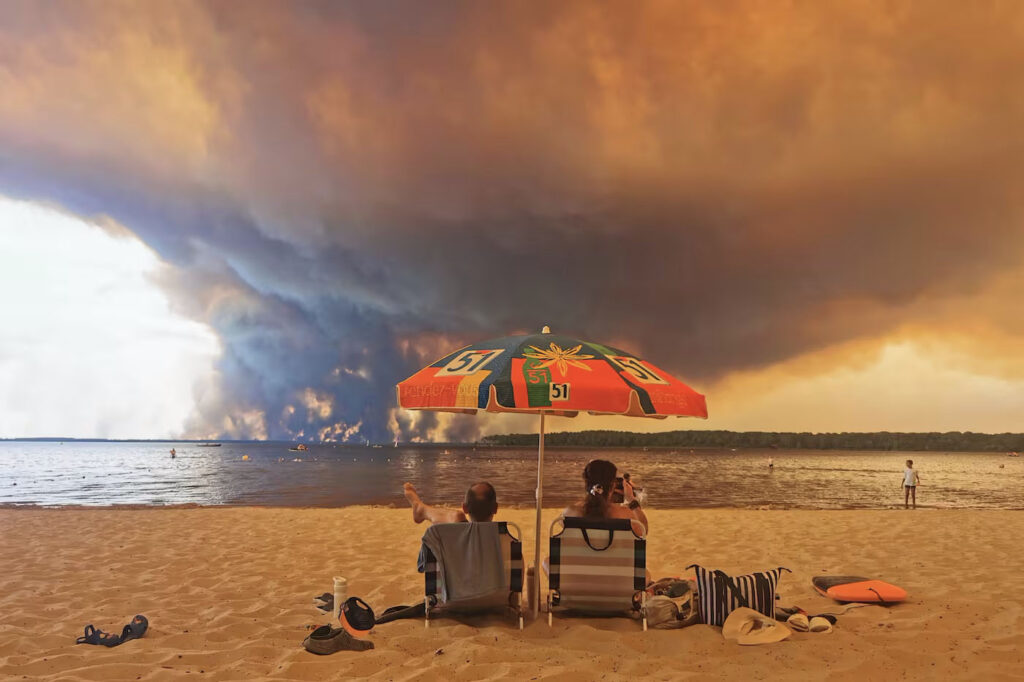
Deux manières de représenter le désastre climatique se partagent aujourd’hui nos images. La première montre l’effondrement. Des êtres humains regardent leur environnement céder autour d’eux, les eaux qui montent, les villes qui se fendent. Ils restent au milieu, ils observent, ils tiennent jusqu’au bout la position du témoin. La seconde montre autre chose. Elle montre la disparition. Nous sommes déjà passés à l’étape d’après, celle où il n’y a plus personne, où le monde a été rendu à sa solitude. Ici le regard se prolonge jusqu’à la fin. Là le regard s’est retiré et il ne reste plus que ce qu’il regardait.
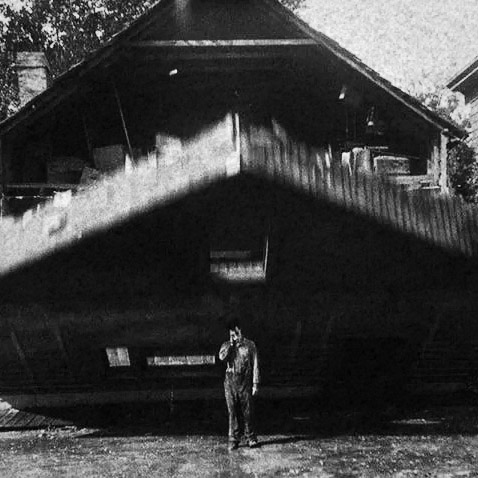
Il existe un film où Buster Keaton se tient immobile dans une rue déserte. Derrière lui la façade entière d’une maison se détache et bascule vers l’avant, d’un seul bloc, sans se briser. La masse descend. Elle recouvre l’espace où il se trouve. Elle l’aurait écrasé si le cadre d’une fenêtre, ménagé exactement à la hauteur et à la largeur de son corps, n’était venu se poser autour de lui sans le toucher. Le mur repose maintenant au sol. Un rectangle de vide entoure l’homme resté debout. Il n’a pas incliné la tête, il n’a pas mesuré la chute, il n’a rien vu venir et rien n’est venu. Il reprend sa marche comme si l’événement n’avait pas eu lieu, et de fait il n’a pas eu lieu, puisque le corps est intact et que le corps continue. Cette image dit tout de la première stratégie. L’homme occupe le centre. Le reste n’est qu’un pourtour, un décor qui peut s’écrouler à la seule condition de l’épargner, lui. On se croirait dans une de ces réalités virtuelles où la perspective d’un seul compte davantage que l’existence de tout ce qui n’est pas lui. Ce qui monte alors est un mélange de fascination et d’effroi, le plaisir trouble de regarder le monde s’abîmer dans un spectacle au terme duquel il ne resterait qu’un œil ouvert. Autour de cet œil tout s’effondre. L’œil ne court aucun risque. Le spectacle nie la finitude à l’instant même où il en fait son sujet.
Cette première stratégie a un cousin dans nos discours, la collapsologie. Le même mouvement les anime. On y espère l’effondrement, on l’attend comme une délivrance, on se prend à souhaiter qu’il vienne de lui-même et nous dispense d’avoir à changer. La catastrophe ferait le travail que nous ne faisons pas. Elle laverait le monde de ce qui l’encombre, elle nous purgerait de l’aliénation où nous vivons, et de l’autre côté de la ruine s’ouvrirait une terre nettoyée où recommencer sur une base neuve. On repartirait. Il y a dans cette espérance la même ruse que dans l’image de Keaton. Celui qui l’entretient se compte toujours parmi les survivants, jamais parmi les décombres. L’effondrement le concerne comme un passage, jamais comme un terme. Il traverse la fin et il se retrouve de l’autre bord, allégé, purifié, prêt à reconstruire. La finitude est encore une fois congédiée au moment même où elle sert de décor. On ne meurt pas dans la collapsologie. On renaît.
La seconde stratégie procède à l’envers. Sa représentation est paradoxale car elle se donne sans nous. Nous sommes là, bien sûr, puisqu’il faut quelqu’un pour recevoir l’image et que l’image nous est adressée. Mais elle fait signe vers un monde qui se poursuivrait sans le regard posé sur lui, un monde qui n’aurait plus à être vu pour être. Faire disparaître l’être humain ne revient pas à l’effacer. La finitude, au lieu de s’en aller avec lui, devient présente, installée au milieu du cadre comme une absence qui aurait pris corps et occuperait toute la place. L’humain n’est plus là, et avec lui s’est évanouie la possibilité du témoignage, cette transmission qui suppose toujours quelqu’un à qui transmettre. Entre la place que nous occupons réellement, assis devant l’écran, et la place que l’image nous assigne, celle de notre propre absence, un écart s’ouvre. C’est cet écart qui travaille. Il nous porte à la limite de notre fragilité. Nous nous éprouvons finis dans le geste même de contempler un monde qui se passe de nous.
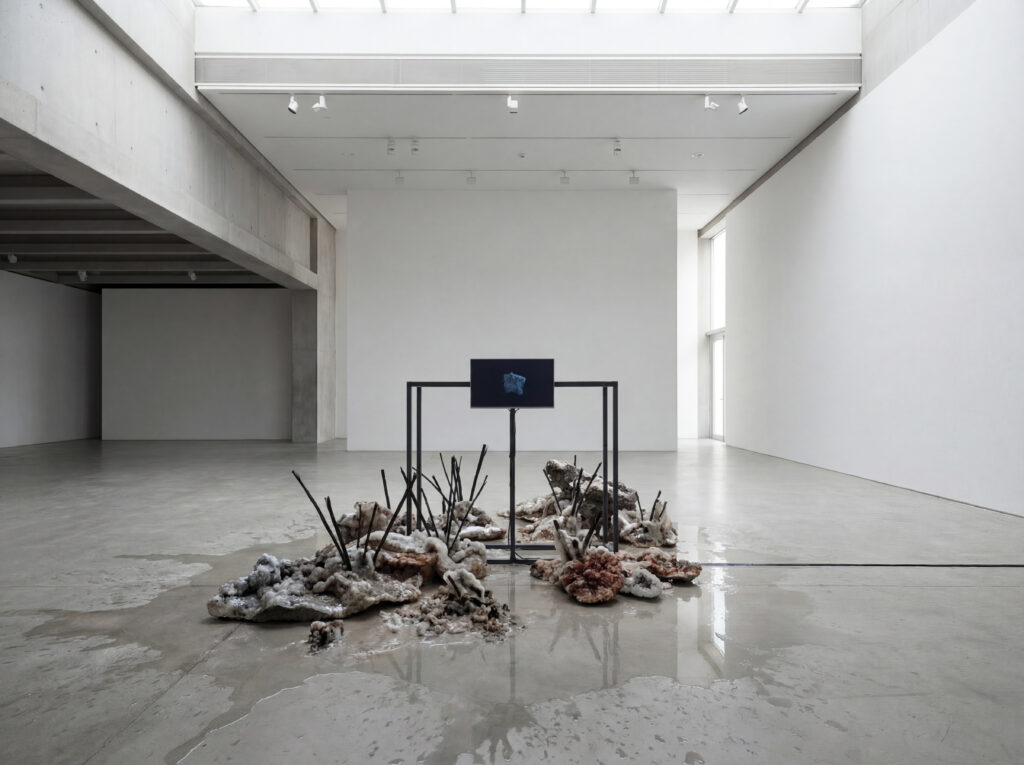
Cette seconde stratégie tient un langage plus matérialiste. Elle ne promet aucune purification. Elle ne suppose aucun recommencement. Le réchauffement de la planète n’ouvre pas une ère nouvelle, il réduit les chances de survie de chaque espèce vivante, une à une, la nôtre comprise, sans distinguer ni récompenser personne. Ce que cette diminution laisse derrière elle n’est pas un monde purgé où bâtir autrement. C’est un retour du vivant vers le minéral, une reminéralisation lente de la Terre, la matière qui reprend ce qu’elle avait un temps prêté aux corps et aux plantes. Les os se dissolvent dans la roche, la roche redevient poussière, la poussière se dépose et se tasse. Il n’y a là ni châtiment ni promesse. Il y a une planète qui continue sans le vivant qui l’avait un moment habitée, et qui n’en garde pas même le souvenir, faute de mémoire pour le garder.
J’avoue une méfiance ancienne envers la première stratégie, envers son goût du spectaculaire et l’anthropocentrisme qui la soutient. Il y a quelque chose de malsain dans l’idée qu’en donnant à voir la destruction on ferait advenir quelque chose. Ce spectacle, nous le connaissons trop bien pour qu’il nous dérange encore. Il entretient l’ordre existant. Il flatte l’appétit de catastrophe sans jamais l’inquiéter. Depuis septembre 2001, qui n’a pas senti passer ce frisson devant les tours qui s’affaissent au ralenti, la poussière grise qui redescend sur les corps et sur les voitures, le nuage qui remonte les avenues. Cette esthétique de la ruine possède une histoire, et cette histoire est politique. Elle vient de loin, des gravures de villes en flammes, des tableaux de déluges où de petites figures lèvent les bras au premier plan pendant que l’eau engloutit tout le reste. On y trouvait déjà cette place réservée au spectateur, un peu en retrait, à qui la catastrophe est offerte comme un tableau. Elle a partie liée avec le fascisme, avec la jouissance des civilisations qui se contemplent en train de mourir tout en se sachant promises à renaître, puisque celui qui contemple survivra à ce qu’il regarde s’éteindre. Le plaisir vient de là. On souffre de la disparition et l’on continue de vivre, et c’est de continuer à vivre au bord de la disparition que naît le plaisir. Rien dans ce plaisir ne prépare à disparaître pour de bon. Il répète au contraire, à chaque image, la certitude d’être celui qui reste.
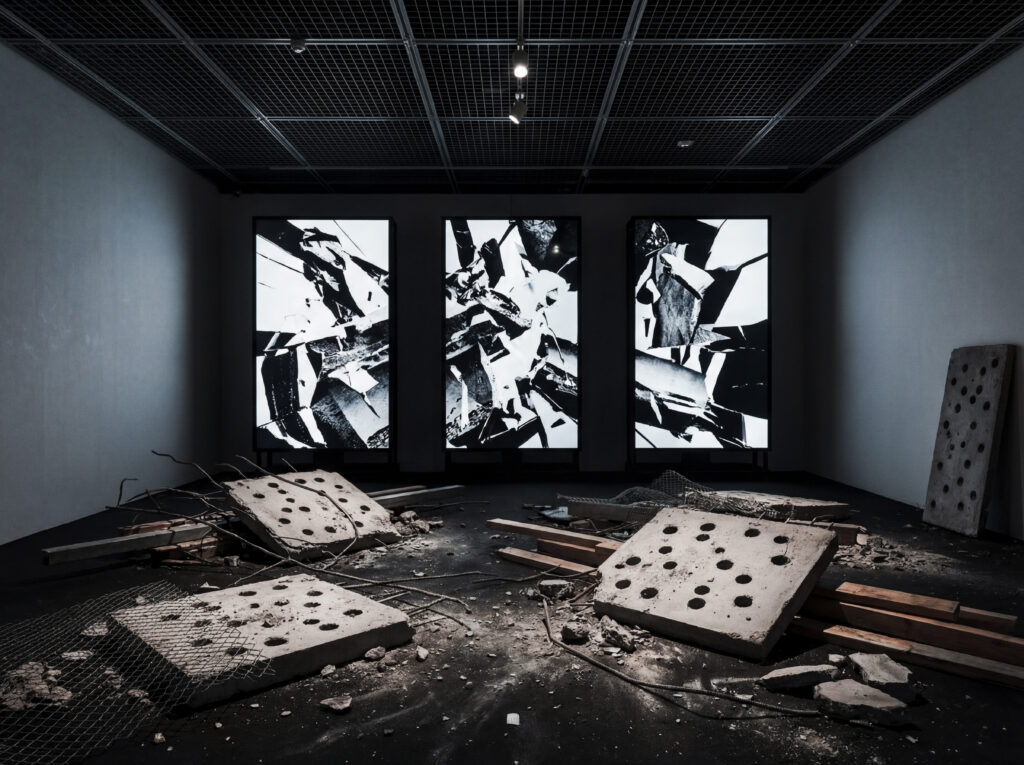
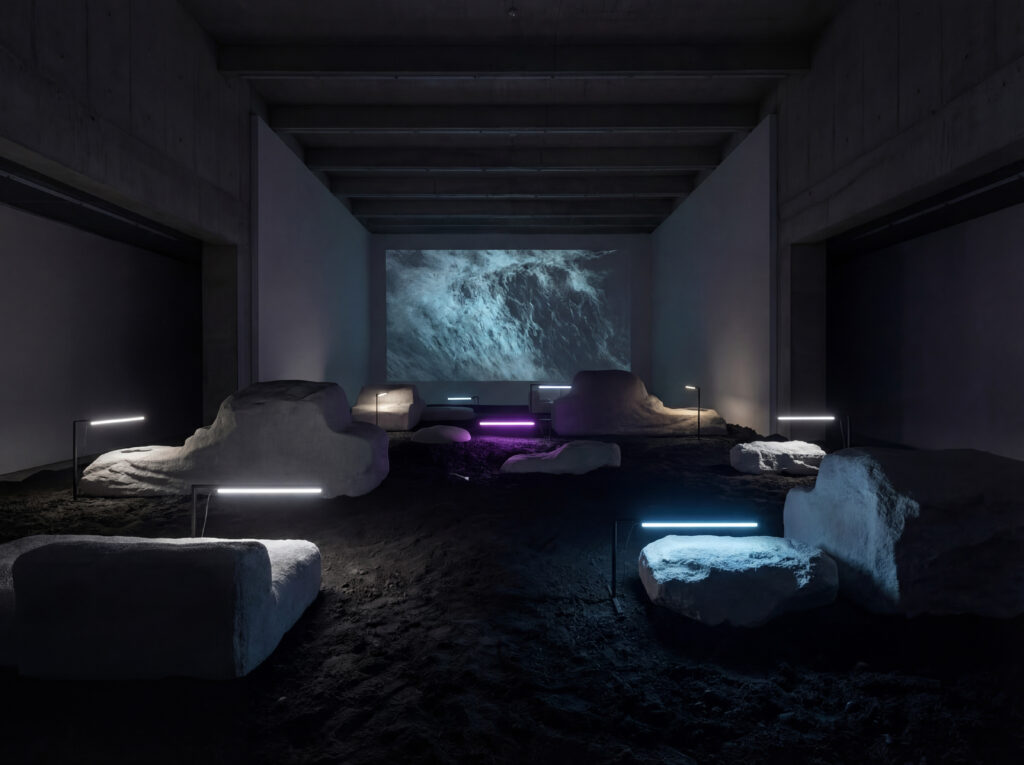
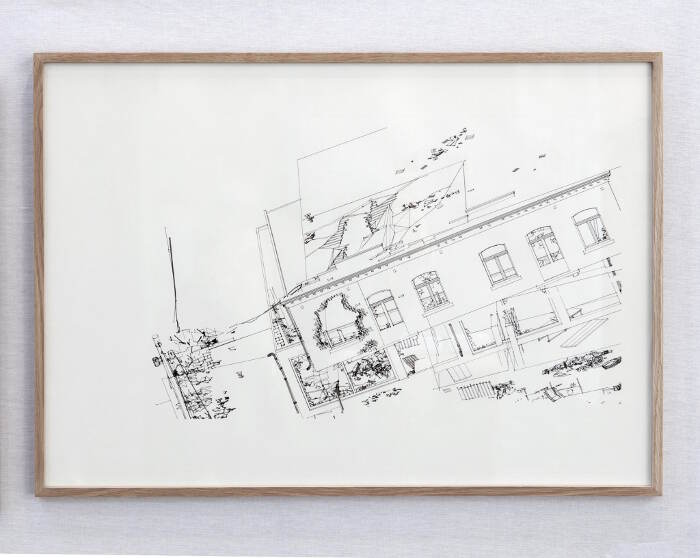
C’est la seconde stratégie qui retient depuis longtemps ma préférence. Des séries que je poursuis depuis le début des années deux mille, Dislocation, Telofossils, Des mémoires éteintes, Terre seconde, tentent de placer celui qui regarde à l’endroit de sa propre absence. Le monde y est rendu à son autonomie. Des objets subsistent qu’aucune main ne vient plus prendre. Un paysage se déploie que personne ne parcourt, et plus loin des machines continuent de parler dans des salles vides. Rien de tout cela ne cherche à produire une émotion de plus. Le geste consiste à nous conduire jusqu’au bord de la finitude et à nous y tenir, à ce point d’incandescence où elle va basculer sans que le basculement soit jamais montré. Une question travaille ces images, celle du passage. Comment passe-t-on de la finitude individuelle, où quelqu’un peut encore raconter ce qu’il a vu, à cette autre finitude, celle de l’espèce et du vivant, où il ne restera plus personne pour raconter, plus personne à qui l’histoire pourrait manquer. Au seuil de ce passage la fascination tombe. Le frisson se retire. Vient à sa place quelque chose qui ressemble à de l’indifférence, une indifférence pourtant sensible, si les deux mots peuvent tenir ensemble, où nous quittons notre propre point de vue pour nous glisser du côté du monde, du côté des pierres, de tous les étants qui resteront là quand nous n’y serons plus.

Une pièce, quelque part, continue d’exister sans que personne y entre. La lumière du dehors traverse la fenêtre selon un angle qui se déplace au long du jour et vient éclairer le mur, puis plus tard le coin de la table. La poussière tombe régulièrement et recouvre les surfaces d’une pellicule que nulle main ne dérangera. Sur la table un verre est resté, à demi plein d’une eau qui s’évapore lentement, jusqu’au cerne, puis jusqu’à rien. Le robinet goutte encore un temps, puis se tait faute de pression. Dehors l’herbe monte entre les dalles, puis jaunit, puis la dalle affleure de nouveau. La scène n’a rien de triste, faute de quelqu’un pour la trouver telle, et c’est précisément cela qu’il faut apprendre à regarder.
Pour l’instant c’est la première stratégie qui domine. Elle règne dans les médias. Elle règne aussi dans des pratiques artistiques qui croient inquiéter et ne font que rassurer, qui montrent la fin pour mieux prouver qu’on y a survécu. Elle domine parce qu’elle garantit la continuation de ce qui est. Elle ne touche jamais à la finitude de celui qui décrit. Le monde a beau s’effondrer autour de lui, il ne s’effondre qu’autour de lui. Celui-là demeure au bord, au dehors, dans la position de qui voit sans être vu et survit sans être atteint. Il regarde le monde depuis un point qui n’appartient pas encore au monde. Tant qu’il regarde de ce point, rien ne lui arrive.
Two ways of representing climate disaster share our images today. The first shows collapse. Human beings watch their environment give way around them, the waters rising, the cities splitting open. They remain in the middle, they observe, they hold to the end the position of the witness. The second shows something else. It shows disappearance. We have already passed to the stage after, the one where no one is left, where the world has been returned to its solitude. Here the gaze extends to the very end. There the gaze has withdrawn, and all that remains is what it was looking at.

There is a film in which Buster Keaton stands motionless in an empty street. Behind him the entire façade of a house comes loose and tips forward, in a single block, without breaking. The mass comes down. It covers the space where he stands. It would have crushed him had the frame of a window, set exactly at the height and width of his body, not come to rest around him without touching him. The wall now lies on the ground. A rectangle of emptiness surrounds the man left standing. He did not tilt his head, he did not measure the fall, he saw nothing coming and nothing came. He resumes his walk as if the event had not taken place, and in fact it did not take place, since the body is intact and the body goes on. This image says everything about the first strategy. Man occupies the center. The rest is only a perimeter, a set that may crumble on the one condition that it spare him. One would think oneself in one of those virtual realities where the perspective of a single person counts for more than the existence of everything that is not him. What rises then is a mixture of fascination and dread, the troubled pleasure of watching the world fall to ruin in a spectacle at the end of which there would remain only an open eye. Around this eye everything collapses. The eye runs no risk. The spectacle denies finitude at the very moment it takes it for its subject.
This first strategy has a cousin in our discourse, collapsology. The same movement drives them both. There one hopes for collapse, one awaits it as a deliverance, one catches oneself wishing it would come of its own accord and spare us from having to change. The catastrophe would do the work we do not do. It would wash the world of what clutters it, it would purge us of the alienation in which we live, and on the far side of the ruin a cleansed earth would open where we might begin again on a fresh basis. We would set off anew. There is in this hope the same trick as in the image of Keaton. Whoever entertains it always counts himself among the survivors, never among the rubble. Collapse concerns him as a passage, never as an end. He crosses the finish and finds himself on the other shore, lightened, purified, ready to rebuild. Finitude is once again dismissed at the very moment it serves as backdrop. One does not die in collapsology. One is reborn.

The second strategy proceeds the other way. Its representation is paradoxical because it gives itself without us. We are there, of course, since someone is needed to receive the image and the image is addressed to us. But it signals toward a world that would go on without the gaze laid upon it, a world that would no longer need to be seen in order to be. To make man disappear does not amount to erasing him. Finitude, instead of departing with him, becomes present, installed at the center of the frame like an absence that had taken on a body and would occupy the whole space. Man is no longer there, and with him has vanished the possibility of testimony, that transmission which always presupposes someone to transmit to. Between the place we actually occupy, seated before the screen, and the place the image assigns us, that of our own absence, a gap opens. It is this gap that does the work. It carries us to the limit of our fragility. We experience ourselves as finite in the very act of contemplating a world that does without us.
This second strategy speaks a more materialist language. It promises no purification. It supposes no beginning again. The warming of the planet opens no new era, it reduces the chances of survival of each living species, one by one, our own included, without distinguishing or rewarding anyone. What this reduction leaves behind is not a purged world in which to build otherwise. It is a return of the living toward the mineral, a slow remineralization of the Earth, matter reclaiming what it had for a time lent to bodies and to plants. Bones dissolve into rock, rock becomes dust again, dust settles and packs down. There is in this neither punishment nor promise. There is a planet that goes on without the living that had for a moment inhabited it, and that keeps not even the memory of it, for want of a memory to keep it.
I confess an old mistrust of the first strategy, of its taste for the spectacular and the anthropocentrism that sustains it. There is something unwholesome in the idea that by giving destruction to be seen one would bring something about. This spectacle we know too well for it to trouble us any longer. It sustains the existing order. It flatters the appetite for catastrophe without ever disturbing it. Since September 2001, who has not felt that shiver pass before the towers sinking in slow motion, the gray dust falling back onto the bodies and onto the cars, the cloud climbing the avenues. This aesthetic of ruin has a history, and this history is political. It comes from far off, from engravings of cities in flames, from paintings of floods where small figures raise their arms in the foreground while the water swallows all the rest. There one already found this place reserved for the spectator, slightly withdrawn, to whom the catastrophe is offered like a painting. It is bound up with fascism, with the enjoyment of civilizations that contemplate themselves in the act of dying while knowing themselves promised to be reborn, since the one who contemplates will survive what he watches go out. The pleasure comes from there. One suffers from the disappearance and one goes on living, and it is from going on living at the edge of disappearance that the pleasure is born. Nothing in this pleasure prepares one to disappear for good. On the contrary, it repeats, with every image, the certainty of being the one who remains.

It is the second strategy that has long held my preference. Certain series I have been pursuing since the early two thousands, Dislocation, Telofossils, Extinguished Memories, Second Earth, attempt to place the one who watches at the site of his own absence. The world there is returned to its autonomy. Objects subsist that no hand comes to take up any longer. A landscape unfolds that no one crosses, and further off machines go on speaking in empty rooms. None of this seeks to produce one more emotion. The gesture consists in leading us to the edge of finitude and holding us there, at that point of incandescence where it is about to tip over without the tipping ever being shown. A question works these images, that of the passage. How does one pass from individual finitude, where someone can still recount what he has seen, to that other finitude, that of the species and of the living, where no one will be left to recount, no one to whom the story might be missed. At the threshold of this passage the fascination falls away. The shiver withdraws. In its place comes something that resembles indifference, an indifference that is nonetheless sentient, if the two words can hold together, in which we leave our own point of view to slip over to the side of the world, to the side of the stones, the trees, all the beings that will remain there when we are no longer.

A room, somewhere, goes on existing without anyone entering it. The light from outside crosses the window at an angle that shifts across the day and comes to light the wall, then later the corner of the table. Dust falls steadily and covers the surfaces with a film that no hand will disturb. On the table a glass has been left, half full of a water that evaporates slowly, down to the ring, then down to nothing. The tap drips for a while longer, then falls silent for want of pressure. Outside the grass rises between the flagstones, then yellows, then the stone shows through again. The scene has nothing sad about it, for want of anyone to find it so, and that is precisely what one must learn to watch.
For now it is the first strategy that dominates. It reigns in the media. It reigns too in artistic practices that believe they trouble and only reassure, that show the end the better to prove one has survived it. It dominates because it guarantees the continuation of what is. It never touches the finitude of the one who describes. The world may collapse around him, it collapses only around him. That one remains at the edge, outside, in the position of one who sees without being seen and survives without being reached. He watches the world from a point that does not yet belong to the world. As long as he watches from that point, nothing happens to him.