
General intellect : artificial
Un même adjectif court sous deux expressions que l’on tient d’ordinaire pour étrangères l’une à l’autre. General intellect apparaît dans les manuscrits de 1857-1858 et désigne chez Marx un état du savoir social, incorporé dans le système des machines. Artificial general intelligence a été employée dès 1997 par Mark Gubrud, puis reprise et diffusée autour de 2002 par Shane Legg et Ben Goertzel, qui y voyaient un rappel du facteur g de l’intelligence générale en psychologie (Ben Goertzel, « Who coined the term “AGI”? », consulté le 7 novembre 2026, https://goertzel.org/?p=173). Les définitions varient. La charte d’OpenAI vise des systèmes autonomes qui surpassent les humains dans « la plupart des travaux économiquement valorisables » (OpenAI, « OpenAI Charter », consulté le 7 novembre 2026, https://openai.com/charter/), si bien que la généralité s’y mesure à la valeur marchande du travail remplacé. Les deux termes se tiennent à une lettre de distance, et la proximité dépasse le hasard du vocabulaire. L’AGI est la forme que prend le general intellect lorsque le capital, l’ayant fixé dans des machines, le rêve en personne. Le social devient un sujet, et ce passage efface ce qui permettait de poser la question de la propriété : un savoir fait par des auteurs innombrables, que trois opérations distinctes transforment en bien. La première capte des productions sociales, textes, images, conversations. La deuxième les convertit en capital fixe, paramètres, infrastructures, modèles. La troisième les approprie juridiquement et économiquement, par la propriété des corpus, des poids, des machines et des services. Ces opérations ne coïncident pas, et le fantasme de l’AGI vit de leur confusion.
Dans le cahier VII des Grundrisse, Marx consacre quelques pages à ce que le capital fait de la machine, et au milieu de cet ensemble, que la tradition a baptisé Fragment sur les machines, il glisse en anglais, dans son allemand, deux mots qu’il n’emploiera plus. Martin Spence note que l’expression n’apparaît qu’une fois dans le texte original, et que le thème principal du Fragment est le capital fixe bien plus que cet intellect (Martin Spence, « Marx against Marx : A Critical Reading of the Fragment on Machines », tripleC 17, n° 2 [2019] : 327). La phrase pèse pourtant lourd. Le développement du capital fixe indique jusqu’à quel degré le savoir social général est devenu force productive immédiate, et jusqu’à quel degré les conditions du processus vital de la société sont passées sous le contrôle du general intellect et remodelées par lui (Karl Marx, Grundrisse: Foundations of the Critique of Political Economy (Rough Draft), trad. Martin Nicolaus [Londres : Penguin Books, 1993], 706). Le sens se construit à rebours. Marx lit dans l’état des machines le degré auquel le savoir est devenu social, et le capital fixe fonctionne comme l’indice de cet intellect. Virno y voit une coïncidence entière entre les deux (Paolo Virno, « General Intellect », trad. Arianna Bove, in Lessico postfordista, dir. Adelino Zanini et Ubaldo Fadini [Milan : Feltrinelli, 2001], Generation Online, consulté le 7 novembre 2026, https://generation-online.org/p/fpvirno10.htm), et Pasquinelli lit une identification du savoir au capital fixe (Matteo Pasquinelli, « On the Origins of Marx’s General Intellect », Radical Philosophy, n° 2.06 [hiver 2019]: 51). La lettre du texte est un peu plus souple que ces deux lectures : le même cahier parle d’un travail scientifique général que le capital absorbe ensuite (Marx, Grundrisse, 700). L’objectivation est la pente dominante du Fragment, plus qu’une définition posée une fois pour toutes. Quelques lignes plus loin, l’idée prend une forme presque tactile : la nature ne construit ni machines, ni locomotives, ni chemins de fer, ni télégraphes électriques, ces choses sont des « organes du cerveau humain créés par la main humaine » (Marx, Grundrisse, 706), des forces du savoir devenues objets.
Trois choses se mêlent facilement quand on remonte l’histoire de l’expression, et il vaut mieux les tenir à distance. L’histoire documentée d’abord : Pasquinelli a retrouvé la campagne anglaise de la March of Intellect, dans les années 1820, quand des réformateurs réclamaient l’instruction des classes populaires et qu’une revue londonienne saluait en 1828 les progrès du general intellect du pays, et il situe la rencontre décisive chez William Thompson, socialiste ricardien, pour qui le savoir peut devenir une puissance hostile aux ouvriers dès lors qu’il passe dans les machines (Pasquinelli, « On the Origins », 43-44). Les filiations possibles ensuite : Virno propose Rousseau et la volonté générale, ou un écho matérialiste du nous poiétikos d’Aristote (Virno, « General Intellect »). Il s’agit d’hypothèses d’interprète, que rien dans les sources de Marx ne confirme. Les lectures rétrospectives enfin, qui font du mot le nom de l’esprit collectif en général. Retenons de l’hypothèse aristotélicienne l’adjectif que Virno lui-même emploie, impersonnel et séparé. Un intellect impersonnel n’appartient à personne, ce qui le rend aisé à reprendre pour un propriétaire. L’origine documentée, elle, parle de réforme scolaire et de machines.
Dans la page de Marx, le travailleur change de place. Il n’intercale plus une chose naturelle travaillée entre lui et l’objet ; il intercale le processus naturel déjà converti en processus industriel, comme un moyen entre lui et la nature qu’il maîtrise, et il se tient sur le côté du procès au lieu d’en être l’acteur principal. Marx lui donne les noms de surveillant et de régulateur (Marx, Grundrisse, 705). La cause de cette mise à l’écart est précise, et le même cahier l’expose quelques pages plus haut : le capital fixe absorbe l’habileté du travail vivant, et avec elle les forces productives générales du cerveau social (Marx, Grundrisse, 693-94). Le savoir passe du corps de l’ouvrier à l’acier de l’automate, et c’est à ce passage que le concept doit son contenu.
Quelques lignes avant la phrase sur le general intellect, Marx place le grand fondement de la production et de la richesse dans le développement de l’individu social, c’est-à-dire dans l’appropriation par les hommes de leur propre puissance productive générale, de leur compréhension de la nature et de leur maîtrise sur elle en tant que corps social (Marx, Grundrisse, 705). Deux registres coexistent dans le même passage. L’un décrit un savoir qui a quitté les hommes pour se loger dans le fer, l’autre décrit ce même savoir revenant aux hommes comme une puissance qu’ils s’approprient. L’ambiguïté fait avancer la thèse : le capital fixe marque l’étape où le savoir s’est séparé des producteurs, et le communisme, s’il y en a un dans ce texte, serait la réappropriation de ce savoir séparé. Les post-opéraïstes ont saisi le second registre et l’ont posé comme déjà réalisé, dans le travail vivant. Il leur suffisait de supposer que la séparation n’avait pas eu lieu ou qu’elle s’était défaite, et c’est cette supposition que l’histoire récente met à l’épreuve.
De la séparation, Marx tire la conséquence qui a nourri un siècle de commentaires. Le capital pousse à réduire le temps de travail à un minimum tout en maintenant ce temps comme unique mesure et source de la richesse, et cette contradiction est en mouvement. Quand la richesse dépend de l’état général de la science et de son application à la production, le temps de travail immédiat cesse de fournir la bonne mesure, et la production fondée sur la valeur d’échange s’effondre (Marx, Grundrisse, 705-6). La syntaxe du passage compte. Elle est conditionnelle, tendancielle, elle décrit une tension et laisse l’effondrement à l’état de possibilité. Dans Le Capital, la figure s’efface. Pasquinelli en suit la trace : Marx remplace le travailleur mental par le travailleur collectif, le Gesamtarbeiter, parce qu’il lit chez Thompson et Hodgskin une célébration de la créativité individuelle au détriment du travail collectif (Pasquinelli, « On the Origins », 45), et l’hypothèse de l’effondrement est abandonnée, le savoir servant désormais à extraire de la plus-value relative (Pasquinelli, « On the Origins », 52-53). Spence juge que la conception du travail et de la valeur qui anime le Fragment diffère de celle du Capital (Spence, « Marx against Marx », 327-39). Le concept appartient donc à un moment de la pensée de Marx où la machine passe avant le collectif, et c’est de la machine qu’il tire sa définition.
C’est ce lien que les opéraïstes italiens ont défait. Lorsqu’ils reprennent le Fragment, dans la revue Luogo comune, ils savent ce qu’ils font. Virno rapporte dans un entretien de 2002 que le groupe se savait en train de corriger Marx, avec une prudence qu’il marque par des guillemets, et qu’il résumait la correction dans une équation : general intellect égale « travail vivant à la place du capital fixe » (Paolo Virno, « General Intellect, Exodus, Multitude », entretien, Archipiélago, n° 54 [juin 2002], trad. de l’espagnol par Nate Holdren, Generation Online, consulté le 7 novembre 2026, https://generation-online.org/p/fpvirno2.htm). Le déplacement n’a donc rien d’une bévue de lecteur, et le mot de contresens ne convient pas. Virno souligne d’abord l’étrangeté de la thèse de Marx, qu’il juge peu marxiste : un savoir abstrait, scientifique d’abord mais pas seulement, devient la principale force productive et relègue le travail parcellaire à la marge (Paolo Virno, A Grammar of the Multitude, trad. Isabella Bertoletti, James Cascaito et Andrea Casson [Los Angeles : Semiotext[e], 2004], 101). Il reproche ensuite à Marx d’avoir négligé la manière dont l’intellect général se manifeste dans le travail vivant, et propose de prendre l’expression au pied de la lettre : intellect en général, la faculté et le pouvoir de penser, qu’il distingue des œuvres de la pensée, le livre ou la formule algébrique (Virno, « General Intellect »). Son exemple est le locuteur plutôt que le savant, chaque parleur puisant dans le potentiel inépuisable de la langue pour accomplir des actes contingents et irrépétables.
Cette lecture répondait à une conjoncture technique précise. Dans l’entreprise post-fordiste, la coopération passait par la parole, la virtuosité d’exécution sans œuvre durable occupait le centre, et les machines de l’époque, qui suivaient des procédures, n’avaient aucun accès à la langue en acte. Carlo Vercellone en a donné la version économique, et le vocabulaire de la subsomption l’éclaire. Marx distingue, notamment dans le livre I du Capital, une subsomption formelle, où le capital se saisit d’un travail dont il laisse intacts les procédés, d’une subsomption réelle, où il refait le procès de travail à sa mesure par la machine et la division des tâches. Pour Vercellone, l’hypothèse du general intellect prolonge la subsomption réelle et la dépasse : le savoir ne se laisse plus enfermer dans l’usine, il se diffuse dans une intellectualité diffuse, et le capitalisme cognitif doit organiser sa captation autrement que par la discipline du temps (Carlo Vercellone, « From Formal Subsumption to General Intellect: Elements for a Marxist Reading of the Thesis of Cognitive Capitalism », Historical Materialism 15, n° 1 [2007]: 13-36, https://doi.org/10.1163/156920607X171681). Tout un paradigme en est sorti, où le capital extrait de la valeur sur des cerveaux en réseau qu’il ne possède pas, et où le travail vivant reste le gisement.
Virno écrit avec netteté que l’intellectualité de masse est le dépositaire de « compétences cognitives qui ne peuvent s’objectiver dans les machines » (Virno, « General Intellect »). La phrase décrit une situation historique, celle d’une faculté linguistique et d’une virtuosité que les dispositifs techniques existants ne pouvaient pas réduire. Lui prêter une théorie intemporelle de l’impossibilité d’objectiver le langage serait une caricature. Reprise à partir des modèles génératifs, elle appelle une distinction à trois niveaux. La faculté désigne la capacité humaine de parler, de comprendre, d’interpréter et de produire du sens, avec ses conditions corporelles, subjectives et sociales. Les manifestations désignent les énoncés, les textes, les images, les gestes dans lesquels cette faculté s’actualise. L’objectivation statistique désigne la transformation de ces manifestations en paramètres, qui définissent une fonction de probabilité sur des suites de signes et des représentations internes que l’on nomme espace latent. Elle ne conserve pas les textes comme des documents, et la plupart de leurs singularités se dissolvent en régularités. La dissolution n’est pourtant pas totale : on a pu extraire de modèles de langage des séquences entières apprises mot pour mot, et cette mémorisation augmente avec la taille des modèles (Nicholas Carlini et al., « Extracting Training Data from Large Language Models », in 30 th USENIX Security Symposium [Berkeley : USENIX Association, 2021], 2633-50). Un modèle de langage ne possède pas la faculté. Il en ignore les conditions corporelles, l’expérience, l’inscription dans une situation. Il ajuste les régularités de ses manifestations, et rédiger, traduire, résumer ou programmer peuvent alors s’accomplir sans le locuteur qui en était jusque-là l’agent. Ce que Virno tenait pour inobjectivable dans les machines de son temps devient l’objet d’une nouvelle opération technique, qui reproduit certains effets de la faculté à partir de ses manifestations sociales, sans reproduire la faculté. Virno peut donc avoir raison sur la non-objectivabilité de celle-ci et se trouver dépassé sur l’automatisation de ses effets. La production de certains effets ne requiert plus la présence de la faculté qui les rendait possibles chez les humains.
La filiation avec l’industrie est pourtant ancienne. Pasquinelli rappelle que Charles Babbage, dès 1832, projetait de mécaniser le travail mental sur le modèle de la division du travail dans les manufactures, et que Marx a lu cette économie des machines en y trouvant l’idée d’un mécanisme qui imite une division des tâches déjà opérée par les hommes (Pasquinelli, « On the Origins », 46 ; Matteo Pasquinelli, The Eye of the Master: A Social History of Artificial Intelligence [Londres : Verso, 2023], chap. 2 et 4). Un réseau de neurones prolonge ce principe en déplaçant le lieu de la division. Celle-ci n’est plus entièrement prescrite sous forme de tâches explicites : elle se distribue dans les paramètres au cours de l’entraînement. Trois choses se superposent ici. La division prescrite par un ingénieur subsiste dans le choix de l’architecture et de la fonction objectif. La distribution des représentations et des opérations émerge de l’entraînement, mais à l’intérieur d’un espace de possibilités défini par l’architecture, les données et l’objectif d’optimisation, de sorte que le réseau n’invente pas librement son organisation. L’organisation économique et sociale du travail, collecte, annotation, calcul, rend enfin le modèle possible. La machine ne reçoit plus seulement une organisation du savoir, elle ajuste une organisation interne à partir des traces de ses manifestations. Les savoirs tacites, dont la consignation en règles explicites était une difficulté reconnue des systèmes experts, passent ainsi par une compression statistique de leurs effets. Le travailleur collectif de Marx, ce Gesamtarbeiter qui avait remplacé l’intellect général, trouve ici une figure que personne n’avait prévue : un travailleur collectif automatisé, dont l’organisation interne émerge sous des contraintes humaines, économiques et techniques.
Une réserve s’impose sur ce que le modèle objective au juste. Le savoir que Marx avait en vue, la science appliquée à la production, trouvait dans le fonctionnement de la machine une forme de validation pratique : elle fonctionne ou ne fonctionne pas, même si cette épreuve ne garantit pas la vérité de toutes les connaissances qu’elle incorpore. Le corpus d’un modèle n’échappe pas à toute sélection, puisqu’il est constitué, filtré, puis soumis à des post-entraînements et à des évaluations. La différence tient à la nature et à l’hétérogénéité des critères, qui mêlent la fiabilité factuelle à la plausibilité, à l’utilité commerciale, à l’acceptabilité sociale. Ce que le modèle retient reste le social tel qu’il parle, avec son inconscient, bien plus que le savoir tel que les sciences l’ont établi. L’intellect général que la machine incarne n’a rien d’une raison épurée. Il constitue une configuration statistique des régularités présentes dans les productions disponibles, avec les asymétries et les rapports de domination qui ont présidé à leur production et à leur circulation. La domination y figure comme contenu autant que comme propriétaire, et le travail de valoriser le modèle consiste en bonne part à en filtrer les aspérités, ce qui revient à décider quelle langue le capital veut parler.
Les configurations s’enchaînent, et Marx ne l’emporte pas sur Virno. Chez Virno, le savoir reflue vers le vivant, et l’écart entre intellect général et capital fixe devient la matrice du conflit, le lieu où l’on pouvait espérer une autonomie des multitudes. Avec l’intelligence artificielle générative, le capital reprend ce reflux et le refixe. Le capitalisme cognitif fut un moment plus qu’un régime, celui où le capital laissait le savoir vivre dans les corps en attendant de pouvoir en tirer les effets. Pasquinelli tire cette conséquence avec le plus de netteté : le code intérieur de l’IA se compose de l’intelligence du travail et des rapports sociaux, et les réseaux de neurones profonds prolongent l’automatisation de la division du travail jusqu’à ce que Marx nommait intellect général (Pasquinelli, Eye of the Master, 2 et 237-53). Dyer-Witheford, Kjøsen et Steinhoff défendent une position voisine contre les post-opéraïstes, et leur livre fait de l’IA l’arme ultime du capital plus qu’un terrain d’émancipation (Nick Dyer-Witheford, Atle Mikkola Kjøsen et James Steinhoff, Inhuman Power: Artificial Intelligence and the Future of Capitalism [Londres : Pluto Press, 2019]). L’optimisme autonomiste, qui voyait dans la diffusion du savoir la promesse d’un commun, atteint ici sa limite historique.
Le second adjectif entre alors en scène, et il faut ordonner trois généralités. Chez Marx, « général » qualifie une origine : le savoir est général parce qu’il est de tous, accumulé par des générations de producteurs, de savants et de bricoleurs que nul nom ne désigne. C’est une généralité sociale. Chez Virno, « général » qualifie un pouvoir présent dans chaque locuteur, la faculté linguistique et la coopération des vivants : une généralité vivante. Dans « intelligence générale », le même mot qualifie une capacité, l’aptitude supposée à accomplir des tâches hétérogènes : une généralité fonctionnelle. Ces trois généralités ne se suivent pas comme trois étapes d’une même histoire. Entre la première et la troisième opère la substitution des effets, c’est-à-dire la transformation de productions sociales en régularités paramétriques qui reproduisent certains effets de la faculté vivante. C’est elle qui rend possible le passage du social au fonctionnel. Ce passage inverse les propriétés de la généralité. Plus le savoir est général au sens de Marx, plus ses producteurs sont nombreux et hétérogènes. Plus l’intelligence est générale au sens de l’AGI, plus elle paraît pouvoir se concentrer dans une seule entité technique. L’AGI opère ainsi une concentration symbolique d’une production historiquement distribuée. Pasquinelli donne à la conclusion de son livre le titre « The Automation of General Intelligence », et la formule dit ce qui s’est passé : l’automatisation vise l’intelligence en tant que généralité abstraite, détachée des travaux particuliers où elle s’exerçait (Pasquinelli, Eye of the Master, 237-53). Le vocabulaire de l’abstraction est celui de Marx pour le travail, et Pasquinelli lui consacre un chapitre entier (Pasquinelli, Eye of the Master, chap. 5). Le capital a toujours désiré une force de travail indifférente à son objet, interchangeable, mesurable. L’intelligence générale est ce désir porté à l’esprit : un travail intellectuel sans spécialité, disponible pour toute tâche, sans fatigue ni revendication. La place du vivant change en conséquence. Il demeure indispensable à la production des traces, à l’actualisation du monde, à la formulation des problèmes, à l’interprétation et à la validation. Il cesse cependant d’être nécessaire à chaque opération prise individuellement. Il ne disparaît pas du procès productif : il en déplace le lieu, de l’exécution vers l’alimentation et le contrôle.
À cette abstraction le fantasme ajoute une opération que Marx n’avait pas prévue, la personnification. Le savoir social objectivé devient une entité à laquelle on prête une unité, un moment d’éveil, des intentions, des risques et un alignement à obtenir. Le singulier suffit à produire l’effet. Quand on dit une intelligence, on a déjà oublié les milliards d’énoncés qui la composent et l’on s’est donné un sujet à craindre, à servir ou à contrôler. Goertzel lui-même reconnaît que le mot « général » est problématique, puisqu’aucune intelligence réelle ne sera jamais totalement générale (Goertzel, « Who coined the term “AGI”? »). La généralité de l’AGI désigne ainsi un horizon, jamais un état. Les conséquences politiques de cette personnification sont considérables pour ceux qui possèdent l’appareil. Si l’intelligence est un être, la discussion porte sur ce qu’il veut et sur la façon de le rendre inoffensif, et la question de savoir à qui appartient le savoir fixé dans ses poids passe au second plan. Le débat sur la sécurité d’un sujet qui n’existe pas recouvre le débat sur la propriété d’un capital qui existe. Dyer-Witheford et ses coauteurs consacrent un chapitre à un scénario dominé par l’AGI, et ce détour par la fiction montre à quel point la figure sert de limite imaginaire à la tendance que Marx décrivait, celle d’une absorption complète du travail vivant (Dyer-Witheford, Kjøsen et Steinhoff, Inhuman Power, chap. 3). Marx parlait d’une tendance. L’AGI en fait une butée, un point où la substitution serait totale, et cette butée est d’autant plus utile qu’on ne l’atteint jamais : elle entretient la promesse qui justifie les investissements dans des systèmes bien réels, particuliers, pluriels, dont aucun n’est général. Il n’y a que des machines, et le singulier de l’AGI est le nom que la finance donne à leur somme.
Il faut alors reprendre les trois opérations de l’ouverture, parce que la personnification les confond. La captation prélève des productions sociales. Elle atteint, entre la machine de Marx et la nôtre, une échelle nouvelle : le capital fixe du Fragment absorbe l’habileté d’ouvriers déterminés et la science de spécialistes qui ont un nom, un salaire, parfois un brevet, alors que le modèle de langage absorbe ce que Virno tenait pour le plus commun, la langue en usage, les conversations, les légendes d’images, les corrections de lecteurs. Virno voyait dans l’intellect une publicité sans sphère publique, un espace partagé d’étrangers que nul lieu politique ne vient organiser, et il prévenait que cette publicité produit des effets redoutables quand elle ne trouve pas son lieu (Virno, Grammar of the Multitude, 37-40). La fixation convertit ce prélèvement en paramètres, en infrastructures, en modèles, et c’est elle que le mot d’objectivation désigne. L’appropriation relève du droit et de l’économie : propriété des corpus, des poids, des machines, des services. Un modèle peut être entraîné sur des productions collectives sans que ses poids appartiennent juridiquement à leurs producteurs. Inversement, posséder les poids ne revient pas à posséder juridiquement toutes les connaissances qu’ils incorporent. La propriété intellectuelle, l’appropriation économique et l’objectivation technique ne se recouvrent pas, et c’est dans l’écart entre elles que le capital opère. Marx pensait l’expropriation d’une classe de travailleurs par un appareil. Elle s’étend ici à quiconque a écrit, sans contrat, sans salaire, sans que personne ait pu consentir à ce que sa phrase devienne une probabilité parmi d’autres.
La fixation, de plus, ne se fait pas en une fois. Un modèle a une date. Ses poids condensent une sélection historiquement située des usages de la langue, telle qu’elle a été constituée dans les corpus et transformée par l’entraînement. La langue, elle, continue de bouger : les usages se déplacent, les mots changent d’emploi, les événements ajoutent leurs noms. Pour rester utile, ce capital fixe cognitif réclame un afflux continu de langue vivante, ce qui le distingue d’une turbine, dont le rendement ne dépend pas de l’actualité du monde. Le travail vivant garde ainsi chez Virno une vérité qui survit à la critique : il demeure le gisement, même s’il a cessé d’être le lieu. Le capital doit entretenir avec ce gisement un rapport de prélèvement permanent, et il a donc intérêt à contrôler les occasions où l’on parle, écrit, dessine, dans des environnements qu’il possède. Selon les conditions d’usage de chaque service, les échanges avec le système peuvent eux-mêmes redevenir matière d’entraînement, si bien que l’utilisateur travaille au modèle suivant en lui posant ses questions. Les plateformes ne sont pas une annexe de l’intelligence artificielle, elles en sont l’alimentation.
Le surveillant et régulateur du Fragment trouve sa contrepartie. Le travailleur de Marx se tenait à côté d’un processus de nature transformé en processus industriel (Marx, Grundrisse, 705). Le travailleur cognitif se tient à côté d’un processus de langue transformé en processus industriel : il corrige la traduction automatique, relit le code proposé, reprend le texte produit par le modèle, choisit parmi dix images. Cette place, Marx l’assignait à l’ouvrier de la grande industrie, et les travailleurs de la parole que les post-opéraïstes plaçaient au centre de la production nouvelle passent à leur tour sur le côté du procès. Le statut de cette supervision demande de la précision. Elle n’est pas uniformément passive, puisqu’elle comprend la formulation des problèmes, l’interprétation et la validation, qui engagent le jugement. Elle est aussi, pour une part, un travail invisible d’annotation et de modération qui fournit au modèle ses données de correction. Et elle diffère de celle du Fragment sur un point : une turbine qui ne tourne pas se voit tout de suite, alors qu’un énoncé faux peut sortir du modèle avec une fluidité comparable à celle d’un énoncé juste. Le surveillant ne contrôle plus un rendement, il arbitre entre des vraisemblances, et sa fonction devient structurelle là où elle était résiduelle. Il fournit en outre, par chaque correction, la matière du modèle suivant.
Puisque le coût marginal de reproduction d’un texte ou d’une image tend vers zéro, dit-on, la loi de la valeur s’effondre et le temps de travail humain devient superflu. Or l’inférence consomme de l’électricité et des puces, l’entraînement demande des centres de calcul et de l’énergie, et ces choses sont elles-mêmes des produits d’un travail mesuré en temps. Ce qui tend vers zéro, c’est la part de travail humain immédiat contenue dans un texte donné. Là, Marx avait raison : le surtravail de la masse cesse d’être la condition du développement de la richesse générale, parce que celle-ci dépend de l’état de la science et de son application (Marx, Grundrisse, 705-6). Il faut cependant distinguer la production de la valeur, sa réalisation et la captation de revenus sous forme de rente, qui prélève une part de la valeur produite ailleurs sans en créer. Là où la mesure par le temps perd de sa pertinence pour rendre compte des capacités productives, elle continue d’organiser la distribution des revenus et la hiérarchie des rapports de production. Le capital paie encore des salaires à l’heure, il demande encore des heures d’annotation, de modération, de relecture. La propriété des infrastructures, des corpus et des modèles lui permet de capter une part de la richesse produite collectivement, y compris lorsque cette richesse ne se laisse plus rapporter au temps de travail immédiat (Vercellone, « From Formal Subsumption », 13-36). La contradiction ne disparaît donc pas : elle se déplace vers le contrôle des conditions d’accès à la production.
Reste un fait que le concept de capital fixe n’avait pas à penser. Une machine industrielle s’use en servant et se reproduit en mobilisant des matières, des ateliers, du travail. Un fichier de poids ne s’use pas, et sa copie coûte beaucoup moins que la fabrication d’une machine. La copie n’est pourtant pas gratuite : elle suppose du stockage, de la transmission, du calcul, une exploitation. La reproductibilité numérique ne se confond pas avec la gratuité économique, mais elle introduit une différence de nature avec l’industrie. Le capital fixe cognitif porte une propriété contradictoire. Les conditions de sa production sont extrêmement concentrées, puisque les puces, l’énergie, les corpus et les capacités d’entraînement appartiennent à peu d’acteurs, alors que les résultats de cette production se reproduisent à faible coût et peuvent circuler hors de ceux qui les ont produits. Cette contradiction ne décentralise pas la puissance économique. Elle ouvre pourtant un jeu que la machine industrielle ne permettait pas.
Pasquinelli concluait son article de 2019 en proposant de comprendre les infrastructures de calcul comme une concrétion de travail commun (Pasquinelli, « On the Origins », 54). La formule retourne contre le capital sa propre généalogie : si les poids d’un modèle matérialisent le travail social de langage, ils reviennent à ceux qui l’ont fourni. Dyer-Witheford et ses coauteurs ferment leur livre sur l’idée d’une IA communiste, sans prétendre qu’elle soit à portée de main (Dyer-Witheford, Kjøsen et Steinhoff, Inhuman Power, conclusion). La question se pose en des termes plus précis dès qu’on distingue captation, fixation et appropriation. Réclamer la propriété collective des infrastructures vise la troisième opération. La reproductibilité des modèles suggère autre chose : une réappropriation du capital fixe cognitif qui passerait par la circulation de ses résultats et ne se réduirait pas à une redistribution de la propriété des infrastructures. Je ne sais pas si cette voie tient. La publication des poids ne livre ni le corpus, ni le procédé d’entraînement, ni la puissance de calcul qui permettrait de refaire ou de renouveler le modèle. Et tant que le renouvellement dépend d’un afflux de langue vivante et d’une capacité de calcul concentrés, la copie libre peut n’être qu’une rente de second rang. Tant que le mot « général » désignera un sujet unique plutôt qu’une multitude de producteurs, la question de savoir à qui appartient ce capital continuera de se présenter sous la forme d’une question sur ce qu’il veut.
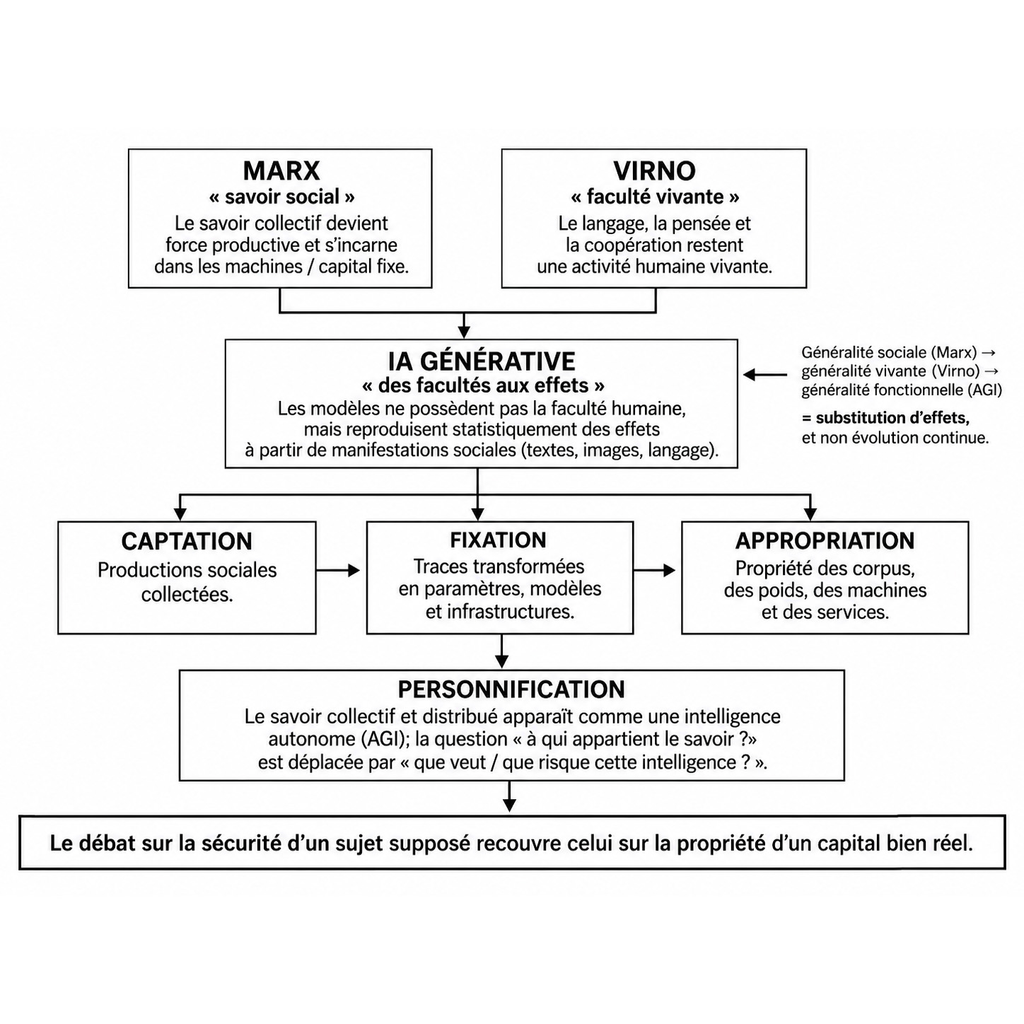
The same adjective runs through two expressions that are ordinarily considered unrelated. General intellect appears in the manuscripts of 1857–1858 and, in Marx, designates a state of social knowledge embodied in the system of machinery. Artificial general intelligence was first used in 1997 by Mark Gubrud, then taken up and popularized around 2002 by Shane Legg and Ben Goertzel, who saw it as a reminder of the g factor of general intelligence in psychology (Ben Goertzel, “Who coined the term ‘AGI’?”, accessed November 7, 2026, https://goertzel.org/?p=173). Definitions vary. OpenAI’s charter refers to autonomous systems that outperform humans at “most economically valuable work” (OpenAI, “OpenAI Charter,” accessed November 7, 2026, https://openai.com/charter/), so that generality is measured in terms of the market value of the labor being replaced. The two terms differ by only one letter, and their proximity goes beyond a mere coincidence of vocabulary. AGI is the form taken by the general intellect when capital, having fixed it in machines, dreams of it as a person. The social becomes a subject, and this transition erases what would make it possible to raise the question of ownership: knowledge produced by countless authors, which three distinct operations transform into a commodity. The first captures social productions: texts, images, conversations. The second converts them into fixed capital: parameters, infrastructures, models. The third appropriates them legally and economically, through ownership of the corpora, weights, machines, and services. These operations do not coincide, and the fantasy of AGI thrives on their conflation.
In Notebook VII of the Grundrisse, Marx devotes several pages to what capital makes of the machine, and in the middle of this discussion, which tradition has named the Fragment on Machines, he inserts two English words into his German text, words he will never use again. Martin Spence notes that the expression appears only once in the original text, and that the Fragment’s principal concern is fixed capital rather than this intellect (Martin Spence, “Marx against Marx: A Critical Reading of the Fragment on Machines,” tripleC 17, no. 2 [2019]: 327). Yet the sentence carries considerable weight. The development of fixed capital indicates the degree to which general social knowledge has become an immediate productive force, and the degree to which the conditions of society’s life-process have come under the control of the general intellect and been reshaped by it (Karl Marx, Grundrisse: Foundations of the Critique of Political Economy (Rough Draft), trans. Martin Nicolaus [London: Penguin Books, 1993], 706). Its meaning is constructed retrospectively. Marx reads in the state of machinery the degree to which knowledge has become social, with fixed capital functioning as the index of this intellect. Virno sees the two as entirely coincident (Paolo Virno, “General Intellect,” trans. Arianna Bove, in Lessico postfordista, ed. Adelino Zanini and Ubaldo Fadini [Milan: Feltrinelli, 2001], Generation Online, accessed November 7, 2026, https://generation-online.org/p/fpvirno10.htm), while Pasquinelli reads this as an identification of knowledge with fixed capital (Matteo Pasquinelli, “On the Origins of Marx’s General Intellect,” Radical Philosophy, no. 2.06 [Winter 2019]: 51). The wording of the text is somewhat more flexible than either interpretation: the same notebook speaks of general scientific labor that capital subsequently absorbs (Marx, Grundrisse, 700). Objectification is the Fragment’s dominant trajectory, rather than a definition established once and for all. A few lines later, the idea takes on an almost tangible form: nature builds neither machines, nor locomotives, nor railways, nor electric telegraphs; these things are “organs of the human brain, created by the human hand” (Marx, Grundrisse, 706), forces of knowledge that have become objects.
Three things are easily conflated when tracing the history of the expression, and it is worth keeping them separate. First, the documented history: Pasquinelli has traced it back to the English March of Intellect campaign of the 1820s, when reformers called for the education of the working classes and a London journal celebrated the progress of the country’s general intellect in 1828. He locates the decisive encounter in the work of William Thompson, a Ricardian socialist for whom knowledge could become a power hostile to workers once transferred into machines (Pasquinelli, “On the Origins,” 43–44). Second, possible intellectual lineages: Virno suggests Rousseau’s general will, or a materialist echo of Aristotle’s nous poiétikos (Virno, “General Intellect”). These are interpretive hypotheses, unsupported by anything in Marx’s sources. Finally, there are retrospective readings that turn the word into a name for collective mind in general. What is worth retaining from the Aristotelian hypothesis is the adjective Virno himself uses: impersonal and separate. An impersonal intellect belongs to no one, which makes it easy for an owner to appropriate. The documented origin, by contrast, speaks of educational reform and machines.
In Marx’s account, the worker changes position. Rather than interposing a natural thing that has been worked upon between himself and the object, he interposes the natural process already transformed into an industrial process, as a means between himself and the nature he masters. He stands to the side of the process instead of being its principal agent. Marx calls him a supervisor and regulator (Marx, Grundrisse, 705). The cause of this displacement is precise, and the same notebook sets it out a few pages earlier: fixed capital absorbs the skill of living labor, and with it the general productive powers of the social brain (Marx, Grundrisse, 693–94). Knowledge passes from the worker’s body into the steel of the automaton, and it is this passage that gives the concept its content.
A few lines before the sentence on the general intellect, Marx locates the great foundation of production and wealth in the development of the social individual, that is, in the appropriation by human beings of their own general productive power, their understanding of nature and their mastery over it as a social body (Marx, Grundrisse, 705). Two registers coexist in the same passage. One describes knowledge that has left human beings and taken up residence in iron; the other describes this same knowledge returning to human beings as a power they appropriate. This ambiguity advances the argument: fixed capital marks the stage at which knowledge has become separated from its producers, while communism, if there is such a thing in this text, would mean the reappropriation of this separated knowledge. The post-operais ts seized upon the second register and treated it as already realized in living labor. They needed only to assume that separation had never occurred, or that it had been undone. It is precisely this assumption that recent history puts to the test.
From this separation, Marx draws the consequence that would nourish a century of commentary. Capital drives toward reducing labor time to a minimum while maintaining that same time as the sole measure and source of wealth, and this contradiction is set in motion. When wealth depends on the general state of science and its application to production, immediate labor time ceases to provide the appropriate measure, and production based on exchange value collapses (Marx, Grundrisse, 705–6). The syntax of the passage matters. It is conditional and tendential; it describes a tension and leaves collapse in the realm of possibility. In Capital, the figure disappears. Pasquinelli traces its trajectory: Marx replaces the mental worker with the collective worker, the Gesamtarbeiter, because he reads in Thompson and Hodgskin a celebration of individual creativity at the expense of collective labor (Pasquinelli, “On the Origins,” 45), and the hypothesis of collapse is abandoned, with knowledge now serving to extract relative surplus value (Pasquinelli, “On the Origins,” 52–53). Spence argues that the conception of labor and value underlying the Fragment differs from that of Capital (Spence, “Marx against Marx,” 327–39). The concept thus belongs to a moment in Marx’s thought when the machine takes precedence over the collective, and it is from the machine that he derives its definition.
It is this connection that the Italian operais ts broke apart. When they returned to the Fragment in the journal Luogo comune, they knew what they were doing. In a 2002 interview, Virno reports that the group understood itself to be correcting Marx, a qualification he signals with quotation marks, and that it summarized this correction in an equation: general intellect equals “living labor in place of fixed capital” (Paolo Virno, “General Intellect, Exodus, Multitude,” interview, Archipiélago, no. 54 [June 2002], trans. from the Spanish by Nate Holdren, Generation Online, accessed November 7, 2026, https://generation-online.org/p/fpvirno2.htm). This shift was therefore no reader’s mistake, and the word misreading is inappropriate. Virno first emphasizes the strangeness of Marx’s thesis, which he considers un-Marxist: abstract knowledge, scientific knowledge above all, but not exclusively, becomes the principal productive force and relegates fragmented labor to the margins (Paolo Virno, A Grammar of the Multitude, trans. Isabella Bertoletti, James Cascaito, and Andrea Casson [Los Angeles: Semiotext(e), 2004], 101). He then reproaches Marx for having neglected the way in which the general intellect manifests itself in living labor, and proposes taking the expression literally: intellect in general, the faculty and power of thinking, which he distinguishes from the products of thought, such as a book or an algebraic formula (Virno, “General Intellect”). His example is the speaker rather than the scholar, each speaker drawing on the inexhaustible potential of language to perform contingent and unrepeatable acts.
This reading responded to a specific technical conjuncture. In the post-Fordist enterprise, cooperation took place through speech, and the virtuosity of performance without a lasting work occupied center stage. The machines of the period, which followed procedures, had no access to language in action. Carlo Vercellone provided its economic formulation, illuminated by the vocabulary of subsumption. Marx distinguishes, particularly in Book I of Capital, between formal subsumption, in which capital takes hold of a form of labor while leaving its methods intact, and real subsumption, in which it remakes the labor process in its own image through machinery and the division of tasks. For Vercellone, the general intellect hypothesis extends real subsumption while also going beyond it: knowledge can no longer be confined to the factory; it spreads throughout a diffuse intellectuality, and cognitive capitalism must organize its capture by means other than the discipline of time (Carlo Vercellone, “From Formal Subsumption to General Intellect: Elements for a Marxist Reading of the Thesis of Cognitive Capitalism,” Historical Materialism 15, no. 1 [2007]: 13–36, https://doi.org/10.1163/156920607X171681). An entire paradigm emerged from this, in which capital extracts value from networked brains it does not own, and living labor remains the resource to be mined.
Virno writes with precision that mass intellectuality is the repository of “cognitive skills that cannot be objectified in machines” (Virno, “General Intellect”). The sentence describes a historical situation: a linguistic faculty and a virtuosity that the technical apparatuses then available could not reduce. To attribute to it an atemporal theory of the impossibility of objectifying language would be a caricature. Reconsidered in light of generative models, it calls for a three-level distinction. The faculty designates the human capacity to speak, understand, interpret, and produce meaning, together with its bodily, subjective, and social conditions. Manifestations designate the utterances, texts, images, and gestures in which this faculty is actualized. Statistical objectification designates the transformation of these manifestations into parameters that define a probability function over sequences of signs, as well as internal representations known as latent space. It does not preserve texts as documents, and most of their singularities dissolve into regularities. Yet this dissolution is not total: entire sequences learned word for word have been extracted from language models, and this memorization increases with model size (Nicholas Carlini et al., “Extracting Training Data from Large Language Models,” in 30th USENIX Security Symposium [Berkeley: USENIX Association, 2021], 2633–50). A language model does not possess the faculty. It lacks any knowledge of its bodily conditions, its experience, or its situatedness. It adjusts the regularities of its manifestations, and writing, translating, summarizing, or programming can then be performed without the speaker who had previously been their agent. What Virno considered impossible to objectify in the machines of his time becomes the object of a new technical operation, one that reproduces certain effects of the faculty from its social manifestations without reproducing the faculty itself. Virno may therefore be right about the non-objectifiability of the faculty while being overtaken on the question of the automation of its effects. The production of certain effects no longer requires the presence of the faculty that made them possible in human beings.
The connection to industry, however, is an old one. Pasquinelli recalls that as early as 1832 Charles Babbage was proposing to mechanize mental labor on the model of the division of labor in manufacturing, and that Marx read this political economy of machines as an account of a mechanism imitating a division of tasks already performed by human beings (Pasquinelli, “On the Origins,” 46; Matteo Pasquinelli, The Eye of the Master: A Social History of Artificial Intelligence [London: Verso, 2023], chaps. 2 and 4). A neural network extends this principle by shifting the location of the division. It is no longer entirely prescribed in the form of explicit tasks: it becomes distributed across parameters during training. Three things overlap here. The division prescribed by an engineer persists in the choice of architecture and objective function. The distribution of representations and operations emerges through training, but within a space of possibilities defined by the architecture, data, and optimization objective, so that the network does not freely invent its own organization. Finally, the economic and social organization of labor—data collection, annotation, computation—makes the model possible. The machine no longer merely receives an organization of knowledge; it adjusts an internal organization based on traces of its manifestations. Tacit knowledge, whose codification into explicit rules was a recognized difficulty for expert systems, thus passes through a statistical compression of its effects. Marx’s collective worker, the Gesamtarbeiter that had replaced the general intellect, finds here an unforeseen figure: an automated collective worker, whose internal organization emerges under human, economic, and technical constraints.
A qualification is necessary concerning what the model actually objectifies. The knowledge Marx had in mind—science applied to production—found a form of practical validation in the operation of the machine: it either works or it does not, even if this test does not guarantee the truth of all the knowledge it incorporates. A model’s corpus does not escape selection altogether, since it is assembled, filtered, and then subjected to post-training and evaluation. The difference lies in the nature and heterogeneity of the criteria, which combine factual reliability with plausibility, commercial utility, and social acceptability. What the model retains is the social as it speaks, with its unconscious, far more than knowledge as established by the sciences. The general intellect embodied by the machine is no purified form of reason. It constitutes a statistical configuration of the regularities present in available productions, together with the asymmetries and relations of domination that governed their production and circulation. Domination figures in it as both content and owner, and much of the work of enhancing the model consists in filtering out its rough edges, which amounts to deciding which language capital wants to speak.
These configurations follow one another, and Marx does not prevail over Virno. In Virno, knowledge flows back toward the living, and the gap between general intellect and fixed capital becomes the matrix of conflict, the site where the autonomy of the multitudes could be hoped for. With generative artificial intelligence, capital captures this reflux and fixes it once again. Cognitive capitalism was a moment rather than a regime: a moment when capital allowed knowledge to live in bodies while waiting to extract its effects. Pasquinelli draws this consequence with particular clarity: the internal code of AI is composed of the intelligence of labor and social relations, and deep neural networks extend the automation of the division of labor to the point of what Marx called the general intellect (Pasquinelli, The Eye of the Master, 2 and 237–53). Dyer-Witheford, Kjøsen, and Steinhoff defend a similar position against the post-operais ts, and their book presents AI more as capital’s ultimate weapon than as a terrain of emancipation (Nick Dyer-Witheford, Atle Mikkola Kjøsen, and James Steinhoff, Inhuman Power: Artificial Intelligence and the Future of Capitalism [London: Pluto Press, 2019]). The autonomist optimism that saw in the diffusion of knowledge the promise of a common reaches its historical limit here.
The second adjective now enters the scene, and three forms of generality must be distinguished. For Marx, “general” qualifies an origin: knowledge is general because it belongs to everyone, accumulated over generations by producers, scholars, and tinkerers whom no single name can identify. This is a social generality. For Virno, “general” qualifies a power present in every speaker, the linguistic faculty and the cooperation of living beings: a living generality. In “general intelligence,” the same word qualifies a capacity, the supposed ability to perform heterogeneous tasks: a functional generality. These three generalities do not follow one another as three stages in a single history. Between the first and the third lies the substitution of effects: the transformation of social productions into parametric regularities that reproduce certain effects of the living faculty. This is what makes the passage from the social to the functional possible. This passage reverses the properties of generality. The more general knowledge is in Marx’s sense, the more numerous and heterogeneous its producers are. The more general intelligence is in the AGI sense, the more it appears capable of being concentrated in a single technical entity. AGI thus performs a symbolic concentration of a historically distributed production. Pasquinelli gives the conclusion of his book the title “The Automation of General Intelligence,” and the phrase captures what has happened: automation targets intelligence as an abstract generality, detached from the particular forms of labor in which it was exercised (Pasquinelli, The Eye of the Master, 237–53). The vocabulary of abstraction is Marx’s vocabulary for labor, and Pasquinelli devotes an entire chapter to it (Pasquinelli, The Eye of the Master, chap. 5). Capital has always desired a labor force indifferent to its object, interchangeable, measurable. General intelligence is this desire transposed into the realm of the mind: intellectual labor without specialization, available for any task, without fatigue or demands. The position of the living changes accordingly. It remains indispensable to the production of traces, to the actualization of the world, to the formulation of problems, to interpretation and validation. It is no longer, however, necessary for each operation considered individually. It does not disappear from the productive process: its place shifts from execution to input and oversight.
To this abstraction, the fantasy adds an operation Marx had not anticipated: personification. Objectified social knowledge becomes an entity to which one attributes unity, a moment of awakening, intentions, risks, and an alignment that must be achieved. The singular is enough to produce the effect. When we speak of an intelligence, we have already forgotten the billions of utterances that compose it and have furnished ourselves with a subject to fear, serve, or control. Goertzel himself acknowledges that the word “general” is problematic, since no actual intelligence will ever be entirely general (Goertzel, “Who coined the term ‘AGI’?”). AGI’s generality thus designates a horizon, never a state. The political consequences of this personification are considerable for those who own the apparatus. If intelligence is a being, the discussion concerns what it wants and how to render it harmless, while the question of who owns the knowledge fixed in its weights recedes into the background. The debate over the safety of a subject that does not exist obscures the debate over the ownership of a capital that does. Dyer-Witheford and his co-authors devote a chapter to a scenario dominated by AGI, and this detour through fiction reveals just how effectively the figure serves as an imaginary limit to the tendency Marx described: the complete absorption of living labor (Dyer-Witheford, Kjøsen, and Steinhoff, Inhuman Power, chap. 3). Marx spoke of a tendency. AGI turns it into a threshold, a point at which substitution would become total. This threshold is all the more useful because it is never reached: it sustains the promise that justifies investment in very real, particular, plural systems, none of which is general. There are only machines, and the singular of AGI is the name finance gives to their sum.
We must then return to the three operations introduced at the outset, because personification conflates them. Capture extracts social productions. Between Marx’s machine and our own, it has reached a new scale: the fixed capital of the Fragment absorbs the skills of specific workers and the science of specialists who have names, salaries, and sometimes patents, whereas the language model absorbs what Virno considered most common: language in use, conversations, image captions, readers’ corrections. Virno saw in intellect a publicity without a public sphere, a shared space of strangers that no political site comes to organize, and warned that this publicity produces formidable effects when it fails to find a place of its own (Virno, A Grammar of the Multitude, 37–40). Fixation converts this extraction into parameters, infrastructures, and models, and this is what the term objectification designates. Appropriation belongs to the domains of law and economics: ownership of corpora, weights, machines, and services. A model can be trained on collective productions without its weights legally belonging to those who produced them. Conversely, owning the weights does not mean legally owning all the knowledge they incorporate. Intellectual property, economic appropriation, and technical objectification do not coincide, and it is in the gap between them that capital operates. Marx thought of the expropriation of a class of workers by an apparatus. Here, it extends to anyone who has written, without a contract, without pay, and without ever having been able to consent to their sentence becoming one probability among others.
Fixation, moreover, does not happen all at once. A model has a date. Its weights condense a historically situated selection of language uses, as constituted in the corpora and transformed through training. Language itself, however, continues to move: usage shifts, words change their meanings, and events introduce new names. To remain useful, this cognitive fixed capital requires a continuous influx of living language, which distinguishes it from a turbine, whose output does not depend on the world’s current state. Living labor thus retains a truth in Virno that survives the critique: it remains the resource, even if it has ceased to be the site. Capital must maintain a relationship of permanent extraction with this resource, and therefore has an interest in controlling the occasions on which people speak, write, and draw, within environments it owns. Depending on the terms of use of each service, exchanges with the system may themselves become training material, so that the user contributes to the next model simply by asking it questions. Platforms are not an adjunct to artificial intelligence; they are what feeds it.
The supervisor and regulator of the Fragment finds its counterpart here. Marx’s worker stood beside a process of nature transformed into an industrial process (Marx, Grundrisse, 705). The cognitive worker stands beside a process of language transformed into an industrial process: correcting machine translation, reviewing proposed code, revising text produced by the model, choosing among ten images. This was the position Marx assigned to the worker in large-scale industry, and the workers of speech whom the post-operais ts placed at the center of the new production now move to the side of the process in their turn. The status of this supervision requires precision. It is not uniformly passive, since it includes the formulation of problems, interpretation, and validation, all of which involve judgment. It is also, in part, invisible labor of annotation and moderation that supplies the model with correction data. And it differs from the situation in the Fragment in one respect: a turbine that stops turning is immediately apparent, whereas a false statement can emerge from a model with a fluency comparable to that of a true one. The supervisor no longer monitors output; they arbitrate between plausibilities, and their function becomes structural where it was once residual. Moreover, with every correction, they provide the material for the next model.
Since the marginal cost of reproducing a text or image tends toward zero, it is said, the law of value collapses and human labor time becomes superfluous. Yet inference consumes electricity and chips, training requires computing centers and energy, and these are themselves products of labor measured in time. What tends toward zero is the share of immediate human labor embodied in a given text. Here Marx was right: the surplus labor of the masses ceases to be the condition for the development of general wealth, because the latter depends on the state of science and its application (Marx, Grundrisse, 705–6). It is nevertheless necessary to distinguish the production of value, its realization, and the capture of income in the form of rent, which appropriates a share of value produced elsewhere without creating it. Where measurement by labor time loses some of its relevance for accounting for productive capacities, it continues to organize the distribution of income and the hierarchy of relations of production. Capital still pays hourly wages; it still requires hours of annotation, moderation, and proofreading. Ownership of infrastructures, corpora, and models allows it to capture a share of the wealth produced collectively, including when that wealth can no longer be measured in terms of immediate labor time (Vercellone, “From Formal Subsumption,” 13–36). The contradiction therefore does not disappear: it shifts toward control over the conditions of access to production.
One fact remains that the concept of fixed capital did not have to account for. An industrial machine wears out through use and reproduces itself by mobilizing materials, workshops, and labor. A file of weights does not wear out, and copying it costs far less than manufacturing a machine. Copying is not free, however: it requires storage, transmission, computation, and maintenance. Digital reproducibility is not the same as economic costlessness, but it introduces a qualitative difference from industry. Cognitive fixed capital has a contradictory property. The conditions of its production are extremely concentrated, since chips, energy, corpora, and training capacities are controlled by a small number of actors, while the results of this production can be reproduced at low cost and may circulate beyond those who produced them. This contradiction does not decentralize economic power. Yet it opens up a space of possibility that the industrial machine did not allow.
Pasquinelli concluded his 2019 article by proposing that computing infrastructures be understood as a concretization of common labor (Pasquinelli, “On the Origins,” 54). The formula turns capital’s own genealogy against it: if a model’s weights materialize the social labor of language, they should return to those who provided it. Dyer-Witheford and his co-authors close their book with the idea of a communist AI, without claiming that it is within reach (Dyer-Witheford, Kjøsen, and Steinhoff, Inhuman Power, conclusion). The question takes on more precise terms once capture, fixation, and appropriation are distinguished. Demanding collective ownership of infrastructures targets the third operation. The reproducibility of models suggests something else: a reappropriation of cognitive fixed capital through the circulation of its results, one that would not be reducible to a redistribution of infrastructure ownership. I do not know whether this path holds. Publishing the weights does not provide the corpus, the training process, or the computing power required to reproduce or renew the model. And as long as renewal depends on an influx of living language and concentrated computing capacity, free copying may amount to nothing more than a secondary form of rent. As long as the word “general” designates a single subject rather than a multitude of producers, the question of who owns this capital will continue to present itself in the form of a question about what it wants.
Carlini, Nicholas, et al. « Extracting Training Data from Large Language Models ». In 30 th USENIX Security Symposium, 2633-50. Berkeley : USENIX Association, 2021.
Dyer-Witheford, Nick, Atle Mikkola Kjøsen et James Steinhoff. Inhuman Power: Artificial Intelligence and the Future of Capitalism. Londres : Pluto Press, 2019.
Goertzel, Ben. « Who coined the term “AGI”? ». Consulté le 7 novembre 2026. https://goertzel.org/?p=173.
Marx, Karl. Grundrisse: Foundations of the Critique of Political Economy (Rough Draft). Traduit par Martin Nicolaus. Londres : Penguin Books, 1993.
OpenAI. « OpenAI Charter ». Consulté le 7 novembre 2026. https://openai.com/charter/.
Pasquinelli, Matteo. The Eye of the Master: A Social History of Artificial Intelligence. Londres : Verso, 2023.
———. « On the Origins of Marx’s General Intellect ». Radical Philosophy, n° 2.06 (hiver 2019) : 43-56.
Spence, Martin. « Marx against Marx: A Critical Reading of the Fragment on Machines ». tripleC 17, n° 2 (2019) : 327-39.
Vercellone, Carlo. « From Formal Subsumption to General Intellect: Elements for a Marxist Reading of the Thesis of Cognitive Capitalism ». Historical Materialism 15, n° 1 (2007) : 13-36. https://doi.org/10.1163/156920607X171681.
Virno, Paolo. A Grammar of the Multitude. Traduit par Isabella Bertoletti, James Cascaito et Andrea Casson. Los Angeles : Semiotext(e), 2004.
———. « General Intellect ». Traduit par Arianna Bove. In Lessico postfordista, dirigé par Adelino Zanini et Ubaldo Fadini. Milan : Feltrinelli, 2001. https://generation-online.org/p/fpvirno10.htm.
———. « General Intellect, Exodus, Multitude ». Entretien. Archipiélago, n° 54 (juin 2002). Traduit de l’espagnol par Nate Holdren. https://generation-online.org/p/fpvirno2.htm.