Le comptable et le sable / The Accountant and the Sand
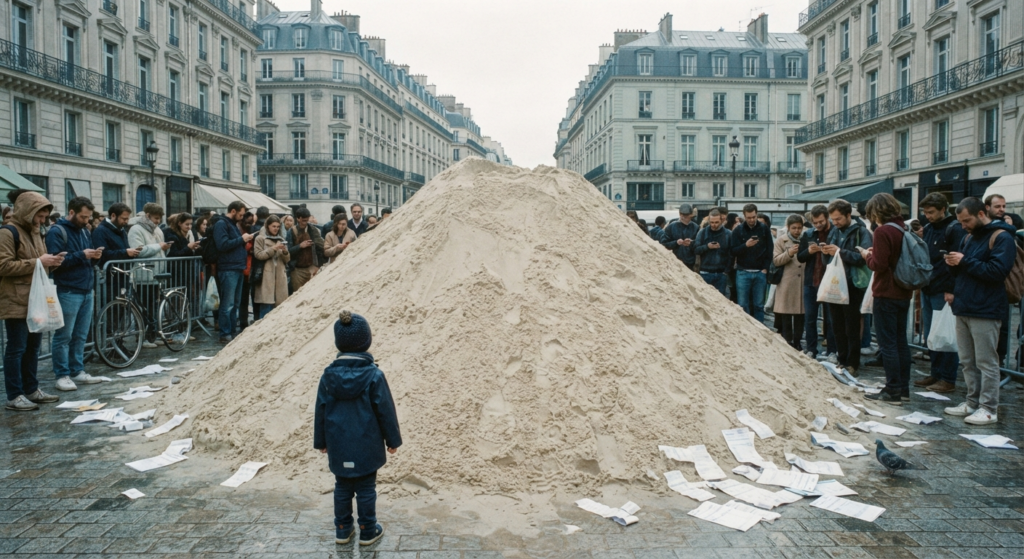
Il y a quelque chose d’étrange dans la manière dont nous regardons désormais l’art dans l’espace public. Nous ne le regardons plus, à vrai dire. Nous le comptons. Devant six cents tonnes de sable déposées au cœur de Nantes par Théo Mercier, devant la caverne creusée par JR sous l’image du Pont Neuf, la première question qui surgit sur les réseaux sociaux n’est pas « qu’est-ce que cela fait ? » mais « combien cela coûte ? ». Cette substitution d’une question à une autre n’est pas anecdotique. Elle signale une mutation du regard lui-même, et peut-être la fin d’une certaine idée du politique.
Mark Fisher avait donné un nom à cette atmosphère : le réalisme capitaliste. Non pas la croyance que le capitalisme serait le meilleur des systèmes, personne ou presque ne le croit, mais la sensation diffuse, presque climatique, qu’aucune alternative n’est pensable. Le réalisme capitaliste n’est pas une idéologie qu’on défendrait ; c’est un horizon qu’on respire. Et ce qui se joue autour de ces deux œuvres, c’est la manière dont cet horizon s’est infiltré jusque dans notre perception, transformant chaque citoyen en auditeur, chaque promeneur en contrôleur de gestion.
Ce qui m’intéresse ici n’est pas de défendre ces œuvres, ni de les attaquer. C’est de comprendre ce que leur réception révèle : la disparition d’un certain régime du possible dans l’espace public, et la clôture du regard sur le seul calculable.
La trahison
À Nantes, l’affaire semble simple. Une œuvre monumentale, un budget public, une sécheresse. La collision était prévisible, presque écrite d’avance. Mais ce qui mérite attention, c’est la structure de la trahison.
Le Voyage à Nantes n’a jamais présenté aux citoyens l’art comme une expérience du vertige ou de l’incalculable. Il l’a présenté et justifié, année après année, comme un investissement. L’art attire les touristes, remplit les hôtels, dynamise le commerce. Cette rhétorique n’était pas cynique ; elle se voulait protectrice. Pour défendre l’art contre l’accusation de gaspillage, l’institution a choisi de le rendre utile, c’est-à-dire de le justifier dans le langage même de ceux qui pourraient l’attaquer. Elle a cru immuniser l’art en le vaccinant avec le poison.
Or ce geste défensif contenait sa propre défaite. Car si l’art est un investissement, alors il doit rendre des comptes comme un investissement. Si l’art est un placement, alors le citoyen est un actionnaire, et l’actionnaire a le droit, mieux : le devoir, de vérifier le rendement. Le jour où la sécheresse est venue heurter le sable, personne ne s’est demandé ce que cette matière déplacée faisait à la ville, ce qu’elle ouvrait ou fermait dans l’expérience de l’espace. On s’est demandé si le ratio était bon. L’incohérence perçue n’était pas esthétique ; elle était budgétaire. L’œuvre n’a pas été jugée : elle a été auditée.
Il faut mesurer ce qui s’est perdu dans cette opération. L’institution n’a pas seulement mal défendu une œuvre ; elle a détruit la possibilité même du jugement esthétique en le remplaçant, préventivement, par le bilan comptable. Elle a appris au public à regarder avec une calculette. Et une fois cet apprentissage accompli, il n’y a plus de retour : on ne désapprend pas à compter.
La privatisation de l’espace public
JR, lui, semble avoir compris le piège. Sa caverne sous le Pont Neuf ne coûte « pas un centime au contribuable », la formule est répétée comme un talisman. Mécénat privé, Bloomberg, Snap. Le débat sur l’argent public est désamorcé avant même d’avoir lieu. Stratégie habile : là où Nantes a offert au public un bilan à éplucher, JR ne lui offre rien à compter : vous n’avez rien à dire puisque cela vous ne coûte rien, le droit à la parole n’est pas déterminé politiquement mais économiquement.
Mais l’évitement n’est pas une sortie ; c’est un déplacement. En se finançant par le capital privé, l’œuvre échappe à l’audit citoyen pour entrer dans un autre régime : celui de la vitrine. L’espace public — ce qui, par définition, n’appartient à personne parce qu’il appartient à tous — devient le support d’une visibilité de marque. Le citoyen ne paie rien, c’est entendu. Mais quelque chose lui est prélevé qui ne figure sur aucune facture : son patrimoine visuel, son droit à un espace qui ne soit pas déjà capté par un intérêt privé.
Et le politique, dans cette configuration ? Il se tait. Ce silence est peut-être plus grave que l’erreur nantaise. À Nantes, le politique s’est trompé de langage, mais il parlait encore ; il assumait un choix, une programmation, une volonté. Face à JR, il se contente de laisser faire. Il n’est plus le souverain qui décide de ce qui advient dans l’espace commun ; il est le gestionnaire qui constate qu’un espace était disponible et qu’il a trouvé preneur. L’abdication est complète : non pas parce qu’une mauvaise décision a été prise, mais parce que la décision elle-même a disparu.
Les deux cas dessinent ainsi une tenaille. D’un côté, l’art public justifié par l’utilité économique, donc soumis à l’audit. De l’autre, l’art public financé par le privé, donc soustrait au commun. Dans les deux cas, ce qui disparaît est identique : la possibilité qu’une chose existe dans l’espace public sans raison, sans rendement, sans propriétaire, la possibilité de l’inutile, c’est-à-dire la possibilité même.
La critique comme contradiction
C’est ici que le paradoxe de Fisher déploie toute sa cruauté. Car on pourrait croire que la colère populaire contre ces œuvres, les fils indignés sur les réseaux, les calculs de coin de table, les comparaisons avec les hôpitaux et les écoles, constitue une résistance. Il n’en est rien. Cette colère est le système en train de se parachever.
Quand la foule s’enflamme sur le prix du sable ou sur la publicité déguisée de la caverne, elle ne conteste pas l’ordre des choses ; elle en réclame une application plus rigoureuse. Elle ne dit pas : « nous voulons un autre monde ». Elle dit : « gérez mieux celui-ci ». La critique prend la forme de l’audit, et l’audit est précisément le regard que le réalisme capitaliste voulait généraliser. Le tour de magie est accompli : les dominés demandent eux-mêmes la suppression de ce qui échappe au calcul, au nom du calcul.
Il y a quelque chose de vertigineux dans cette boucle. La critique engagée croit s’opposer au pouvoir, mais elle en parle la langue, elle en valide les catégories, elle en reconduit le régime de discours. On sait ce qu’elle cherche, ce qu’elle énonce ; on reconnaît d’avance sa forme. Elle participe à la table des négociations dont elle croit renverser la table. Si l’art public disparaît un jour, ce ne sera pas par décret autoritaire : ce sera par demande populaire, formulée dans le vocabulaire de la bonne gestion, par un peuple épuisé d’austérité à qui l’on aura appris que seul ce qui rapporte a le droit d’exister, et qui aura fini par le croire, non par conviction, mais par fatigue.
Ce qui reste possible
Comment sortir de là ? La tentation est grande de répondre au « combien ça coûte ? » par une liste de solutions. Mais une telle liste resterait prise dans la logique qu’elle prétend quitter : à l’audit, elle opposerait un meilleur audit ; à la gestion, une gestion plus participative. Elle jouerait encore le jeu de l’échange, où toute critique appelle sa contre-proposition, où tout problème appelle sa solution, comme si la calculette pouvait être vaincue par une meilleure calculette. Il ne s’agit donc pas de proposer un programme, mais de décrire trois déplacements, trois manières de changer non pas les réponses, mais la position d’où les questions se posent.
Le premier déplacement concerne le débat comptable lui-même. Il ne faut ni le fuir, comme JR, ni s’y installer, comme Nantes : il faut l’épuiser. Publier les chiffres (le Voyage à Nantes est largement bénéficiaire pour l’économie locale, les données existent), non pour gagner la discussion mais pour la clore, pour lui retirer son statut de question. Car le propre du réalisme capitaliste n’est pas d’imposer de mauvaises réponses ; c’est de maintenir indéfiniment ouverte la seule question qu’il autorise. Tant que le « combien ? » reste en suspens, il occupe toute la place. Y répondre exhaustivement, c’est faire apparaître, par soustraction, ce que cette question recouvrait : une fois les colonnes équilibrées, il reste le sable, la caverne, et le silence embarrassant de ceux qui n’ont plus rien à compter. C’est dans ce silence que le jugement esthétique peut recommencer, non parce qu’on l’aura défendu, mais parce qu’on lui aura rendu son terrain.
Le deuxième déplacement concerne la position du citoyen. On propose souvent des comités tirés au sort pour choisir les œuvres, et l’idée n’est pas mauvaise, mais elle rate l’essentiel si elle se contente de déplacer le moment du vote. Un citoyen qui choisit entre trois projets déjà conçus, déjà budgétés, reste un actionnaire , on lui a seulement élargi le conseil d’administration. Ce qui change la donne, c’est d’être impliqué dans la genèse : là où rien n’est encore décidé, là où l’œuvre n’existe qu’à l’état de possible parmi d’autres possibles. Car la position de l’auditeur suppose que la chose soit finie, facturable, évaluable ; on ne peut auditer que ce qui est clos. Celui qui a fréquenté un projet quand il était encore ouvert, quand il pouvait ne pas être, ou être autrement, sait d’expérience que l’œuvre n’est pas une dépense mais une bifurcation. Il ne demande pas de comptes à ce qui aurait pu ne pas exister, parce qu’il a vu, de l’intérieur, que l’existence de l’œuvre n’allait pas de soi. C’est cette expérience de la contingence, et non la participation comme procédure, qui désarme la calculette : on ne compte pas ce qu’on a vu advenir. Ce travail d’élaboration est long, exige de l’investissement et demande, paradoxalement, à être rémunéré correctement.
Le troisième déplacement est le plus lent et le plus profond, car il porte sur le regard lui-même. On dira : il faut éduquer à l’art. Mais l’éducation artistique, telle qu’elle existe, forme surtout des consommateurs mieux informés, des gens qui savent pourquoi une œuvre est importante, c’est-à-dire des gens qui savent la justifier. Or justifier, c’est déjà compter dans une autre monnaie. Ce qu’il faudrait apprendre est plus étrange : soutenir le regard devant ce qui ne se justifie pas. Rester devant six cents tonnes de sable sans convertir l’expérience en argument, sans la traduire en retombées, en message, en engagement. Cet apprentissage n’est pas un supplément d’âme ; c’est un entraînement contre la capture, comparable à ce que serait, pour l’attention, un art martial. Il ne s’agit pas d’aimer l’art, mais de préserver en soi une zone où la question « à quoi cela sert-il ? » ne se déclenche pas automatiquement, car c’est cet automatisme, plus que n’importe quelle politique, qui constitue le réalisme capitaliste en chacun de nous.
On voit alors pourquoi l’inutile et le possible sont une seule et même chose, et non deux valeurs qu’on rapprocherait par goût de la formule. Ce qui est utile est, par définition, déterminé par sa fin : l’outil est clos sur sa fonction, l’investissement sur son rendement. L’utile est le nom de ce dont l’existence est déjà justifiée, donc déjà décidée, donc déjà fermée. L’inutile, à l’inverse, est ce qui existe sans que son existence soit déduite de rien, ce qui aurait pu ne pas être, et qui est pourtant là. En ce sens précis, l’inutile est la seule expérience publique de la contingence : la preuve, déposée au milieu de la ville, que le monde tel qu’il est n’épuise pas ce qui peut être. Supprimer l’inutile, ce n’est donc pas faire des économies ; c’est fermer la démonstration, quotidienne et matérielle, qu’autre chose est possible. Voilà pourquoi le réalisme capitaliste s’acharne sur l’art public avec une énergie sans proportion avec les sommes en jeu : quelques millions d’euros ne menacent rien, mais une brèche dans l’évidence menace tout.
C’est peut-être là que se loge la politique véritable de l’art public : non dans ses messages, non dans ses engagements affichés, mais dans le simple fait qu’il maintienne, au milieu de la ville, quelque chose qui reste possible sans avoir à se justifier d’être. Le jour où nous accepterons de nouveau qu’une œuvre puisse exister sans prix ni preuve, nous n’aurons pas seulement sauvé l’art public. Nous aurons commencé à respirer un autre air que celui du réalisme capitaliste, cet air raréfié où tout ce qui compte doit se compter. Ce qui compte le plus ne se compte jamais. Encore faut-il des lieux, dans la ville, pour s’en souvenir.
There is something strange about the way we now look at art in public spaces. In truth, we no longer look at it; we count it. Faced with six hundred tons of sand deposited in the heart of Nantes by Théo Mercier, or the cave carved by JR beneath the image of the Pont Neuf, the first question that arises on social media is not “what does this do?” but “how much does it cost?” This substitution of one question for another is not anecdotal. It signals a mutation in the gaze itself, and perhaps the end of a certain idea of politics.
Mark Fisher gave a name to this atmosphere: capitalist realism. It is not the belief that capitalism is the best of systems—hardly anyone believes that—but the diffuse, almost climatic sensation that no alternative is conceivable. Capitalist realism is not an ideology one defends; it is a horizon one breathes. And what is at play around these two works is the way this horizon has infiltrated our perception, transforming every citizen into an auditor, every pedestrian into a management controller. My interest here is not to defend these works, nor to attack them. It is to understand what their reception reveals: the disappearance of a certain regime of the possible in public space, and the closure of the gaze onto the purely calculable.
The Betrayal
In Nantes, the matter seems simple. A monumental work, a public budget, a drought. The collision was foreseeable, almost written in advance. But what deserves attention is the structure of the betrayal.
The Voyage à Nantes never presented art to citizens as an experience of vertigo or the incalculable. It presented and justified it, year after year, as an investment. Art attracts tourists, fills hotels, stimulates business. This rhetoric was not cynical; it was intended to be protective. To defend art against accusations of waste, the institution chose to make it useful—that is, to justify it in the very language of those who might attack it. It believed it could immunize art by vaccinating it with the poison.
However, this defensive gesture contained its own defeat. For if art is an investment, then it must account for itself like an investment. If art is an asset, then the citizen is a shareholder, and the shareholder has the right—or rather, the duty—to verify the return. The day the drought hit the sand, no one asked what this displaced matter did to the city, or what it opened or closed in the experience of space. They asked if the ratio was good. The perceived inconsistency was not aesthetic; it was budgetary. The work was not judged: it was audited.
One must measure what was lost in this operation. The institution did not merely defend a work poorly; it destroyed the very possibility of aesthetic judgment by replacing it, preventively, with the accounting balance sheet. It taught the public to look with a calculator. And once this learning is accomplished, there is no going back: one does not unlearn how to count.
The Privatization of Public Space
JR, for his part, seems to have understood the trap. His cave under the Pont Neuf costs “not a penny to the taxpayer,” a formula repeated like a talisman. Private patronage, Bloomberg, Snap. The debate over public money is defused before it can even take place. A clever strategy: where Nantes offered the public a balance sheet to scrutinize, JR offers them nothing to count. You have nothing to say since it costs you nothing; the right to speak is determined not politically, but economically.
But avoidance is not an exit; it is a displacement. By funding itself through private capital, the work escapes citizen audit to enter another regime: that of the storefront. Public space—which, by definition, belongs to no one because it belongs to everyone—becomes the medium for brand visibility. The citizen pays nothing, that is understood. But something is taken from them that does not appear on any invoice: their visual heritage, their right to a space that is not already captured by private interest.
And politics, in this configuration? It remains silent. This silence is perhaps more serious than the Nantes error. In Nantes, politics used the wrong language, but it was still speaking; it assumed a choice, a program, a will. Faced with JR, it merely lets things happen. It is no longer the sovereign that decides what happens in the common space; it is the manager who notes that a space was available and that it found a taker. The abdication is complete: not because a bad decision was made, but because the decision itself has disappeared.
The two cases thus draw a pincer movement. On one side, public art justified by economic utility, and therefore subject to audit. On the other, public art financed by the private sector, and therefore removed from the common. In both cases, what disappears is identical: the possibility that a thing might exist in public space without reason, without return, without an owner—the possibility of the useless, that is to say, possibility itself.
Criticism as Contradiction
It is here that Fisher’s paradox unfolds all its cruelty. For one might believe that the popular anger against these works—the indignant threads on social media, the back-of-the-envelope calculations, the comparisons with hospitals and schools—constitutes resistance. It is nothing of the sort. This anger is the system in the process of completing itself.
When the crowd flares up over the price of sand or the disguised advertising of the cave, it does not challenge the order of things; it demands a more rigorous application of it. It does not say: “we want another world.” It says: “manage this one better.” Criticism takes the form of an audit, and the audit is precisely the gaze that capitalist realism sought to generalize. The magic trick is accomplished: the dominated themselves demand the suppression of what escapes calculation, in the name of calculation.
There is something dizzying about this loop. The engaged critic thinks they are opposing power, but they speak its language, validate its categories, and reproduce its regime of discourse. One knows what they are looking for, what they are stating; one recognizes its form in advance. They participate at the negotiating table they think they are overturning. If public art disappears one day, it will not be by authoritarian decree: it will be by popular demand, formulated in the vocabulary of good management, by a people exhausted by austerity who have been taught that only what is profitable has the right to exist, and who will have ended up believing it—not out of conviction, but out of fatigue.
What Remains Possible
How do we get out of this? The temptation is great to answer the “how much does it cost?” question with a list of solutions. But such a list would remain caught in the logic it claims to abandon: to the audit, it would oppose a better audit; to management, a more participatory management. It would still play the game of exchange, where every critique calls for its counter-proposal, where every problem calls for its solution, as if the calculator could be defeated by a better calculator. The goal, therefore, is not to propose a program, but to describe three displacements—three ways of changing not the answers, but the position from which the questions are asked.
The first displacement concerns the accounting debate itself. One must neither flee from it, like JR, nor settle into it, like Nantes: one must exhaust it. Publish the figures (the Voyage à Nantes is largely profitable for the local economy; the data exists), not to win the discussion but to close it, to strip it of its status as a question. For the hallmark of capitalist realism is not to impose bad answers; it is to keep the only question it authorizes open indefinitely. As long as the “how much?” remains in suspense, it occupies all the space. Answering it exhaustively means revealing, by subtraction, what this question covered: once the columns are balanced, what remains is the sand, the cave, and the embarrassing silence of those who have nothing left to count. It is in this silence that aesthetic judgment can begin again, not because we have defended it, but because we have returned its terrain to it.
The second displacement concerns the position of the citizen. People often propose committees chosen by lottery to select works, and the idea is not bad, but it misses the essential point if it merely shifts the moment of voting. A citizen who chooses between three projects already designed, already budgeted, remains a shareholder; they have simply been granted a seat on the board of directors. What changes the situation is to be involved in the genesis: where nothing is yet decided, where the work exists only as a possibility among other possibilities. For the position of the auditor assumes that the thing is finished, billable, evaluable; one can only audit what is closed. Someone who has engaged with a project when it was still open, when it could have not been, or could have been otherwise, knows from experience that the work is not an expense but a bifurcation. They do not demand accounts from something that could have not existed, because they have seen, from the inside, that the existence of the work was not a given. It is this experience of contingency, rather than participation as a procedure, that disarms the calculator: one does not count what one has seen coming into being. This work of elaboration is long, requires investment, and, paradoxically, requires being paid properly.
The third displacement is the slowest and deepest, as it concerns the gaze itself. One might say: we must educate people in art. But artistic education, as it exists, mostly trains better-informed consumers, people who know why a work is important—that is, people who know how to justify it. Yet, to justify is already to count in a different currency. What we should learn is stranger: to sustain the gaze before what does not justify itself. To stand before six hundred tons of sand without converting the experience into an argument, without translating it into benefits, into a message, into a commitment. This learning is not a “supplement of the soul”; it is training against capture, comparable to what a martial art would be for attention. It is not about liking art, but about preserving within oneself a zone where the question “what is this for?” does not trigger automatically, for it is this automatism, more than any policy, that constitutes capitalist realism within each of us.
We then see why the useless and the possible are one and the same thing, and not two values that one might bring together out of a taste for turns of phrase. The useful is, by definition, determined by its end: the tool is closed on its function, the investment on its return. The useful is the name of that whose existence is already justified, therefore already decided, therefore already closed. The useless, conversely, is what exists without its existence being deduced from anything, what could have not been, yet is here nonetheless. In this precise sense, the useless is the only public experience of contingency: the proof, deposited in the middle of the city, that the world as it is does not exhaust what can be. To suppress the useless, therefore, is not to save money; it is to close the daily, material demonstration that something else is possible. This is why capitalist realism attacks public art with an energy disproportionate to the sums involved: a few million euros do not threaten anything, but a breach in the obvious threatens everything.
Perhaps this is where the true politics of public art lies: not in its messages, not in its displayed commitments, but in the simple fact that it maintains, in the middle of the city, something that remains possible without having to justify its existence. The day we accept again that a work can exist without a price or proof, we will not only have saved public art. We will have begun to breathe an air other than that of capitalist realism, that rarefied air where everything that counts must be counted. What counts most is never counted. Yet, we still need places in the city to remember that.