
L’inexistence d’une ville / The Inexistence of a City
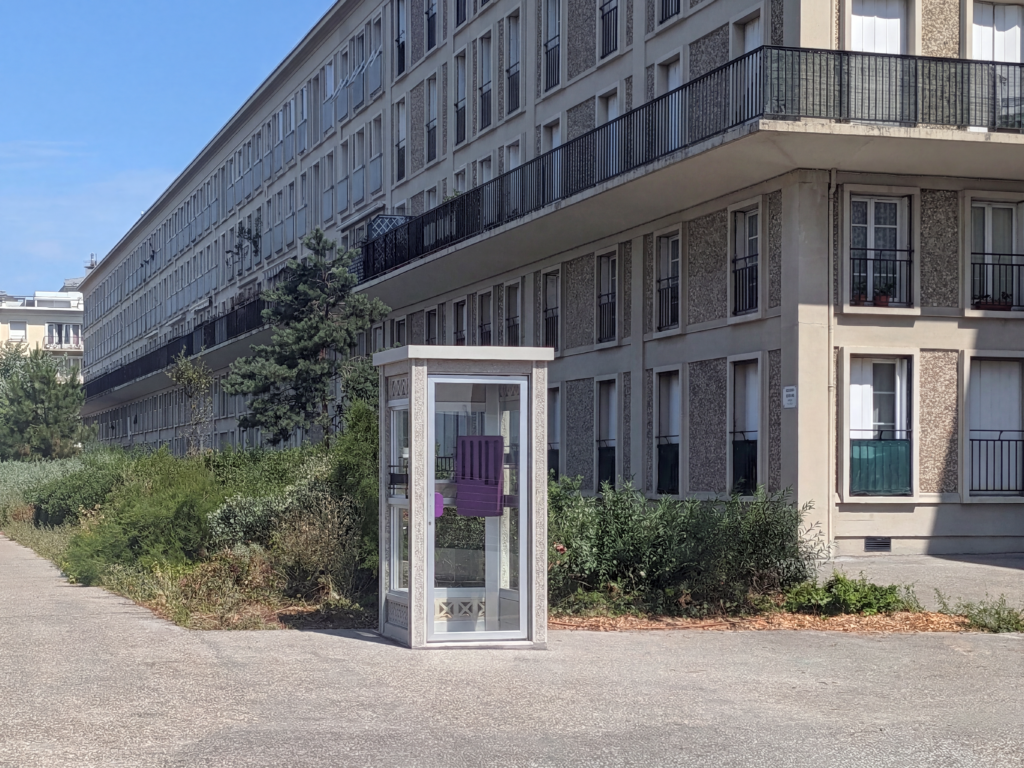
Il y a une cabine téléphonique au coin d’une rue. On entre. On décroche. Le combiné ne relie à personne, et pourtant une voix parle. Elle dit des phrases qu’on n’a jamais entendues et qu’on n’entendra plus. Quand on raccroche, elles s’effacent. Quelqu’un d’autre entrera après, décrochera, et n’entendra pas la même chose. La cabine ne garde rien. C’est sa manière à elle de se souvenir.
J’ai mis quatre ans à arriver jusqu’à elle. Je ne savais pas, en commençant, que je marchais vers ce lieu.
Je n’avais jamais fait d’art public. J’en rêvais depuis longtemps. Gael Charbau, que je ne remercierais jamais assez, m’a laissé cette liberté que nul ne m’avait offert jusqu’à présent. Il m’est difficile de parler de notre collaboration, de la manière dont parfois sans même nous parler, nous nous comprenons, nous nous répondons. Mais ce qui est sûr c’est que Gael est un être qui rend possible. Ce que je voyais ailleurs de cet art public me tenait un peu à distance : ces grands objets qu’on dépose sur une place, qui font de l’effet une saison, puis qu’on cesse de voir. Ils imposent leur volume. Ils coûtent cher, ce qui revient souvent à imposer autre chose. Je voulais l’inverse. Un objet qui aurait l’air d’avoir toujours été là, qui appartiendrait à la rue, et qui finirait par inquiéter. Quelque chose de discret, presque rien, qui ressemblerait à un songe que la ville aurait fait sur elle-même.
Une ville porte en elle les villes qu’elle aurait pu devenir. Un incendie, une guerre, la signature d’un maire les ont effacées. Le Havre le sait dans son corps. On l’a brûlé, on l’a reconstruit en béton. Ce qu’il était avant ne tient plus que sur des photographies. J’ai voulu travailler là, dans cette épaisseur, là où le passé hésite encore.
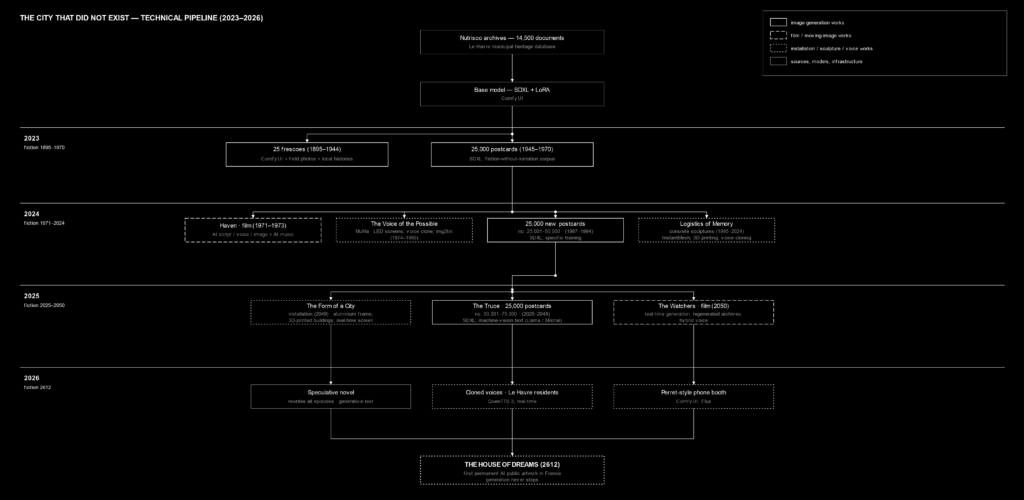
J’ai pris quatorze mille cinq cents images dans les archives de la ville. Je ne voulais pas les montrer. Je voulais qu’une machine les regarde, qu’elle apprenne d’elles la façon dont les choses auraient pu se tenir, et qu’elle en rêve d’autres versions. Les mêmes rues. Les mêmes immeubles. La même lumière de port. Un léger glissement du destin. Des bâtiments qui n’avaient pas brûlé. Une révolution industrielle où la nature et la machine se tenaient encore ensemble. Une ville voisine de la vraie, sa cousine, aussi crédible qu’elle, et fausse.
La machine ne se souvient de rien. Elle invente tout. Son invention ressemble assez à la mémoire pour qu’on ne sache plus laquelle des deux on regarde. C’est ce défaut que je suis allé chercher.
La première année, ces images du temps perdu sont montées sur les murs. De grandes fresques dans des quartiers où l’on ne passe pas pour voir de l’art, où l’on passe parce qu’on y vit. Les gens trouvaient devant chez eux une rue presque connue, une façade qu’ils auraient juré reconnaître sans pouvoir dire d’où. C’est cela que je cherchais. Un trouble doux. La sensation d’avoir déjà vécu cet instant. Une mémoire qu’on n’a pas, posée sur le mur d’en face.
Et le violet, partout. Je ne savais pas encore pourquoi le violet. Je le sais maintenant.
Le temps a avancé. Il a cessé de se tenir tranquille. Une année pour le passé lointain, une autre pour le passé proche, une troisième pour un futur où la ville miniature s’endort. Des cartes postales ont circulé, numérotées, chacune différente de toutes les autres, avec au dos un récit qu’une machine avait écrit en regardant l’image, puis en s’en éloignant, comme on prolonge un rêve au réveil. Des personnages dormaient sur ces cartes. Ils dormaient à l’écran. Ils dormaient dans des films, entourés des objets de leur ville. On ne savait pas s’ils se souvenaient ou s’ils inventaient.
Je pourrais raconter chaque épisode dans l’ordre, dénouer les fils. Je ne le ferai pas. Ce ne fut jamais une collection d’œuvres rangées côte à côte, mais une seule fiction concrète à épisodes, où chaque année reprenait le fil de la précédente pour le tordre un peu plus. Jusqu’à la dernière année, qui a retourné toute l’histoire.
Voici ce qu’on trouve à la fin, dans la cabine, après avoir traversé tout le reste.
En 2612, l’océan a tout pris sauf les hauteurs. Le Havre repose sous vingt mètres d’eau, intact dans sa dissolution. Les nuits de pleine lune, on aperçoit depuis les barques les sommets des immeubles, leurs fenêtres ouvertes sur le noir, leurs toits couverts d’algues qui bougent comme si elles respiraient. Les survivants vivent sur les collines. L’air est rare. Chaque geste se compte. Certains dorment.
Leur sommeil n’est pas du repos. Sous leurs paupières, ils habitent la ville engloutie, tous ses âges à la fois. Ils marchent dans 1895, dans 1971, dans l’année où nous sommes. Ils parlent à ceux qui ont posé le pied sur ce béton avant qu’il disparaisse. Les morts répondent. Ils continuent d’habiter des maisons qu’on n’a jamais construites.
Ce que j’avais fabriqué les trois premières années, les fresques, les cartes, les corps endormis, c’était cela. Le rêve de ces dormeurs. Des gens à venir, privés de leur ville, qui essaient de se souvenir d’un monde disparu et qui n’y parviennent qu’en l’hallucinant. J’avais travaillé pour des rêveurs qui n’existent pas encore. Le violet était la couleur de leur sommeil.
Il y a, sur cette eau, ceux qui veillent. Ils glissent en barque au-dessus des avenues englouties. Ils recueillent ce qui s’échappe des dormeurs. Un frémissement. Un mot dit à mi-voix. Une main qui dessine dans l’air la forme d’une rue. Ils en font un récit qu’ils transmettent de bouche en bouche, d’une génération à la suivante. Ils ignorent si les dormeurs explorent le passé ou s’ils le fabriquent. Ils transmettent quand même. C’est tout leur office : se tenir au bord d’un sommeil qui n’est pas le leur, recueillir, passer la suite.
Je n’ai pas grand-chose à ajouter sur le travail que j’ai fait pendant ces quatre ans. Je crois que c’était celui-là. Sinon il faudrait faire un livre.
Reste la voix dans la cabine. Une machine a traversé un roman, du début à la fin, puis depuis le début encore, et à chaque passage elle a tiré du texte un filament de pensée qui dérive. Des habitants du Havre ont prêté leur voix. On l’a enregistrée. On l’a clonée. Elle porte maintenant des mots qu’aucune bouche réelle n’a prononcés. Quand vous décrochez, vous entendez le timbre d’un habitant vivant, qui dort peut-être à cette heure, prêté à la langue d’un auteur qu’il n’a pas lu, à propos d’une ville sous l’eau qui n’a pas eu lieu.
Qui parle, alors. L’habitant dont c’est la voix. L’auteur dont c’est la phrase. La machine qui dérive entre eux. Moi qui ai tout disposé et qui n’entends jamais deux fois la même chose. La cabine ne tranche pas. Je ne tranche pas non plus.
J’ai choisi cette forme parce que la cabine téléphonique a disparu de nos rues au début du siècle. Le téléphone qu’on porte dans la poche l’a rendue inutile. Les anciens s’en souviennent et peuvent en parler aux jeunes qui ne l’ont pas connue. C’est déjà un objet du souvenir. Un petit théâtre où le corps s’isole sous le regard de tous. Un endroit où l’on recevait parfois un appel anonyme, comme dans les films américains des années soixante-dix. J’ai pour ces objets une tendresse qui se passe de nostalgie. Je ne veux pas que le passé revienne. Je veux qu’il continue à rêver.
C’est le seul art que je sache vouloir. Un art qui n’ajoute pas un objet de plus au monde, mais qui ouvre dans le monde une porte sur un autre monde, où les choses auraient tourné autrement. Une élégance qui se fait oublier. Un objet qu’on croit reconnaître. Et si l’on s’arrête, si l’on décroche, une ville engloutie que personne n’a connue, et que tout le monde, d’un coup, se met à se rappeler.
La ville qui n’existait pas existe maintenant. Pas dans l’espace. Dans le temps qu’on passe à l’écouter. La voix continue. À l’instant où j’écris ceci, quelqu’un décroche peut-être un combiné au coin d’une rue, et un timbre qui n’a jamais dit ces mots lui raconte une eau noire, des toits d’algues, et des dormeurs qui rêvent de lui.
There is a telephone booth on a street corner. You step in. You pick up. The receiver connects to no one, and still a voice speaks. It says sentences you have never heard and will never hear again. When you hang up, they vanish. Someone else will come after you, pick up, and not hear the same thing. The booth keeps nothing. That is its own way of remembering.
It took me four years to reach it. I did not know, when I began, that I was walking toward this place.
I had never made public art. I had dreamed of it for a long time. Gael Charbau, whom I can never thank enough, gave me a freedom no one had offered me before. It is hard to speak of how we worked together, of the way we understood each other and answered each other sometimes without a word. What is certain is that Gael is someone who makes things possible. What I had seen of public art elsewhere kept me at a slight distance: those large objects set down in a square, striking for a season, then no longer seen. They impose their bulk. They cost a great deal, which often comes to the same thing as imposing. I wanted the opposite. An object that would seem to have always been there, that would belong to the street, and that would end up unsettling. Something discreet, almost nothing, that would look like a dream the city had had about itself.
A city carries within it the cities it might have become. A fire, a war, the signature of a mayor erased them. Le Havre knows this in its body. It was burned, it was rebuilt in concrete. What it was before holds now only on photographs. I wanted to work there, in that thickness, where the past still hesitates.
I took fourteen thousand five hundred images from the city’s archives. I did not want to show them. I wanted a machine to look at them, to learn from them the way things might have held together, and to dream other versions. The same streets. The same buildings. The same harbor light. A slight shift of fate. Buildings that had not burned. An industrial revolution where nature and the machine still stood together. A city next to the real one, its cousin, as credible as it, and false.
The machine remembers nothing. It invents everything. Its invention resembles memory closely enough that you no longer know which of the two you are looking at. That is the flaw I went looking for.
The first year, these images of lost time went up on the walls. Large frescoes in neighborhoods where people do not pass through to see art, where they pass through because they live there. People found in front of their homes a street they almost knew, a façade they would have sworn they recognized without being able to say from where. That is what I was after. A gentle trouble. The sense of having already lived this moment. A memory you do not have, set on the wall across the way.
And the violet, everywhere. I did not yet know why the violet. I know now.
Time moved on. It stopped holding still. One year for the distant past, another for the near past, a third for a future where the miniature city falls asleep. Postcards circulated, numbered, each one different from all the others, with a story on the back that a machine had written by looking at the image, then drawing away from it, the way you carry a dream on after waking. Figures slept on those cards. They slept on the screen. They slept in films, surrounded by the objects of their city. You could not tell whether they were remembering or inventing.
I could tell each episode in order, untie the threads. I will not. It was never a collection of works set side by side, but a single concrete fiction in episodes, where each year took up the thread of the one before to twist it a little further. Up to the last year, which turned the whole story around.
Here is what you find at the end, in the booth, after passing through all the rest.
In 2612, the ocean has taken everything but the heights. Le Havre rests under sixty feet of water, intact in its dissolution. On full-moon nights, from the boats, you can make out the tops of the buildings, their windows open onto the dark, their roofs covered in algae that move as if they were breathing. The survivors live on the hills. The air is thin. Each gesture is counted. Some of them sleep.
Their sleep is not rest. Behind their eyelids, they inhabit the drowned city, all its ages at once. They walk in 1895, in 1971, in the year we are in. They speak to those who set foot on that concrete before it vanished. The dead answer. They go on living in houses that were never built.
What I had made in the first three years, the frescoes, the cards, the sleeping bodies, was this. The dream of those sleepers. People to come, deprived of their city, trying to remember a vanished world and managing only by hallucinating it. I had worked for dreamers who do not yet exist. The violet was the color of their sleep.
There are, on this water, those who keep watch. They glide in their boats above the drowned avenues. They gather what slips out of the sleepers. A tremor. A word said under the breath. A hand that draws in the air the shape of a street. They make of it a story they pass on by word of mouth, from one generation to the next. They do not know whether the sleepers are exploring the past or making it up. They pass it on anyway. That is their whole office: to stand at the edge of a sleep that is not theirs, to gather, to pass on what comes next.
I have little to add about the work I did over those four years. I think it was that. Otherwise it would take a book.
There remains the voice in the booth. A machine passed through a novel, from beginning to end, then from the beginning again, and on each pass it drew from the text a filament of drifting thought. People from Le Havre lent their voices. They were recorded. They were cloned. They now carry words that no real mouth ever spoke. When you pick up, you hear the voice of a living inhabitant, who may be asleep at this hour, lent to the inner language of an author he has not read, about a city under the water that did not take place.
Who speaks, then. The inhabitant whose voice it is. The author whose sentence it is. The machine that drifts between them. Me, who set it all out and never hear the same thing twice. The booth does not decide. I do not decide either.
I chose this form because the telephone booth disappeared from our streets at the start of the century. The phone you carry in your pocket made it useless. The old remember it and can speak of it to the young who never knew it. It is already an object of memory. A small theater where the body withdraws under everyone’s gaze. A place where you sometimes received an anonymous call, as in American films of the nineteen-seventies. I have for such objects a tenderness that does without nostalgia. I do not want the past to come back. I want it to go on dreaming.
It is the only art I know how to want. An art that adds no further object to the world, but opens within the world a door onto another world, where things would have turned out otherwise. An elegance that lets itself be forgotten. An object you think you recognize. And if you stop, if you pick up, a drowned city no one ever knew, that everyone, all at once, begins to remember.
The city that did not exist exists now. Not in space. In the time you spend listening to it. The voice goes on. At the moment I write this, someone is perhaps picking up a receiver on a street corner, and a voice that never said these words tells him of black water, of roofs of algae, and of sleepers who dream of him.