
Dépeupler l’espace latent / Depopulating the Latent Space
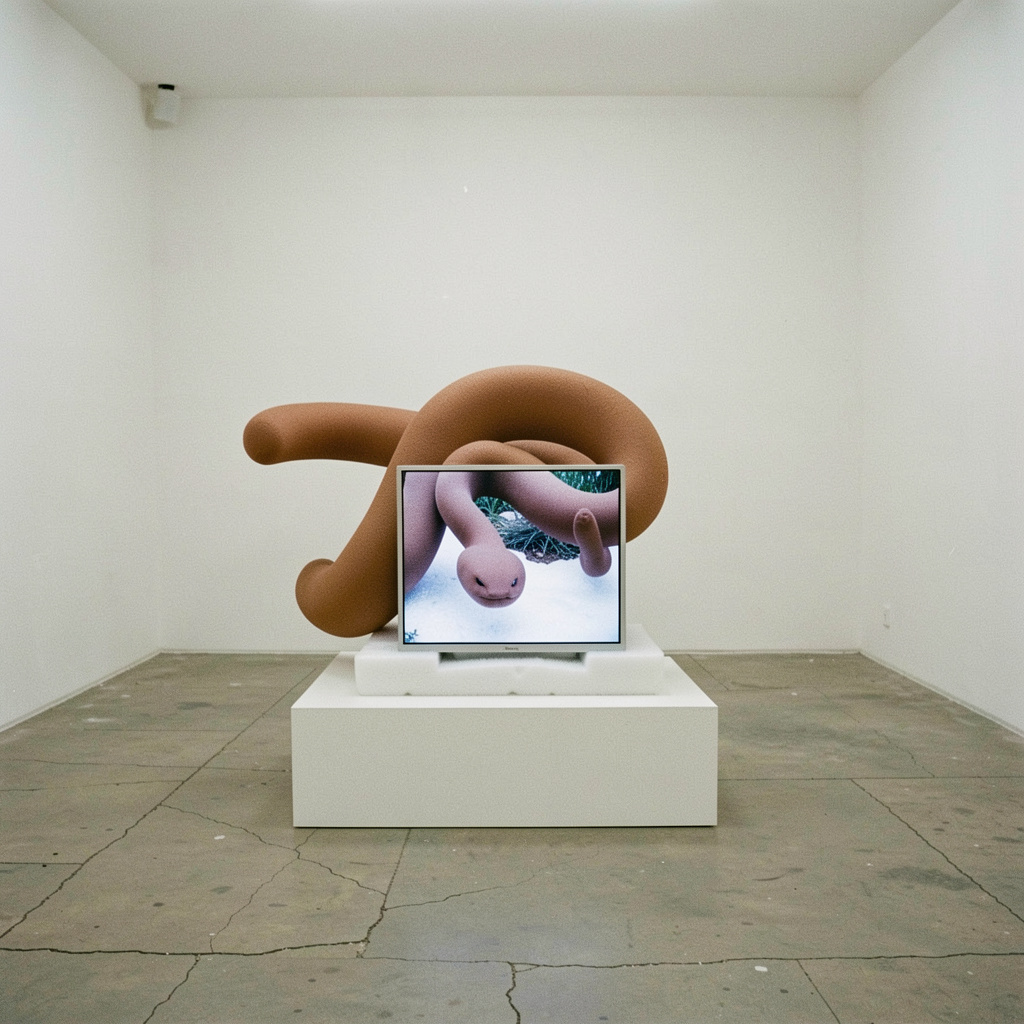
Comment opère-t-on la coupure avant la génération ? La question paraît mal formée, puisqu’elle demande de sélectionner ce qui n’existe pas encore, de séquencer des termes dont aucun n’a été produit. Elle s’est pourtant imposée par le travail, au moment où j’ai cessé d’utiliser les modèles génératifs pour fabriquer des images à moindre coût et où j’ai commencé à leur confier la manière même dont un film pouvait être imaginé. Ce que je croyais être un outillage nouveau au service d’une opération ancienne s’est révélé être une redistribution complète des moments et des agents de cette opération. Je ne suis plus un éditeur qui ordonne du matériel préexistant. J’apprends à devenir sensible à un espace intégralement potentiel, et cette sensibilité n’a pas de précédent dans l’histoire du montage.
Cette histoire, on peut la raconter selon quatre instances. À l’émission, les éditeurices assemblent et agencent les matériaux qui forment une œuvre. Dans la circulation, les programmateurices sélectionnent parmi les œuvres disponibles pour composer une grille, un agenda, une collection. À la réception, les attendeureuses disposent d’une liberté variable de diriger leur attention, de regarder ailleurs, de zapper, et sans cette attention aucune des opérations précédentes n’aurait de sens. Une quatrième instance est devenue proéminente au début du XXIe siècle, quand le capitalisme de plateforme a confié aux algorithmes de recommandation la composition des flux qui parviennent effectivement à nos attentions, en deçà de nos personnes et au-delà de nos identifications subjectives. Sa puissance tient à sa granularité : elle n’opère plus sur des plans ou des phrases, unités déjà chargées de sens, mais sur des pixels et des vecteurs, entités a-signifiantes qui ne deviennent porteuses de signification que par composition. Ces quatre instances effectuent un mondage. Elles constituent ce qui comptera comme monde commun, ce qui aura du poids, ce qui existera pour une sensibilité partagée.
Elles ont en commun une propriété que la théorie n’a jamais eu besoin d’expliciter, parce qu’aucune situation ne l’avait rendue visible : toutes opèrent sur un stock. Monter, programmer, recommander supposent que les termes de l’opération existent déjà comme objets dénombrables, indexables, retrouvables. Le montage retire un plan qui a été tourné, la programmation écarte un film qui a été produit, la recommandation enfouit une vidéo qui reste en ligne. Chacune de ces opérations laisse derrière elle son propre reste, les chutes, les refusés, les invisibilisés, et ce reste demeure théoriquement disponible. C’est cette disponibilité résiduelle qui rend possible la critique du montage, l’histoire des œuvres censurées, la sociologie des programmations, l’audit des systèmes de recommandation. On peut toujours demander ce qui a été coupé, parce que ce qui a été coupé subsiste quelque part comme objet.
L’espace latent défait cette propriété. Il ne contient pas d’images. Il contient une distribution de probabilités sur des configurations possibles, une topologie de proximités statistiques où les formes n’existent que comme régions plus ou moins denses. Y intervenir revient à modifier les chances qu’une configuration advienne, non à retirer un objet d’un ensemble. Quand j’ai commencé à travailler sur Haven, invité quatre années consécutives dans le cadre d’Un Été au Havre, j’ai compris que la première opération ne pouvait être l’addition. L’espace latent constitue d’abord une saturation : les modèles ont absorbé des quantités inimaginables d’images standardisées, alignées sur des moyennes, constituant une hypermnésie technologique qui nous excède alors même que nous l’avons produite. Il n’en émerge que du probable, du médian, du déjà-vu réchauffé. Pour qu’une ville disfactuelle advienne, il fallait dépeupler : retirer la banalité majoritaire, écarter les résonances faciles, produire un silence dans la saturation. Puis repeupler, par un fine-tuning fondé sur les archives municipales du Havre, la base Nutrisco, qui ne sert pas à reproduire la ville historique mais fonctionne comme grammaire, comme apprentissage d’une autre tonalité et d’une autre densité possible de ce qu’une ville pourrait être.
Ce dépeupler-repeupler constitue une cinquième instance, et je voudrais préciser en quoi elle ne se réduit pas à l’éditorialisation redescendue d’un cran. Lorsque je retire d’une matrice les résonances majoritaires, je ne supprime aucune image, puisque aucune image n’y était. Je déforme un paysage de vraisemblance. Ce qui disparaît n’est pas un objet mais une facilité, une pente, une probabilité de retour. L’opération ne produit donc aucun reste. Il n’existe pas d’inventaire de ce que le dépeuplement a rendu improbable, aucune archive des chutes, aucune liste des configurations devenues inatteignables. La coupure s’exerce sur ce qui n’a pas de nom et ne laisse aucune trace de son exercice. Une matrice fine-tunée se présente comme un espace homogène, également disponible en tous ses points, alors qu’elle porte inscrite dans ses poids une décision qu’aucune inspection ne restituera sous forme de liste. C’est un montage dont le montage même est illisible.
Cette illisibilité change le statut politique de l’opération. Les quatre instances précédentes pouvaient être contestées parce qu’elles laissaient apparaître leur geste : on compare le rush et le film, le catalogue et la programmation, le corpus disponible et le flux recommandé. La cinquième ne se contredit pas de l’extérieur, parce qu’elle ne se manifeste que dans la vraisemblance de ce qu’elle rend possible. Elle configure non pas ce que nous voyons mais l’espace de ce qui peut nous apparaître, et cet espace se donne toujours comme allant de soi, comme la texture même du plausible. Il faut mesurer que cette opération n’est nullement une singularité artistique. Chaque modèle commercial est une matrice dépeuplée et repeuplée selon des critères de sécurité, de conformité, de rentabilité, dont l’effet est de resserrer la distribution autour de ses régions les plus denses. Le vectofascisme ne commence pas au moment où un flux nous est recommandé. Il commence dans la constitution d’un espace où certaines formes n’ont statistiquement plus de chances d’advenir, et où cette impossibilité se donne comme une absence d’intérêt, une invraisemblance, un manque de qualité. La question de savoir qui tient la matrice précède celle de savoir qui programme le flux, et elle est moins visible d’un ordre de grandeur.
C’est pourquoi le dépeupler-repeupler ne me paraît praticable qu’avec des modèles locaux et ouverts, et c’est aussi pourquoi il expose sa perspective au lieu de la dissimuler. Une matrice entraînée sur les archives d’une ville portuaire ne prétend à aucune neutralité statistique. Elle déclare son parti pris dans son corpus. Ce qu’une pratique artistique peut apporter ici n’a rien d’une résistance de masse, mais consiste à rendre l’opération matricielle perceptible en la conduisant délibérément, à échelle réduite, pour qu’on puisse constater qu’elle a lieu partout ailleurs sans être conduite par personne d’identifiable.
J’avais approché cette question longtemps avant d’en avoir les moyens techniques. Depuis Le Tempo des Possibles, en 2003, j’ai soutenu que le montage cinématographique, structuré par la linéarité de vingt-quatre images par seconde et par la causalité narrative, ne pouvait rendre compte de l’excès anthropotechnologique produit par l’hypermnésie du Web, dont la disponibilité dépassait par principe toute capacité humaine de sélection. Il fallait un tempo variable, une opération granularisée à l’échelle infinitésimale, effectuant ses sélections sous le seuil de la perception. Entre 1998 et 2009, Incident of the last century 1999 et La révolution a eu lieu à New York exploraient cette fiction sans narration, montage anarchique et rythmé où aucune projection n’était identique, où le programme composait en continu un flux excédant toute consommation. L’œuvre grandissait plus vite que le temps passé à la regarder. Memories Center, en 2014, a poussé cette intuition en montant la mémoire elle-même : une base de rêves constituée par deux psychologues de l’Université de Santa Clara devenait chaînes de Markov générant des rêves inédits, lus par voix synthétique, dont les mots dominants déclenchaient la récupération en temps réel d’images provenant du Web. Des rêves humains entraînaient l’algorithme à prédire le mot suivant, ces mots généraient d’autres rêves, ces rêves appelaient des images que personne n’avait rêvées. L’imagination y précédait la signification herméneutique.
Ces pièces installaient un programmateur machinique à l’intérieur de l’œuvre, mais elles restaient prises dans la logique du stock. La combinatoire s’ouvrait, le tempo variait, et chaque élément avait pourtant été capté, indexé, conservé. La variation portait sur l’ordre, jamais sur l’existence des termes. On pouvait, en principe, dresser la liste de ce qui composait ces travaux. Ce que le passage à la génération rend impossible, c’est précisément cette liste.
Dans Haven, les images fixes ont été générées par des prompts variables contenant des millions de possibilités, l’objectif n’ayant jamais été d’obtenir l’image désirée ni de valoriser le glitch comme signature d’auteur, mais de produire un monde d’images. Chaque prompt générait des centaines d’images appartenant au même lieu, automatiquement animées, puis classées à la main selon le thème implicite qui s’y dessinait. Vingt-cinq mille cartes postales contrefactuelles couvrent ainsi la période 1945-1970. Progressivement, l’histoire d’un peuple organisant son existence autour d’œuvres violettes a émergé, sans que je sache si je l’avais voulue ou simplement reprise de la machine : « Si l’un d’entre nous se souvenait de quelque chose, alors chacun s’en rappelait. Une personne racontait à une autre personne son souvenir, et l’entendait comme si c’était celui d’un autre. » Les images étaient analysées par un modèle de langage produisant des textes issus d’un entraînement littéraire, tandis qu’Olivier Alary générait la musique avec un autre modèle, à partir des mêmes images. Notre travail et le travail automatique y deviennent inextricables parce qu’ils s’anticipent et se retiennent l’un l’autre.
Une croyance s’effondre ici, celle qui fait de la collision l’essence du montage et attend du heurt entre deux images une tierce signification irréductible aux deux termes 1. Cette logique supposait un spectateur capable de recevoir le choc, et surtout une intention antécédente, un moment où quelqu’un décide de juxtaposer ceci et cela pour que leur friction engendre du sens. Haven ne procède d’aucune juxtaposition. Les images ne se heurtent pas, elles surgissent générées, sans plan préalable, intercompatibles parce que narrativement indéterminées, capables d’aller en tout sens. La signification naît de la génération continue en l’absence de projet auctorial. Le sens n’y est plus produit par différence entre deux termes retenus, il se dépose comme un effet de densité sur une population d’images dont aucune n’a été choisie contre une autre. Les critiques anciennes du montage, celles qui opposaient au découpage la profondeur de champ et la durée non manipulée2, comme celles qui espéraient libérer le temps cinématographique de la causalité 3, demeuraient à cet égard solidaires de ce qu’elles contestaient : elles discutaient de ce qu’il fallait faire d’un enregistrement, et laissaient intacte l’inscription elle-même. Même le temps le plus complexe s’inscrivait encore. La pellicule puis le disque dur fixaient cette libération, et chaque projection demeurait identique.
La Quatrième Mémoire, en 2025, franchit cette limite. Ce qui s’est exposé au Jeu de Paume est un film transfini se générant plus rapidement qu’il n’est visionné, jamais deux fois identiquement. J’y génère des images selon une entité « Grégory Chatonsky » suffisamment bruitée pour s’indéterminer, je les fais décrire par un algorithme de vision, je transpose ces descriptions en style littéraire, je les vocalise avec ma voix clonée, le tout selon une simulation de mes propres logiques de mémorisation fugitive, c’est-à-dire de ma manière d’oublier. La coupure structurante advient pourtant ailleurs. Sur trois écrans LED, un système co-développé avec Visual Contagion, à l’Université de Genève4, observe en temps réel les images générées et les apparie à quatorze millions d’images provenant des revues d’art des XIXe et XXe siècles, par ressemblance formelle statistiquement détectée plutôt que par indexation sémantique. Les archives ressurgissent réanimées. L’image n’existe jamais seule, elle s’accompagne infiniment d’autres jusqu’à déborder l’espace latent sensible en constellations iconologiques étranges, à la lisière entre Warburg et la revue Documents5.
Le montage y devient une opération de voisinage exercée sur des proximités que nulle conscience n’a établies. Ce qui rapproche une image générée d’une planche de revue oubliée n’est ni une hypothèse de survivance ni une intention iconographique, mais une distance calculée dans un espace de représentation qui ignore ce que sont un motif, une école, une époque. La granularisation rend manipulable ce qui n’avait jamais été objet de composition : les zones d’indétermination, les régions où les formes hésitent entre plusieurs attracteurs sans se fixer. Cette descente sous le seuil du sens fonctionne comme dépossession chaque fois qu’elle sert à densifier les régions déjà denses. Elle ouvre aussi un terrain d’expérimentation que les montages de première articulation ne rendaient pas possibles, celui d’une navigation délibérée des marges de la distribution. Ce qui décide entre les deux versants tient à l’usage, non à la technique.
Le temps, ici, cesse de s’inscrire. Il se génère à chaque instant, jamais identiquement, et chaque génération introduit de l’irrémédiablement nouveau. Jamais deux spectateurs ne verront le même film, jamais le même spectateur ne verra deux fois la même projection. Le cinéma classique reposait sur la rétention tertiaire, l’enregistrement sur un support qui garantit la fidélité de la copie, forme d’externalisation par laquelle le souvenir se dépose sur un objet stable. Nous entrons dans un régime de rétention quaternaire où la mémoire se génère au lieu de s’inscrire. Ma mémoire du film se constitue en l’absence de toute intention de la constituer, et je la reçois comme neuve à chaque fois. Je ne suis plus celui qui mémorise l’œuvre en la regardant, je deviens le témoin transitoire d’une œuvre qui génère une mémoire d’elle-même dont je ne suis pas le destinataire. Les habitants de Haven vivent exactement cette condition, et la formule qui les décrit ne fonctionne pas comme métaphore. Chacun y garde des souvenirs qui ne lui appartiennent pas entièrement, qui se génèrent en dehors de lui, et à travers lesquels il existe pourtant. Il n’y a plus de mémoire partagée, ce qui supposerait une identité de contenu et donc une répétabilité, il y a une mémoire distribuée où chacun porte une singularité non identique de ce qui s’est produit.
L’attendeureuse voit alors son agentivité portée à son comble et simultanément privée de son opération la plus élémentaire, la comparaison. Jamais le récepteur n’a pris en charge une telle part du montage, du choix des sources au séquençage de ses flux, et jamais il n’a été aussi peu en mesure de vérifier ce qui lui a été présenté, puisqu’il n’existe aucun exemplaire auquel confronter son expérience. Les deux mouvements ne se contredisent pas, ils s’étagent : nous n’avons jamais été aussi libres de monter ce qui nous parvient, ni aussi captés dans la fabrique de ce qui se présente à monter. C’est le fondement du partage classique du sensible qui se défait, celui qui reposait sur la certitude technique d’avoir vu la même chose et qui rendait le désaccord possible, puisqu’on ne peut diverger que sur un objet commun.
Entre mon intention flottante, exprimée dans des prompts qui contiennent des millions de possibilités parce que je ne cherche pas l’apparition d’une image, et ce qui émerge effectivement, s’établit une passibilité radicale. Je n’ai pas d’idée préalable de ce qui doit être raconté, j’ai une idée vague, et l’espace latent répond, dévie, échappe, me surprend. Un pas de deux s’installe où je cesse de savoir qui anticipe l’autre, double bind véritable dont je ne sors ni par la maîtrise ni par l’abandon. Je suis devenu sensible aux bruits de la machine, à ses bifurcations imprévisibles, à ce qu’elle génère quand j’ai cru demander autre chose, et ce moment où je ne me reconnais pas dans mes propres productions conditionne l’apparition d’un monde. L’aliénation technique ouvre ici des formes de subjectivation qui n’existaient pas. L’auteur cesse d’être source souveraine de sens, il devient un point de passage entre ce qui émerge et ce qui se manifeste, medium réactif, perturbant, non transparent. Le prétendu artiste n’a pas écrit les textes de Haven, il a laissé un modèle les imaginer en voyant les images, exactement comme le prétendu compositeur s’est abandonné aux productions machiniques. Une responsabilité subsiste, déportée en amont vers la constitution de la matrice et en aval vers le classement patient de ce qui a surgi.
Reste la question qui commande toutes les autres, celle de savoir pourquoi ce travail sur le possible engage quelque chose comme une justice. L’injustice fondamentale que l’histoire exerce sur ce qui a eu lieu tient à sa manière de convertir rétrospectivement l’effectif en nécessaire. Une fois qu’un événement s’est produit, il projette son ombre en arrière et se donne comme ce qui devait arriver, effaçant l’épaisseur des bifurcations qui restaient ouvertes juste avant lui6. Les vaincus perdent deux fois : d’abord dans l’événement, ensuite dans le récit qui rend leur défaite inévitable. L’archive redouble cette opération, puisqu’elle ne conserve que ce qui a laissé trace, et qu’une trace suppose des moyens de l’inscrire et de la garder. Ce que l’espace latent rend praticable, c’est la restitution d’une consistance à ces bifurcations non empruntées. Non pas leur reconstitution documentaire, qui serait une fabrication, mais leur maintien à l’état de possible sensible, avec une densité statistique faible et pourtant réelle. Haven est la ville qui n’existe pas, qui n’existe plus ou pas encore, et qui hante le présent de ses versions alternatives en rendant palpable l’empreinte de ce qui n’est pas.
Il faut aussitôt marquer où cette justice s’inverse. Générer des passés alternatifs équivaut techniquement à fabriquer des faux, et la même opération produit le négationnisme, le révisionnisme illustré, la falsification photoréaliste des atrocités. La différence ne tient à aucune propriété interne des images, qui sont exactement de même nature dans les deux cas. Elle tient au régime de leur énonciation. Le disfactuel se déclare comme tel, il ne se substitue pas à ce qui a eu lieu, il travaille à côté, comme une pression exercée sur la nécessité apparente du réel. Le faux prétend occuper la place du fait et supprimer la différence entre les deux. Une pratique du possible n’est donc juste qu’à la condition de maintenir explicitement l’écart qui la sépare du document, et cette condition n’est pas esthétique, elle est la seule chose qui distingue une mémoire des possibles d’une entreprise de destruction du passé. Percevoir le possible comme la réalité la plus proche et la plus sensible n’ouvre à une forme de justice que si l’on tient simultanément que le passé effectif, lui, ne se négocie pas. La justice n’est pas ici la restitution d’une vérité cachée, c’est le maintien de la contestabilité de ce qui a eu lieu, la conservation d’un doute sur son caractère inéluctable, et cette conservation exige un dispositif capable de dire de quel côté de la ligne il se tient.
Nous n’avons aucun de ces dispositifs. Ni les institutions qui permettraient de distinguer publiquement une génération disfactuelle assumée d’une falsification documentaire, ni les hygiènes interprétatives qui rendraient cette distinction praticable à l’échelle des attentions ordinaires, ni les procédures qui rendraient inspectable ce qu’une matrice a rendu improbable. Nous quittons le réalisme photosensible hérité de la révolution industrielle et nous entrons dans une mondiation par génération, sans que rien de ce qui accompagnait l’ancien régime nous ait suivis. Ce qui s’est effondré ne se répare pas, et ce qui vient n’a pas encore de mots.
- Sergueï M. Eisenstein, « Hors-cadre » (1929), repris dans Le Film : sa forme, son sens, Paris, Christian Bourgois, 1976.
- André Bazin, Qu’est-ce que le cinéma ?, Paris, Cerf, 1958-1962, notamment « Montage interdit ».
- Gilles Deleuze, Cinéma 2. L’image-temps, Paris, Minuit, 1985.
- Système co-développé avec Béatrice Joyeux-Prunel et Robin Champenois, projet Visual Contagion, Université de Genève.
- Sur la constellation plutôt que la séquence, voir Aby Warburg, Atlas Mnémosyne (1929), et la revue Documents dirigée par Georges Bataille (1929-1930).
- Henri Bergson, « Le possible et le réel » (1930), repris dans La Pensée et le mouvant, Paris, PUF, 1938.
How is the cut executed before generation? The question seems ill-formed, since it asks to select what does not yet exist, to sequence terms none of which have been produced. Yet it imposed itself through the work, at the moment I stopped using generative models to produce images at a lower cost and began entrusting them with the very way a film could be imagined. What I believed to be a new set of tools serving an old operation turned out to be a complete redistribution of the moments and agents of that operation. I am no longer an editor who orders pre-existing material. I am learning to become sensitive to an entirely potential space, and this sensitivity has no precedent in the history of editing.
This history can be told according to four instances. At the emission stage, editors assemble and arrange the materials that form a work. In circulation, programmers select from available works to compose a schedule, an agenda, a collection. At reception, audience members possess a varying freedom to direct their attention, to look elsewhere, to channel-surf, and without this attention none of the preceding operations would have any meaning. A fourth instance became prominent at the beginning of the twenty-first century, when platform capitalism entrusted recommendation algorithms with the composition of the flows that actually reach our attentions, beneath our persons and beyond our subjective identifications. Its power lies in its granularity: it no longer operates on shots or sentences, units already charged with meaning, but on pixels and vectors, a-signifying entities that only become carriers of meaning through composition. These four instances perform a world-making. They constitute what will count as a common world, what will have weight, what will exist for a shared sensibility.
They share a property that theory never needed to make explicit, because no situation had rendered it visible: all of them operate on a stock. Editing, programming, recommending presuppose that the terms of the operation already exist as countable, indexable, retrievable objects. Editing removes a shot that has been filmed, programming sets aside a film that has been produced, recommendation buries a video that remains online. Each of these operations leaves behind its own remainder, the outtakes, the rejected, the invisibilized, and this remainder remains theoretically available. It is this residual availability that makes possible the critique of editing, the history of censored works, the sociology of programming, the audit of recommendation systems. One can always ask what was cut, because what was cut subsists somewhere as an object.
The latent space undoes this property. It contains no images. It contains a probability distribution over possible configurations, a topology of statistical proximities where forms exist only as more or less dense regions. Intervening in it amounts to modifying the chances of a configuration coming to pass, not to removing an object from a set. When I began working on Haven, invited four consecutive years as part of Un Été au Havre, I understood that the first operation could not be addition. The latent space constitutes first a saturation: the models have absorbed unimaginable quantities of standardized images, aligned around averages, constituting a technological hypermnesia that exceeds us even though we produced it. Only the probable, the median, the reheated deja-vu emerges from it. For a disfactual city to come into being, it was necessary to depopulate: to remove majority banality, to set aside easy resonances, to produce a silence within saturation. Then to repopulate, through fine-tuning based on the municipal archives of Le Havre, the Nutrisco database, which does not serve to reproduce the historical city but functions as a grammar, as an apprenticeship of another tonality and another possible density of what a city could be.
This depopulating-repopulating constitutes a fifth instance, and I would like to clarify how it does not reduce to editorialization brought down a notch. When I remove majority resonances from a matrix, I am not suppressing any image, since no image was there. I am distorting a landscape of likelihood. What disappears is not an object but a facility, a slope, a probability of return. The operation therefore produces no remainder. There is no inventory of what depopulation has rendered improbable, no archive of outtakes, no list of configurations that have become unreachable. The cut is exerted on what has no name and leaves no trace of its exercise. A fine-tuned matrix presents itself as a homogeneous space, equally available at all its points, whereas it bears inscribed in its weights a decision that no inspection will restore in the form of a list. It is an edit whose very editing is illegible.
This illegibility changes the political status of the operation. The previous four instances could be contested because they revealed their gesture: one compares the rushes and the film, the catalog and the programming, the available corpus and the recommended flow. The fifth does not contradict itself from the outside, because it manifests itself only in the likelihood of what it makes possible. It configures not what we see but the space of what can appear to us, and this space always presents itself as self-evident, as the very texture of the plausible. We must measure that this operation is by no means an artistic singularity. Every commercial matrix is a depopulated and repopulated matrix according to criteria of security, conformity, and profitability, the effect of which is to tighten the distribution around its densest regions. Vectofascism does not begin at the moment a flow is recommended to us. It begins in the constitution of a space where certain forms statistically no longer have any chance of coming to pass, and where this impossibility presents itself as a lack of interest, an implausibility, a lack of quality. The question of who holds the matrix precedes that of who programs the flow, and it is less visible by an order of magnitude.
This is why depopulating-repopulating only seems practicable to me with local and open models, and this is also why it exposes its perspective instead of concealing it. A matrix trained on the archives of a port city lays claim to no statistical neutrality. It declares its bias in its corpus. What an artistic practice can bring here has nothing of a mass resistance, but consists in making the matrix operation perceptible by conducting it deliberately, on a reduced scale, so that one can observe that it takes place everywhere else without being conducted by anyone identifiable.
I had approached this question long before having the technical means to do so. Since Le Tempo des Possibles in 2003, I have argued that cinematic editing, structured by the linearity of twenty-four frames per second and by narrative causality, could not account for the anthropotechnological excess produced by the hypermnesia of the Web, whose availability exceeded in principle any human capacity for selection. A variable tempo was required, an operation granularized at the infinitesimal scale, carrying out its selections below the threshold of perception. Between 1998 and 2009, Incident of the last century 1999 and La révolution a eu lieu à New York explored this fiction without narration, an anarchic and rhythmic editing where no projection was identical, where the program continuously composed a flow exceeding all consumption. The work grew faster than the time spent watching it. Memories Center, in 2014, pushed this intuition further by editing memory itself: a database of dreams compiled by two psychologists from Santa Clara University became Markov chains generating unprecedented dreams, read by a synthetic voice, whose dominant words triggered the real-time retrieval of images from the Web. Human dreams trained the algorithm to predict the following word, these words generated other dreams, these dreams called for images that no one had dreamed. Imagination preceded hermeneutic meaning therein.
These pieces installed a machinic programmer inside the work, but they remained caught in the logic of the stock. Combinatorics opened up, the tempo varied, and yet every element had been captured, indexed, preserved. The variation bore on the order, never on the existence of the terms. One could, in principle, draw up a list of what composed these works. What the transition to generation makes impossible is precisely this list.
In Haven, still images were generated by variable prompts containing millions of possibilities, the objective never having been to obtain the desired image nor to valorize the glitch as an authorial signature, but to produce a world of images. Each prompt generated hundreds of images belonging to the same place, automatically animated, then classified by hand according to the implicit theme taking shape within them. Twenty-five thousand counterfactual postcards thus cover the period 1945–1970. Gradually, the story of a people organizing its existence around violet works emerged, without my knowing whether I had willed it or simply taken it from the machine: “If one of us remembered something, then everyone remembered it. One person told another person their memory, and heard it as if it were someone else’s.” The images were analyzed by a language model producing texts stemming from a literary training, while Olivier Alary generated the music with another model, starting from the same images. Our work and the automatic work become inextricable there because they anticipate and hold back one another.
A belief collapses here, the one that makes collision the essence of editing and expects from the clash between two images a third meaning irreducible to the two terms [1]. This logic presupposed a spectator capable of receiving the shock, and above all an antecedent intention, a moment when someone decides to juxtapose this and that so that their friction generates meaning. Haven proceeds from no juxtaposition. Images do not clash, they surge forth generated, without prior plan, intercompatible because narratively indeterminate, capable of going in any direction. Meaning is born from continuous generation in the absence of an authorial project. Sense is no longer produced by difference between two retained terms, it is deposited as an effect of density on a population of images none of which was chosen against another. The old critiques of editing, those that opposed depth of field and unmanipulated duration to decoupage [2], like those that hoped to liberate cinematic time from causality [3], remained in this respect bound to what they contested: they discussed what should be done with a recording, and left the inscription itself intact. Even the most complex time was still inscribed. Film stock and then hard drives fixed this liberation, and each projection remained identical.
La Quatrième Mémoire, in 2025, crosses this limit. What was exhibited at the Jeu de Paume is a transfinite film generating itself faster than it is viewed, never twice identically. I generate images therein according to a “Grégory Chatonsky” entity sufficiently noisified to become indeterminate, I have them described by a vision algorithm, I transpose these descriptions into a literary style, I vocalize them with my cloned voice, all according to a simulation of my own fleeting memorization logics, that is to say, of my way of forgetting.
Yet the structuring cut happens elsewhere. On three LED screens, a system co-developed with Visual Contagion, at the University of Geneva [4], observes the generated images in real time and matches them to fourteen million images originating from nineteenth- and twentieth-century art journals, by formally detected statistical resemblance rather than semantic indexing. The archives resurface reanimated. The image never exists alone, it is infinitely accompanied by others until it overflows the sensitive latent space into strange iconological constellations, on the border between Warburg and the Documents journal [5].
Editing becomes therein an operation of neighborhood exerted on proximities that no consciousness has established. What brings a generated image close to a forgotten journal plate is neither a hypothesis of survival nor an iconographic intention, but a distance calculated in a representation space that ignores what a motif, a school, or an epoch are. Granularization makes manipulable what had never been an object of composition: zones of indeterminacy, regions where forms hesitate between several attractors without settling. This descent below the threshold of meaning functions as dispossession whenever it serves to densify already dense regions. It also opens up a terrain of experimentation that first-articulation edits did not make possible, that of a deliberate navigation of the margins of the distribution. What decides between the two slopes comes down to usage, not technique.
Time, here, ceases to be inscribed. It generates itself at every moment, never identically, and each introduction of generation introduces the irremediably new. Never will two spectators see the same film, never will the same spectator see the same projection twice. Classical cinema relied on tertiary retention, recording on a medium that guarantees the fidelity of the copy, a form of externalization by which memory is deposited on a stable object. We are entering a regime of quaternary retention where memory generates itself instead of inscribing itself. My memory of the film constitutes itself in the absence of any intention to constitute it, and I receive it as new each time. I am no longer the one who memorizes the work by watching it, I become the transitory witness of a work that generates a memory of itself of which I am not the addressee. The inhabitants of Haven live this exact condition, and the formula describing them does not function as a metaphor. Each of them keeps memories that do not entirely belong to them, that generate themselves outside of them, and through which they nevertheless exist. There is no longer a shared memory, which would suppose an identity of content and therefore repeatability; there is a distributed memory where each carries a non-identical singularity of what has happened.
The audience member then sees their agency brought to its peak and simultaneously deprived of its most elementary operation, comparison. Never has the receiver taken charge of such a share of the editing, from the choice of sources to the sequencing of its flows, and never have they been so poorly equipped to verify what has been presented to them, since no copy exists against which to confront their experience. The two movements do not contradict each other, they are layered: we have never been so free to edit what reaches us, nor so captured in the manufacture of what presents itself to be edited. It is the foundation of the classical partition of the sensible that is coming undone, the one that relied on the technical certainty of having seen the same thing and that made disagreement possible, since one can only diverge on a common object.
Between my floating intention, expressed in prompts containing millions of possibilities because I am not seeking the appearance of an image, and what actually emerges, a radical passibility is established. I have no prior idea of what must be narrated, I have a vague idea, and the latent space responds, deviates, escapes, surprises me. A pas de deux is established where I cease to know who anticipates the other, a genuine double bind from which I escape neither through mastery nor abandonment. I have become sensitive to the machine’s noises, to its unpredictable bifurcations, to what it generates when I thought I was asking for something else, and this moment when I do not recognize myself in my own productions conditions the appearance of a world.
Technical alienation opens up forms of subjectivation here that did not exist. The author ceases to be the sovereign source of meaning, becoming a crossing point between what emerges and what manifests, a reactive, disturbing, non-transparent medium. The so-called artist did not write the texts of Haven, they allowed a model to imagine them upon seeing the images, exactly as the so-called composer abandoned himself to machinic productions. A responsibility remains, deported upstream toward the constitution of the matrix and downstream toward the patient classification of what has surged forth.
There remains the question that commands all others, that of knowing why this work on the possible engages something like justice. The fundamental injustice that history exerts on what has taken place lies in its way of retroactively converting the actual into the necessary. Once an event has occurred, it casts its shadow backward and presents itself as what had to happen, erasing the thickness of the bifurcations that remained open just before it [6]. The vanquished lose twice: first in the event, second in the narrative that makes their defeat inevitable. The archive doubles this operation, since it preserves only what has left a trace, and a trace presupposes means to inscribe and keep it. What the latent space makes practicable is the restitution of a consistency to these un-embarked bifurcations. Not their documentary reconstitution, which would be a fabrication, but their maintenance in the state of a sensible possible, with a weak and yet real statistical density. Haven is the city that does not exist, that no longer exists or does not yet exist, and that haunts the present with its alternative versions by making the imprint of what is not palpable.
One must immediately mark where this justice inverts. Generating alternative pasts is technically equivalent to fabricating fakes, and the same operation produces Holocaust denial, illustrated revisionism, the photorealistic falsification of atrocities. The difference relies on no internal property of the images, which are of exactly the same nature in both cases. It relies on the regime of their enunciation. The disfactual declares itself as such, it does not substitute itself for what took place, it works alongside, like a pressure exerted on the apparent necessity of the real. The fake pretends to occupy the place of the fact and suppress the difference between the two. A practice of the possible is therefore just only on the condition of explicitly maintaining the gap separating it from the document, and this condition is not aesthetic, it is the only thing distinguishing a memory of possibles from an enterprise of destruction of the past. Perceiving the possible as the closest and most sensible reality opens to a form of justice only if one simultaneously holds that the actual past itself is not negotiable. Justice here is not the restitution of a hidden truth, it is the maintenance of the contestability of what took place, the conservation of a doubt as to its inescapable character, and this conservation demands a device capable of saying which side of the line it stands on.
We have none of these devices. Neither the institutions that would allow us to publicly distinguish an assumed disfactual generation from a documentary falsification, nor the interpretative hygiene that would make this distinction practicable on the scale of ordinary attentions, nor the procedures that would make what a matrix has rendered improbable inspectable. We are leaving the photosensitive realism inherited from the industrial revolution and entering world-making by generation, without anything that accompanied the old regime having followed us. What has collapsed cannot be repaired, and what is coming does not yet have words.
- Sergei M. Eisenstein, “Out of Frame” (1929), reprinted in Film Form: Essays in Film Theory, New York, Harcourt, Brace & World, 1949. (Note: adapted to standard English translation title of the text).
- André Bazin, What is Cinema?, Berkeley, University of California Press, 1967–1971, notably “Change of Forbidden Montage” (Montage interdit).
- Gilles Deleuze, Cinema 2: The Time-Image, Minneapolis, University of Minnesota Press, 1989.
- System co-developed with Béatrice Joyeux-Prunel and Robin Champenois, Visual Contagion project, University of Geneva.
- On constellation rather than sequence, see Aby Warburg, Mnemosyne Atlas (1929), and the Documents journal directed by Georges Bataille (1929–1930).
- Henri Bergson, “The Possible and the Real” (1930), reprinted in The Creative Mind, New York, Philosophical Library, 1946.